Walter André, Bechsgaard Jesper, Scavenius Carsten, Dyrlund Thomas S, Sanggaard Kristian W, Enghild Jan J, Bilde Trine
Department of Bioscience, Aarhus University, Aarhus, Denmark.
Department of Molecular Biology and Genetics, Aarhus University, Aarhus, Denmark.
BMC Genomics. 2017 Aug 10;18(1):600. doi: 10.1186/s12864-017-3987-9.
Spiders are predaceous arthropods that are capable of subduing and consuming relatively large prey items compared to their own body size. For this purpose, spiders have evolved potent venoms to immobilise prey and digestive fluids that break down nutrients inside the prey's body by means of extra-oral digestion (EOD). Both secretions contain an array of active proteins, and an overlap of some components has been anecdotally reported, but not quantified. We systematically investigated the extent of such protein overlap. As venom injection and EOD succeed each other, we further infer functional explanations, and, by comparing two spider species belonging to different clades, assess its adaptive significance for spider EOD in general.
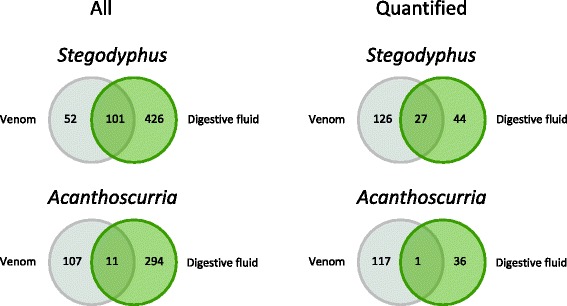
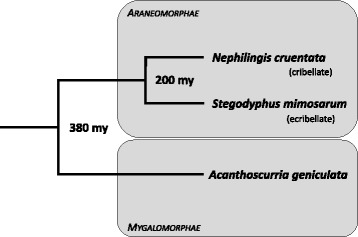
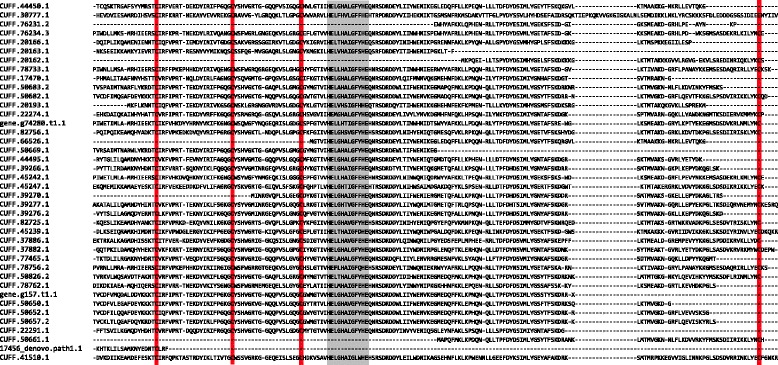
We describe the protein composition of the digestive fluids of the mygalomorph Acanthoscurria geniculata and the araneomorph Stegodyphus mimosarum, in comparison with previously published data on a third spider species. We found a number of similar hydrolases being highly abundant in all three species. Among them, members of the family of astacin-like metalloproteases were particularly abundant. While the importance of these proteases in spider venom and digestive fluid was previously noted, we now highlight their widespread use across different spider taxa. Finally, we found species specific differences in the protein overlap between venom and digestive fluid, with the difference being significantly greater in S. mimosarum compared to A. geniculata.
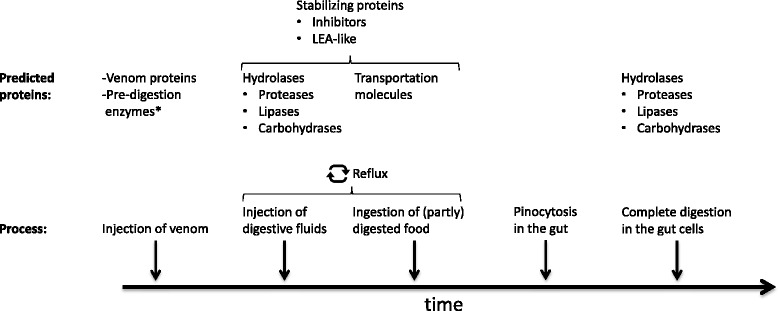
The injection of venom precedes the injection with digestive fluid, and the overlap of proteins between venom and digestive fluid suggests an early involvement in EOD. Species specific differences in the overlap may reflect differences in ecology between our two study species. The protein composition of the digestive fluid of all the three species we compared is highly similar, suggesting that the cocktail of enzymes is highly conserved and adapted to spider EOD.
蜘蛛是肉食性节肢动物,与自身身体大小相比,它们有能力制服并捕食相对较大的猎物。为此,蜘蛛进化出了强效毒液来麻痹猎物,以及消化液,通过口外消化(EOD)分解猎物体内的营养物质。这两种分泌物都含有一系列活性蛋白,并且有一些成分重叠的情况已有传闻报道,但未进行量化。我们系统地研究了这种蛋白质重叠的程度。由于毒液注射和口外消化相继发生,我们进一步推断其功能解释,并通过比较属于不同进化枝的两种蜘蛛物种,总体评估其对蜘蛛口外消化的适应性意义。
我们描述了原蛛亚目(Mygalomorphae)的膝形棘蛛(Acanthoscurria geniculata)和新蛛亚目(Araneomorphae)的拟态隙蛛(Stegodyphus mimosarum)消化液的蛋白质组成,并与之前发表的关于第三种蜘蛛物种的数据进行了比较。我们发现许多相似的水解酶在这三个物种中都高度丰富。其中,虾红素样金属蛋白酶家族的成员特别丰富。虽然这些蛋白酶在蜘蛛毒液和消化液中的重要性此前已被提及,但我们现在强调它们在不同蜘蛛类群中的广泛应用。最后,我们发现毒液和消化液之间的蛋白质重叠存在物种特异性差异,拟态隙蛛的差异比膝形棘蛛显著更大。
毒液注射先于消化液注射,毒液和消化液之间的蛋白质重叠表明其在口外消化中早期就发挥作用。重叠的物种特异性差异可能反映了我们两个研究物种在生态方面的差异。我们比较的所有三个物种消化液的蛋白质组成高度相似,表明酶的组合高度保守且适应蜘蛛的口外消化。