Institute of Zoology, Slovak Academy of Sciences, Dúbravská cesta 9, 845 06, Bratislava, Slovakia.
Stockholm University, Department of Zoology, Svante Arrhenius väg 18B, S-106 91, Stockholm, Sweden.
Sci Rep. 2019 Mar 27;9(1):5239. doi: 10.1038/s41598-019-41754-5.
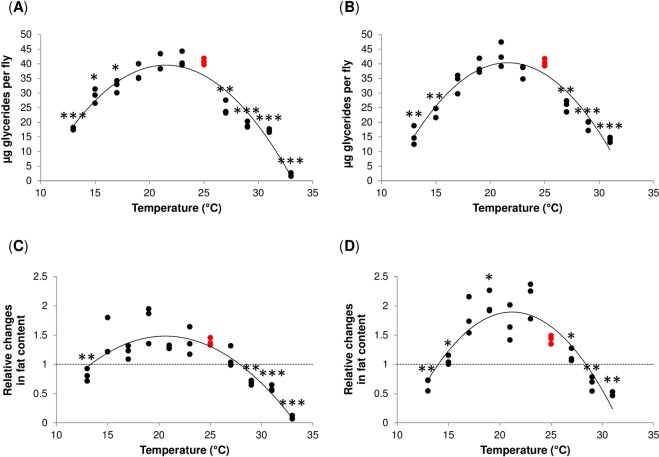
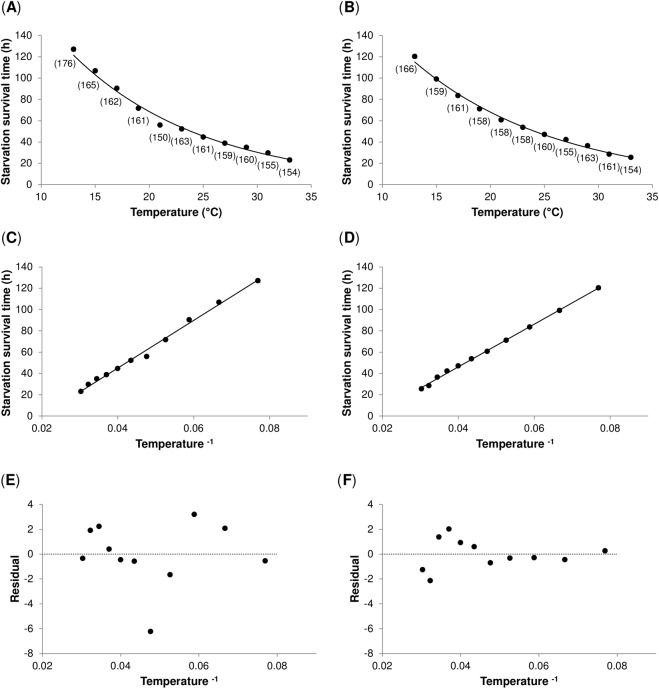
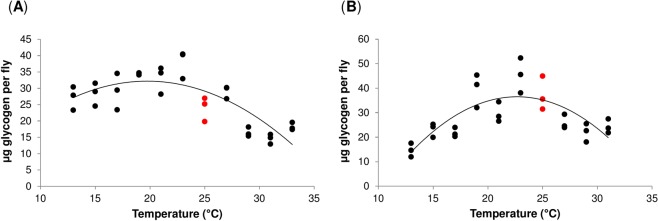
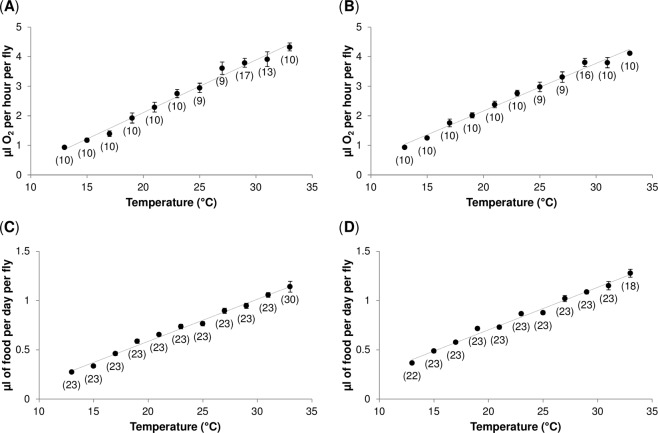
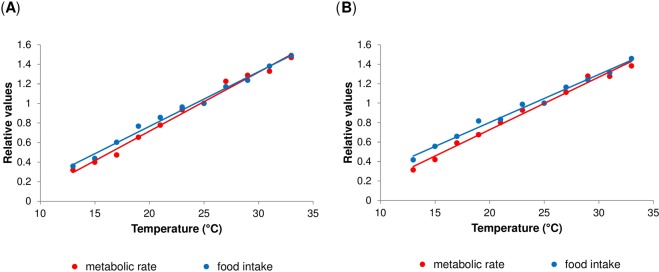
Temperature has a profound impact on animal physiology. In this study, we examined the effect of ambient temperature on the energy stores of the model organism Drosophila melanogaster. By exposing adult males to 11 temperatures between 13 °C and 33 °C, we found that temperature significantly affects the amount of energy reserves. Whereas flies increase their fat stores at intermediate temperatures, exposure to temperatures below 15 °C or above 27 °C causes a reduction of fat reserves. Moreover, we found that glycogen stores followed a similar trend, although not so pronounced. To elucidate the underlying mechanism of these changes, we compared the temperature dependence of food consumption and metabolic rate. This analysis revealed that food intake and metabolic rate scale with temperature equally, suggesting that the temperature-induced changes in energy reserves are probably not caused by a mismatch between these two traits. Finally, we assessed the effect of temperature on starvation resistance. We found that starvation survival is a negative exponential function of temperature; however we did not find any clear evidence that implies the relative starvation resistance is compromised at non-optimal temperatures. Our results indicate that whilst optimal temperatures can promote accumulation of energy reserves, exposure to non-optimal temperatures reduces Drosophila energy stores.
温度对动物生理学有深远的影响。在这项研究中,我们研究了环境温度对模式生物黑腹果蝇能量储备的影响。通过将成年雄性果蝇暴露在 13°C 到 33°C 之间的 11 个温度下,我们发现温度显著影响能量储备量。虽然在中等温度下,果蝇会增加脂肪储存,但暴露在 15°C 以下或 27°C 以上的温度会导致脂肪储存减少。此外,我们发现糖原储存也呈现出类似的趋势,尽管不那么明显。为了阐明这些变化的潜在机制,我们比较了食物消耗和代谢率随温度的变化。该分析表明,食物摄入和代谢率与温度呈同等比例缩放,这表明能量储备的温度诱导变化可能不是由这两个特征之间的不匹配引起的。最后,我们评估了温度对饥饿抵抗的影响。我们发现,饥饿存活率是温度的负指数函数;然而,我们没有发现任何明确的证据表明,在非最佳温度下,相对饥饿抵抗能力会受到损害。我们的结果表明,虽然最佳温度可以促进能量储备的积累,但暴露在非最佳温度下会减少果蝇的能量储存。