van 't Veen Hanneke, Chalmandrier Loïc, Sandau Nadine, Nobis Michael P, Descombes Patrice, Psomas Achilleas, Hautier Yann, Pellissier Loïc
Earth System Science Department of Geography University of Zurich (UZH) Zürich Switzerland.
School of Biological Sciences University of Canterbury Christchurch New Zealand.
Ecol Evol. 2020 Aug 16;10(18):9906-9919. doi: 10.1002/ece3.6650. eCollection 2020 Sep.
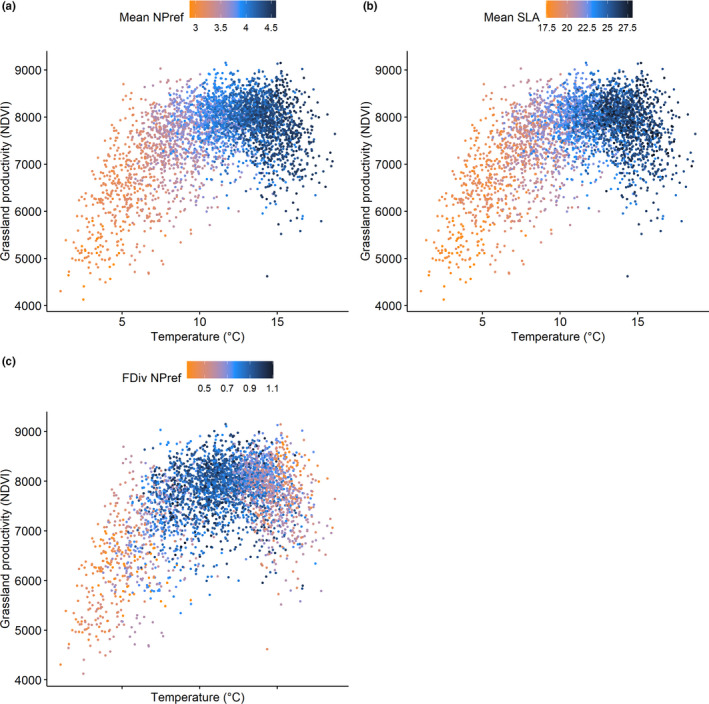
Livestock farmers rely on a high and stable grassland productivity for fodder production to sustain their livelihoods. Future drought events related to climate change, however, threaten grassland functionality in many regions across the globe. The introduction of sustainable grassland management could buffer these negative effects. According to the biodiversity-productivity hypothesis, productivity positively associates with local biodiversity. The biodiversity-insurance hypothesis states that higher biodiversity enhances the temporal stability of productivity. To date, these hypotheses have mostly been tested through experimental studies under restricted environmental conditions, hereby neglecting climatic variations at a landscape-scale. Here, we provide a landscape-scale assessment of the contribution of species richness, functional composition, temperature, and precipitation on grassland productivity. We found that the variation in grassland productivity during the growing season was best explained by functional trait composition. The community mean of plant preference for nutrients explained 24.8% of the variation in productivity and the community mean of specific leaf area explained 18.6%, while species richness explained only 2.4%. Temperature and precipitation explained an additional 22.1% of the variation in productivity. Our results indicate that functional trait composition is an important predictor of landscape-scale grassland productivity.
牧民依靠高产且稳定的草地生产力来生产饲料,以维持生计。然而,未来与气候变化相关的干旱事件威胁着全球许多地区的草地功能。引入可持续的草地管理可以缓冲这些负面影响。根据生物多样性-生产力假说,生产力与当地生物多样性呈正相关。生物多样性保险假说指出,更高的生物多样性会增强生产力的时间稳定性。迄今为止,这些假说大多是在有限的环境条件下通过实验研究进行检验的,从而忽略了景观尺度上的气候变化。在此,我们对物种丰富度、功能组成、温度和降水对草地生产力的贡献进行了景观尺度评估。我们发现,生长季草地生产力的变化最好由功能性状组成来解释。植物对养分偏好的群落均值解释了生产力变化的24.8%,比叶面积的群落均值解释了18.6%,而物种丰富度仅解释了2.4%。温度和降水又解释了生产力变化的22.1%。我们的结果表明,功能性状组成是景观尺度草地生产力的重要预测指标。