Yi Xueling, Donner Deahn M, Marquardt Paula E, Palmer Jonathan M, Jusino Michelle A, Frair Jacqueline, Lindner Daniel L, Latch Emily K
Department of Biological Sciences University of Wisconsin-Milwaukee Milwaukee WI USA.
Northern Research Station USDA Forest Service Rhinelander WI USA.
Ecol Evol. 2020 Aug 31;10(18):10031-10043. doi: 10.1002/ece3.6662. eCollection 2020 Sep.
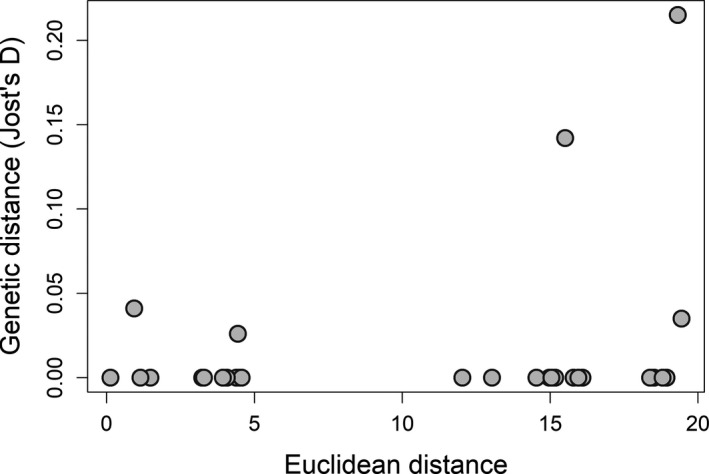
White-nose syndrome (WNS), caused by the fungal pathogen (Pd), has driven alarming declines in North American hibernating bats, such as little brown bat (). During hibernation, infected little brown bats are able to initiate anti-Pd immune responses, indicating pathogen-mediated selection on the major histocompatibility complex (MHC) genes. However, such immune responses may not be protective as they interrupt torpor, elevate energy costs, and potentially lead to higher mortality rates. To assess whether WNS drives selection on MHC genes, we compared the MHC gene in little brown bats pre- (Wisconsin) and post- (Michigan, New York, Vermont, and Pennsylvania) WNS (detection spanning 2014-2015). We genotyped 131 individuals and found 45 nucleotide alleles (27 amino acid alleles) indicating a maximum of 3 loci (1-5 alleles per individual). We observed high allelic admixture and a lack of genetic differentiation both among sampling sites and between pre- and post-WNS populations, indicating no signal of selection on MHC genes. However, post-WNS populations exhibited decreased allelic richness, reflecting effects from bottleneck and drift following rapid population declines. We propose that mechanisms other than adaptive immunity are more likely driving current persistence of little brown bats in affected regions.
白鼻综合征(WNS)由真菌病原体(Pd)引起,已导致北美冬眠蝙蝠数量急剧下降,如小棕蝠()。在冬眠期间,受感染的小棕蝠能够启动抗Pd免疫反应,这表明病原体对主要组织相容性复合体(MHC)基因进行了选择。然而,这种免疫反应可能没有保护作用,因为它们会打断蛰伏状态,提高能量消耗,并可能导致更高的死亡率。为了评估WNS是否对MHC基因进行选择,我们比较了小棕蝠在WNS出现之前(威斯康星州)和之后(密歇根州、纽约州、佛蒙特州和宾夕法尼亚州)的MHC基因(检测时间跨度为2014 - 2015年)。我们对131只个体进行了基因分型,发现了45个核苷酸等位基因(27个氨基酸等位基因),表明最多有3个位点(每个个体有1 - 5个等位基因)。我们观察到采样地点之间以及WNS出现前后的种群之间存在高度的等位基因混合和缺乏遗传分化,这表明没有对MHC基因进行选择的信号。然而,WNS出现后的种群等位基因丰富度有所下降,这反映了种群数量迅速下降后瓶颈效应和遗传漂变的影响。我们认为,除适应性免疫之外的其他机制更有可能推动小棕蝠在受影响地区的当前存续。