Department of Neurology and Neurosurgery, McGill University, Montreal, QC, Canada.
Department of Pediatrics, McGill University, Montreal, QC, Canada.
J Clin Endocrinol Metab. 2021 Jan 23;106(2):e660-e674. doi: 10.1210/clinem/dgaa700.
4H or POLR3-related leukodystrophy is an autosomal recessive disorder typically characterized by hypomyelination, hypodontia, and hypogonadotropic hypogonadism, caused by biallelic pathogenic variants in POLR3A, POLR3B, POLR1C, and POLR3K. The endocrine and growth abnormalities associated with this disorder have not been thoroughly investigated to date.
To systematically characterize endocrine abnormalities of patients with 4H leukodystrophy.
An international cross-sectional study was performed on 150 patients with genetically confirmed 4H leukodystrophy between 2015 and 2016. Endocrine and growth abnormalities were evaluated, and neurological and other non-neurological features were reviewed. Potential genotype/phenotype associations were also investigated.
This was a multicenter retrospective study using information collected from 3 predominant centers.
A total of 150 patients with 4H leukodystrophy and pathogenic variants in POLR3A, POLR3B, or POLR1C were included.
Variables used to evaluate endocrine and growth abnormalities included pubertal history, hormone levels (estradiol, testosterone, stimulated LH and FSH, stimulated GH, IGF-I, prolactin, ACTH, cortisol, TSH, and T4), and height and head circumference charts.
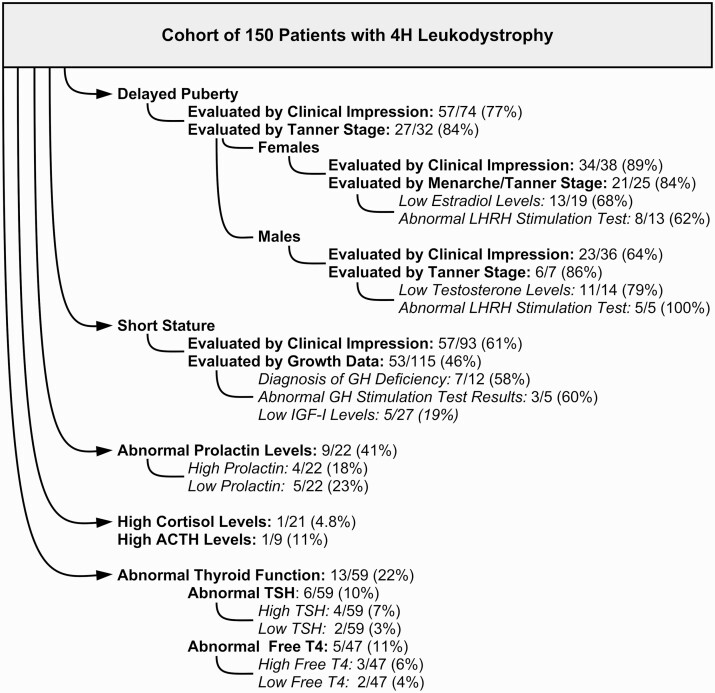
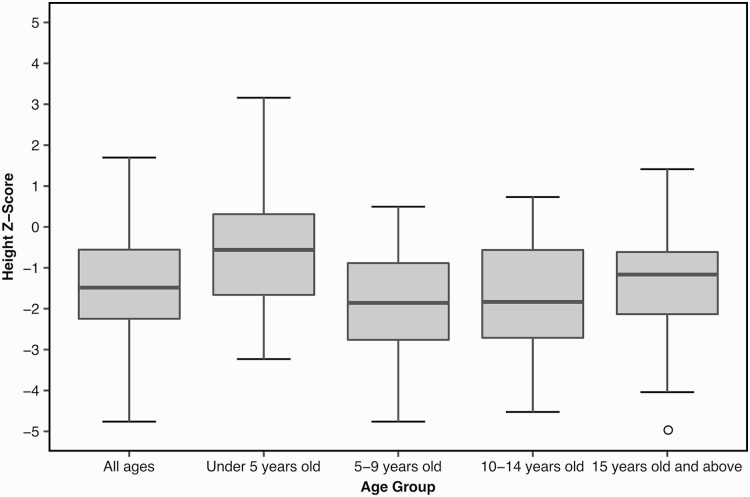
The most common endocrine abnormalities were delayed puberty (57/74; 77% overall, 64% in males, 89% in females) and short stature (57/93; 61%), when evaluated according to physician assessment. Abnormal thyroid function was reported in 22% (13/59) of patients.
Our results confirm pubertal abnormalities and short stature are the most common endocrine features seen in 4H leukodystrophy. However, we noted that endocrine abnormalities are typically underinvestigated in this patient population. A prospective study is required to formulate evidence-based recommendations for management of the endocrine manifestations of this disorder.
4H 或 POLR3 相关脑白质营养不良是一种常染色体隐性疾病,其特征通常为少突胶质细胞发育不全、牙齿缺失和促性腺激素低下性性腺功能减退,由 POLR3A、POLR3B、POLR1C 和 POLR3K 的双等位基因致病性变异引起。迄今为止,尚未对与这种疾病相关的内分泌和生长异常进行全面研究。
系统描述 4H 脑白质营养不良患者的内分泌异常。
2015 年至 2016 年,对 150 名经基因证实的 4H 脑白质营养不良患者进行了国际横断面研究。评估了内分泌和生长异常,并回顾了神经和其他非神经特征。还研究了潜在的基因型/表型相关性。
这是一项多中心回顾性研究,使用了来自 3 个主要中心的信息。
共纳入 150 名患有 4H 脑白质营养不良且 POLR3A、POLR3B 或 POLR1C 存在致病性变异的患者。
用于评估内分泌和生长异常的变量包括青春期史、激素水平(雌二醇、睾酮、促黄体生成素和促卵泡激素刺激、生长激素刺激、IGF-I、催乳素、ACTH、皮质醇、TSH 和 T4)以及身高和头围图表。
根据医生评估,最常见的内分泌异常是青春期延迟(57/74;总体 77%,男性 64%,女性 89%)和身材矮小(57/93;61%)。报告 22%(13/59)的患者甲状腺功能异常。
我们的结果证实,青春期异常和身材矮小是 4H 脑白质营养不良最常见的内分泌特征。然而,我们注意到,在内分泌异常方面,该患者群体通常研究不足。需要进行前瞻性研究,为该疾病的内分泌表现制定基于证据的管理建议。