Solomon Marjorie, Gordon Andrew, Iosif Ana-Maria, Geddert Raphael, Krug Marie K, Mundy Peter, Hessl David
Department of Psychiatry and Behavioral Sciences, University of California-Davis, Sacramento, California, USA.
Imaging Research Center, University of California-Davis, Sacramento, California, USA.
Autism Res. 2021 Mar;14(3):500-511. doi: 10.1002/aur.2399. Epub 2020 Oct 2.
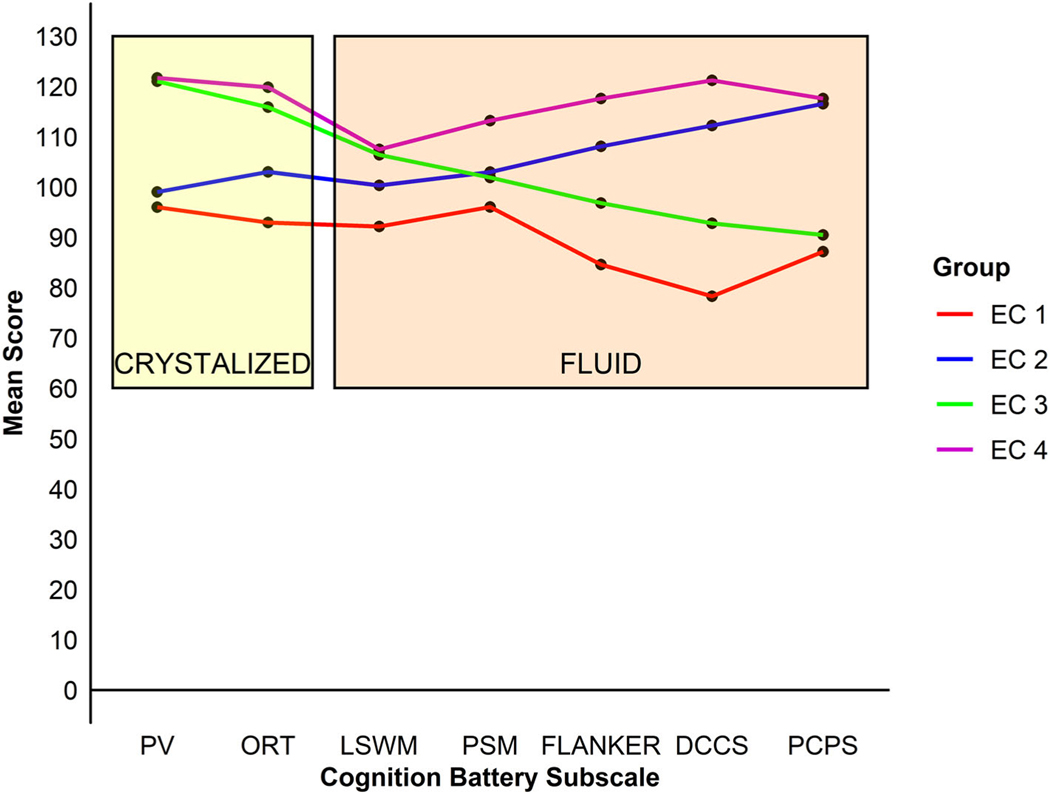
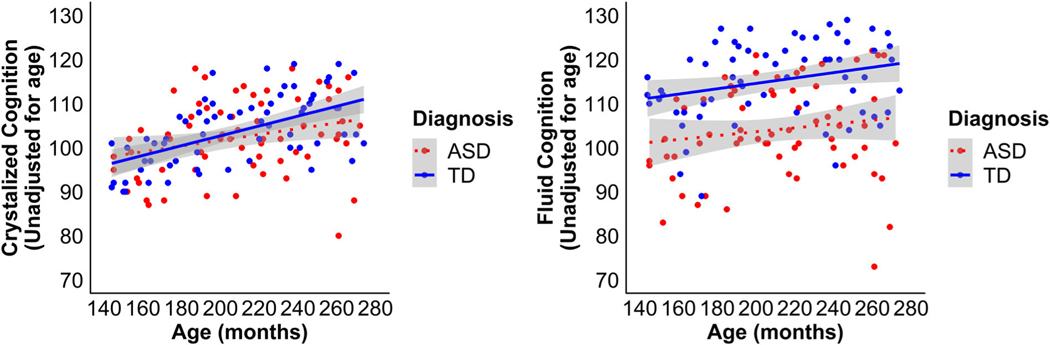
Despite the clinically significant impact of executive dysfunction on the outcomes of adolescents and young adults with autism spectrum disorders (ASD), we lack a clear understanding of its prevalence, profile, and development. To address this gap, we administered the NIH Toolbox Cognition Battery to a cross-sectional Intelligence Quotient (IQ) case-matched cohort with ASD (n = 66) and typical development (TD; n = 66) ages 12-22. We used a general linear model framework to examine group differences in task performance and their associations with age. Latent profile analysis (LPA) was used to identify subgroups of individuals with similar cognitive profiles. Compared to IQ case-matched controls, ASD demonstrated poorer performance on inhibitory control (P < 0.001), cognitive flexibility (P < 0.001), episodic memory (P < 0.02), and processing speed (P < 0.001) (components of Fluid Cognition), but not on vocabulary or word reading (components of Crystallized Cognition). There was a significant positive association between age and Crystallized and Fluid Cognition in both groups. For Fluid (but not Crystallized) Cognition, ASD performed more poorly than TD at all ages. A four-group LPA model based on subtest scores best fit the data. Eighty percent of ASD belonged to two groups that exhibited relatively stronger Crystallized versus Fluid Cognition. Attention deficits were not associated with Toolbox subtest scores, but were lowest in the group with the lowest proportion of autistic participants. Adaptive functioning was poorer in the groups with the greatest proportion of autistic participants. Autistic persons are especially impaired on Fluid Cognition, and this more flexible form of thinking remains poorer in the ASD group through adolescence. LAY SUMMARY: A set of brief tests of cognitive functioning called the NIH Toolbox Cognition Battery was administered to adolescents and young adults with autism spectrum disorders (ASD; n = 66) and typical development (TD; n = 66) ages 12-22 years. Compared to TD, ASD showed poorer performance in inhibiting responses, acting flexibly, memorizing events, and processing information quickly (Fluid Cognition). Groups did not differ on vocabulary or word reading (Crystallized Cognition). Crystallized and Fluid Cognition increased with age in both groups, but the ASD group showed lower Fluid, but not Crystallized, Cognition than TD at all ages. A categorization analysis including all participants showed that most participants with ASD fell into one of two categories: a group characterized by poor performance across all tasks, or a group characterized by relatively stronger Crystallized compared to Fluid Cognition. Adaptive functioning was poorer for participants in these groups, which consisted of mostly individuals with ASD, while ADHD symptoms were lowest in the group with the greatest proportion of TD participants.
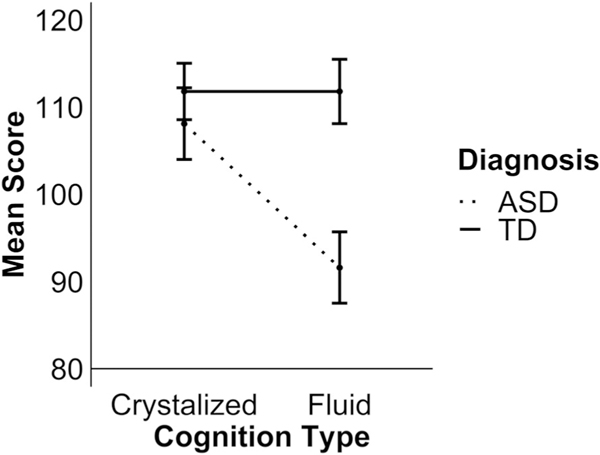
尽管执行功能障碍对患有自闭症谱系障碍(ASD)的青少年和青年的预后具有临床上的显著影响,但我们对其患病率、特征和发展缺乏清晰的认识。为了填补这一空白,我们对一个年龄在12 - 22岁、智商(IQ)病例匹配的ASD队列(n = 66)和典型发育(TD;n = 66)的人群进行了美国国立卫生研究院工具箱认知电池测试。我们使用一般线性模型框架来检验任务表现的组间差异及其与年龄的关联。潜在剖面分析(LPA)用于识别具有相似认知特征的个体亚组。与IQ病例匹配的对照组相比,ASD在抑制控制(P < 0.001)、认知灵活性(P < 0.001)、情景记忆(P < 0.02)和处理速度(P < 0.001)(流体认知的组成部分)方面表现较差,但在词汇或单词阅读(晶体认知的组成部分)方面没有差异。两组中年龄与晶体认知和流体认知之间均存在显著正相关。对于流体(而非晶体)认知,ASD在所有年龄段的表现均比TD差。基于子测试分数的四组LPA模型最适合该数据。80%的ASD患者属于两组,一组表现出相对较强的晶体认知而非流体认知。注意力缺陷与工具箱子测试分数无关,但在自闭症参与者比例最低的组中最低。在自闭症参与者比例最高的组中,适应性功能较差。自闭症患者在流体认知方面尤其受损,并且这种更灵活的思维形式在ASD组中直到青春期仍然较差。
对年龄在12 - 22岁的患有自闭症谱系障碍(ASD;n = 66)和典型发育(TD;n = 66)的青少年和青年进行了一组名为美国国立卫生研究院工具箱认知电池的认知功能简短测试。与TD相比,ASD在抑制反应、灵活行动、记忆事件和快速处理信息(流体认知)方面表现较差。两组在词汇或单词阅读(晶体认知)方面没有差异。两组中晶体认知和流体认知均随年龄增长,但ASD组在所有年龄段的流体认知低于TD,晶体认知则无差异。对所有参与者进行的分类分析表明,大多数ASD参与者属于两类之一:一类在所有任务中表现较差,另一类与流体认知相比晶体认知相对较强。这些组中的参与者适应性功能较差,这些组主要由ASD个体组成,而多动症症状在TD参与者比例最高的组中最低。