O'Hora Kathleen P, Kushan-Wells Leila, Hoftman Gil D, Jalbrzikowski Maria, Gur Raquel C, Gur Ruben, Bearden Carrie E
Department of Psychiatry and Biobehavioral Sciences, Semel Institute for Neuroscience and Human Behavior, University of California, Los Angeles, CA, USA.
Neuroscience Interdepartmental Program, University of California, Los Angeles, CA, USA.
medRxiv. 2023 May 16:2023.05.12.23289905. doi: 10.1101/2023.05.12.23289905.
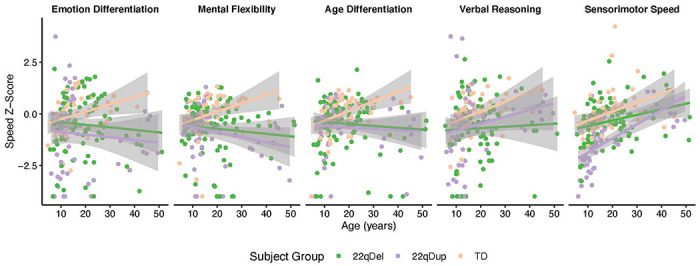
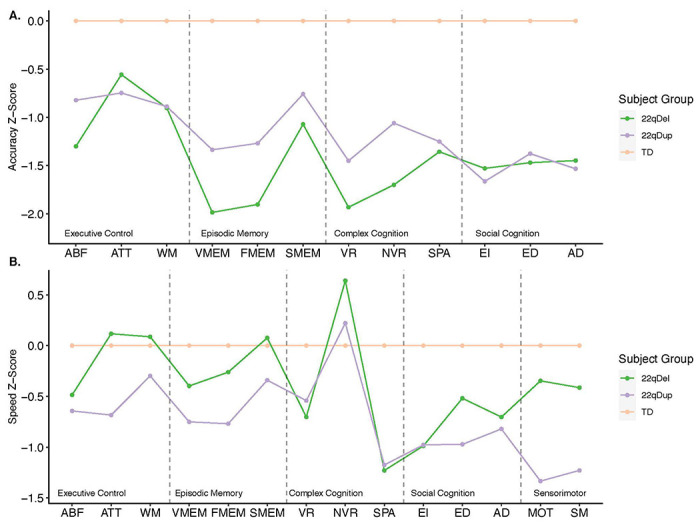
Rare genetic variants that confer large effects on neurodevelopment and behavioral phenotypes can reveal novel gene-brain-behavior relationships relevant to autism. Copy number variation at the 22q11.2 locus offer one compelling example, as both the 22q11.2 deletion (22qDel) and duplication (22qDup) confer increased likelihood of autism spectrum disorders (ASD) and cognitive deficits, but only 22qDel confers increased psychosis risk. Here, we used the Penn Computerized Neurocognitive Battery (Penn-CNB) to characterized neurocognitive profiles of 126 individuals: 55 22qDel carriers (M=19.2 years, 49.1% male), 30 22qDup carriers (M=17.3 years, 53.3 % male), and 41 typically developing (TD) subjects (M=17.3 years, 39.0 % male). We performed linear mixed models to assess group differences in overall neurocognitive profiles, domain scores, and individual test scores. We found all three groups exhibited distinct overall neurocognitive profiles. 22qDel and 22qDup carriers showed significant accuracy deficits across all domains relative to controls (Episodic Memory, Executive Function, Complex Cognition, Social Cognition, and Sensorimotor Speed), with 22qDel carriers exhibiting more severe accuracy deficits, particularly in Episodic Memory. However, 22qDup carriers generally showed greater slowing than 22qDel carriers. Notably, slower social cognition speed was uniquely associated with increased global psychopathology and poorer psychosocial functioning in 22qDup. Compared to TD, 22q11.2 CNV carriers failed to show age-associated improvements in multiple cognitive domains. Exploratory analyses revealed 22q11.2 CNV carriers with ASD exhibited differential neurocognitive profiles, based on 22q11.2 copy number. These results suggest that there are distinct neurocognitive profiles associated with either a loss or gain of genomic material at the 22q11.2 locus.
对神经发育和行为表型具有重大影响的罕见基因变异能够揭示与自闭症相关的新型基因-脑-行为关系。22q11.2位点的拷贝数变异就是一个令人信服的例子,因为22q11.2缺失(22qDel)和重复(22qDup)都会增加自闭症谱系障碍(ASD)和认知缺陷的可能性,但只有22qDel会增加患精神病的风险。在此,我们使用宾夕法尼亚计算机化神经认知测试组合(Penn-CNB)对126名个体的神经认知特征进行了表征:55名22qDel携带者(平均年龄19.2岁,49.1%为男性)、30名22qDup携带者(平均年龄17.3岁,53.3%为男性)以及41名发育正常(TD)的受试者(平均年龄17.3岁,39.0%为男性)。我们进行了线性混合模型分析,以评估三组在整体神经认知特征、领域得分和个体测试得分方面的差异。我们发现,所有三组都表现出独特的整体神经认知特征。与对照组相比,22qDel和22qDup携带者在所有领域(情景记忆、执行功能、复杂认知、社会认知和感觉运动速度)均表现出显著的准确性缺陷,其中22qDel携带者的准确性缺陷更为严重,尤其是在情景记忆方面。然而,22qDup携带者通常比22qDel携带者表现出更大的反应迟缓。值得注意的是,在22qDup中,较慢的社会认知速度与整体精神病理学增加以及较差的心理社会功能独特相关。与TD相比,22q11.2拷贝数变异(CNV)携带者在多个认知领域未能表现出与年龄相关的改善。探索性分析显示,患有ASD的22q11.2 CNV携带者根据22q11.2拷贝数表现出不同的神经认知特征。这些结果表明,在22q11.2位点,基因组物质的缺失或增加与不同的神经认知特征相关。