Department of Psychology, University of Houston , Houston, TX, USA.
Department of Behavioral Science, The University of Texas MD Anderson Cancer Center , Houston, TX, USA.
Cogn Behav Ther. 2021 Mar;50(2):138-153. doi: 10.1080/16506073.2020.1819868. Epub 2020 Oct 2.
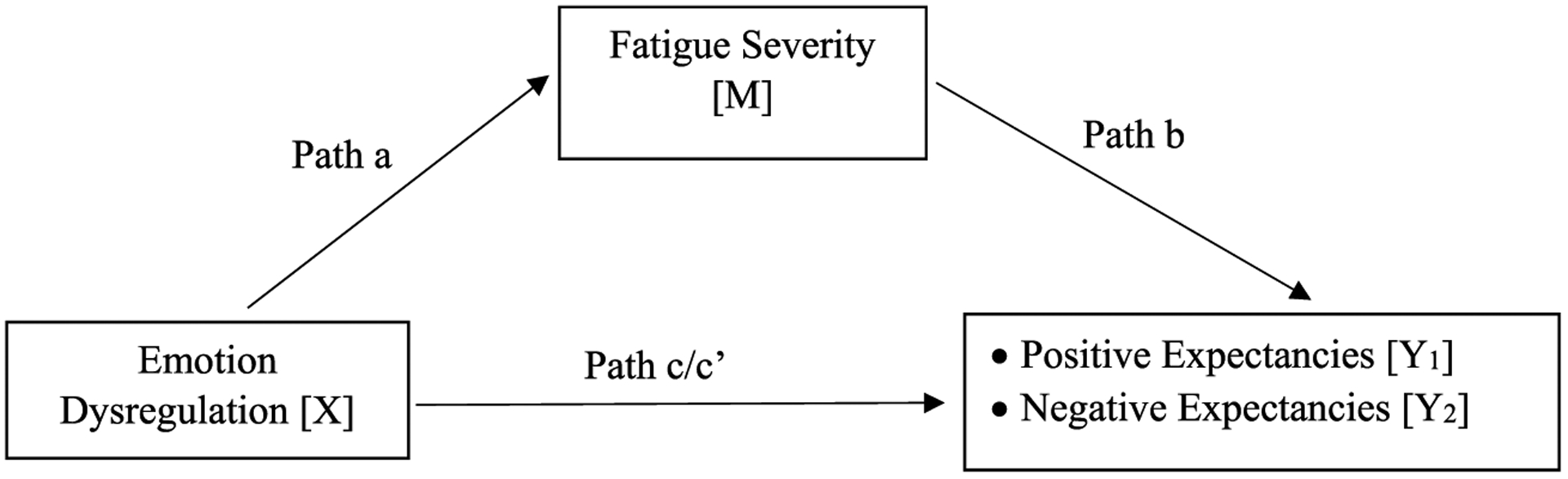
Emotion dysregulation and the experience of fatigue have both been linked to the maintenance of substance use. However, limited empirical data has evaluated individual differences in these constructs in terms of e-cigarette use expectancies. The present study examined a theoretically relevant model focused on whether the experience of more severe fatigue explains, in part, the relation between individual differences in emotion dysregulation and positive and negative e-cigarette expectancies among 525 adult e-cigarette users (50.9% female, = 35.25 years, = 10.10). It was hypothesized that emotion dysregulation, via fatigue severity, would significantly predict greater positive and negative e-cigarette expectancies, which was examined in two separate mediation models. Fatigue severity significantly explained, in part, the relation between emotion dysregulation and positive ( = 0.02, CI [0.01, 0.02]) and negative expectancies of e-cigarette use ( = 0.02, 95% CI [0.02, 0.03]). The current findings suggest that the experience of fatigue helps explain the relation between emotion dysregulation and positive and negative e-cigarette expectancies among adult e-cigarette users. Future work is needed to explicate how reducing fatigue severity in the context of emotion dysregulation may change expectancies about e-cigarette expectancies.
情绪调节障碍和疲劳感与物质使用的维持都有关。然而,关于电子烟使用预期,评估这些结构个体差异的经验数据有限。本研究通过 525 名成年电子烟使用者(50.9%为女性,年龄=35.25 岁,=10.10),考察了一个理论上相关的模型,重点关注疲劳感的严重程度是否部分解释了情绪调节障碍与电子烟的积极和消极预期之间的个体差异。假设情绪调节障碍通过疲劳严重程度,显著预测更大的电子烟的积极和消极预期,这在两个单独的中介模型中进行了检验。疲劳严重程度显著部分解释了情绪调节障碍与电子烟使用的积极预期(=0.02,CI [0.01, 0.02])和消极预期(=0.02,95% CI [0.02, 0.03])之间的关系。当前的研究结果表明,疲劳感的体验有助于解释成年电子烟使用者中情绪调节障碍与电子烟的积极和消极预期之间的关系。需要进一步研究如何在情绪调节障碍的背景下减轻疲劳感的严重程度,从而改变对电子烟的预期。