Lee Jinhee, Son Min Ji, Son Chei Yun, Jeong Gwang Hun, Lee Keum Hwa, Lee Kwang Seob, Ko Younhee, Kim Jong Yeob, Lee Jun Young, Radua Joaquim, Eisenhut Michael, Gressier Florence, Koyanagi Ai, Stubbs Brendon, Solmi Marco, Rais Theodor B, Kronbichler Andreas, Dragioti Elena, Vasconcelos Daniel Fernando Pereira, Silva Felipe Rodolfo Pereira da, Tizaoui Kalthoum, Brunoni André Russowsky, Carvalho Andre F, Cargnin Sarah, Terrazzino Salvatore, Stickley Andrew, Smith Lee, Thompson Trevor, Shin Jae Il, Fusar-Poli Paolo
Department of Psychiatry, Yonsei University Wonju College of Medicine, Wonju 26426, Korea.
Yonsei University College of Medicine, Seoul 03722, Korea.
Brain Sci. 2020 Sep 30;10(10):692. doi: 10.3390/brainsci10100692.
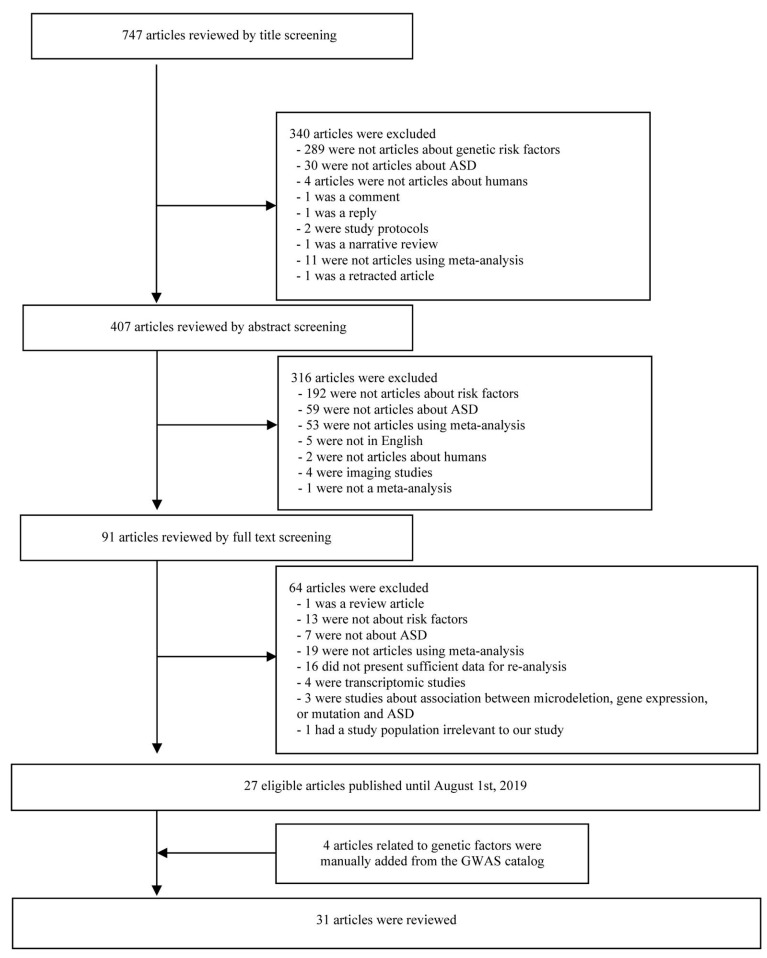
This study aimed to verify noteworthy findings between genetic risk factors and autism spectrum disorder (ASD) by employing the false positive report probability (FPRP) and the Bayesian false-discovery probability (BFDP). PubMed and the Genome-Wide Association Studies (GWAS) catalog were searched from inception to 1 August, 2019. We included meta-analyses on genetic factors of ASD of any study design. Overall, twenty-seven meta-analyses articles from literature searches, and four manually added articles from the GWAS catalog were re-analyzed. This showed that five of 31 comparisons for meta-analyses of observational studies, 40 out of 203 comparisons for the GWAS meta-analyses, and 18 out of 20 comparisons for the GWAS catalog, respectively, had noteworthy estimations under both Bayesian approaches. In this study, we found noteworthy genetic comparisons highly related to an increased risk of ASD. Multiple genetic comparisons were shown to be associated with ASD risk; however, genuine associations should be carefully verified and understood.
本研究旨在通过采用假阳性报告概率(FPRP)和贝叶斯假发现概率(BFDP)来验证遗传风险因素与自闭症谱系障碍(ASD)之间的显著发现。从数据库建立至2019年8月1日检索了PubMed和全基因组关联研究(GWAS)目录。我们纳入了任何研究设计的关于ASD遗传因素的荟萃分析。总体而言,对文献检索得到的27篇荟萃分析文章以及GWAS目录中手动添加的4篇文章进行了重新分析。结果显示,在两种贝叶斯方法下,观察性研究荟萃分析的31项比较中有5项、GWAS荟萃分析的203项比较中有40项以及GWAS目录的20项比较中有18项具有显著估计值。在本研究中,我们发现了与ASD风险增加高度相关的显著遗传比较。多项遗传比较显示与ASD风险相关;然而,真正的关联应仔细验证和理解。