Department of Obstetrics, Maternal and Child Health Hospital of Hubei Province, No. 745 Wuluo Road, Hongshan District, Wuhan City, 430070, Hubei Province, China.
Department of Obstetrics, The First Affiliated Hospital of Chongqing Medical University, No. 1 Youyi Road, Yuzhong District, Chongqing, 400016, China.
BMC Pregnancy Childbirth. 2020 Oct 2;20(1):580. doi: 10.1186/s12884-020-03281-4.
During the ongoing global outbreak of COVID-19, pregnant women who are susceptible to COVID-19 should be highly concerned. The issue of vertical transmission and the possibility of neonatal infection is a major concern.
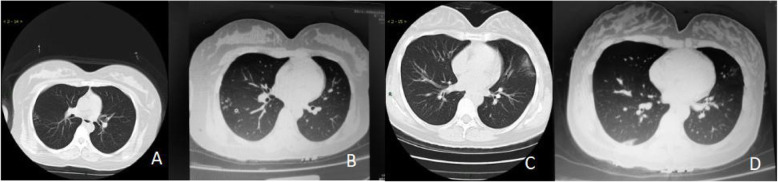
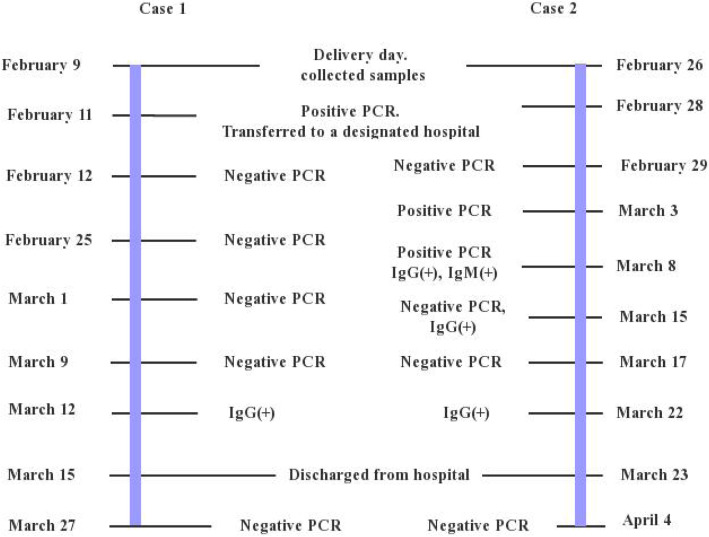
Case 1: A 35-year-old pregnant woman with a gestational age of 37 weeks and 6 days was admitted to our hospital at the point of giving birth. Except for the abnormalities in her chest CT image, she was asymptomatic. She had an uncomplicated spontaneous vaginal delivery, and her infant was discharged home for isolation. Because of the positive result of the maternal swabs for SARS-CoV-2 obtained on the 2nd day after sampling, we transferred the mother to the designated hospital and followed up with her by telephone interviews. Luckily, it was confirmed on February 23 that the newborn did not develop any COVID-19 symptoms after observation for 14 days after birth. Case 2: Another pregnant woman, with a gestational age of 38 weeks and 2 days, was also admitted to our hospital because of spontaneous labor with cervical dilation of 5 cm. Since she had the typical manifestations of COVID-19, including cough, lymphopenia, and abnormal chest CT images, she was highly suspected of having COVID-19. Based on the experience from case 1, we helped the mother deliver a healthy baby by vaginal delivery. On the 2nd day after delivery, the maternal nasopharyngeal swab result was positive, while the infant's result was negative.
There is still insufficient evidence supporting maternal-fetal vertical transmission for COVID-19-infected mothers in late pregnancy, and vaginal delivery may not increase the possibility of neonatal infection.
在当前全球 COVID-19 大流行期间,易感染 COVID-19 的孕妇应受到高度关注。垂直传播问题和新生儿感染的可能性是主要关注点。
病例 1:一名 35 岁的孕妇,妊娠 37 周+6 天,临产入院。除胸部 CT 图像异常外,她无症状。她顺产,婴儿出院回家隔离。由于在采样后第 2 天母亲的 SARS-CoV-2 拭子结果阳性,我们将母亲转至指定医院,并通过电话访谈进行随访。幸运的是,在出生后 14 天观察到新生儿没有出现任何 COVID-19 症状后,于 2 月 23 日确诊。病例 2:另一名孕妇,妊娠 38 周+2 天,因自然临产、宫颈扩张 5cm 入院。由于她有 COVID-19 的典型表现,包括咳嗽、淋巴细胞减少和异常的胸部 CT 图像,因此高度怀疑患有 COVID-19。根据病例 1 的经验,我们帮助母亲经阴道分娩了一个健康的婴儿。分娩后第 2 天,母亲的鼻咽拭子结果阳性,而婴儿的结果为阴性。
对于妊娠晚期感染 COVID-19 的母亲,母婴垂直传播的证据仍然不足,阴道分娩可能不会增加新生儿感染的可能性。