Meamar Fatemeh Z, Farajkhoda Tahmineh, Afshani Seyed A, Ardakani Tayebeh S
Department of Midwifery and Reproductive Health, Faculty of Nursing and Midwifery, Reproductive Sciences and Sexual Health Research Center, Isfahan University of Medical Sciences, Isfahan, Iran.
Research Center for Nursing and Midwifery Care, Non-Communicable Diseases Research Institute, Department of Midwifery, School of Nursing and Midwifery, Shahid Sadoughi University of Medical Sciences, Yazd, Iran.
J Educ Health Promot. 2024 Jul 29;13:263. doi: 10.4103/jehp.jehp_387_23. eCollection 2024.
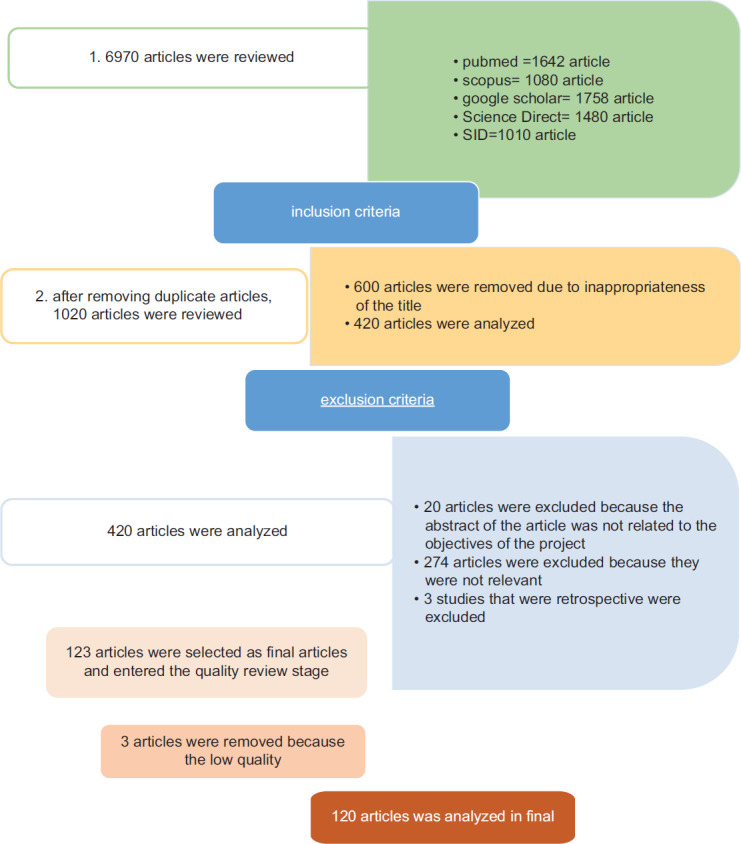
In a global pandemic, the coronavirus has brought new challenges to reproductive and sexual health. This systematic review has been conducted with the aim of investigating a) the transmission of coronavirus disease 2019 (COVID-19) through female-to-male sexual secretions and vice versa, b) vertical transmission to the fetus, c) transmission to the newborn through the birth canal, and d) transmission through breast milk. In this review study, to find related articles, databases were searched using English and Persian keywords from the beginning of 2019 to the end of 2023. Based on the entry and exit criteria and the qualitative evaluation of the studies based on the STROBE criterion, the final studies were summarized. According to the initial search, 5970 articles were reviewed. After removing duplicate articles and the inappropriateness of the title, the abstract of the article was not related to the objectives of the project, there was no relevant study, and retrospective studies were excluded. Finally, 120 articles were selected as final articles. The general results show that transmission of the virus through the vagina to the blood of the fetus causing septicemia, vertical transmission from the mother to the fetus, transmission through the water bag, genital secretions, and ejaculate fluid are considered rare and ruled out. Transmission through rectal secretions during anal or oral sex requires more extensive studies. It is not possible to transmit the virus through breast milk. The long-term reproductive impact of COVID-19 on the reproductive systems of women and men is unclear.
在全球大流行中,冠状病毒给生殖健康和性健康带来了新的挑战。本系统综述旨在调查:a)2019冠状病毒病(COVID-19)通过女性至男性的性分泌物以及反之亦然的传播情况;b)垂直传播给胎儿的情况;c)通过产道传播给新生儿的情况;d)通过母乳传播的情况。在本综述研究中,为了查找相关文章,从2019年初到2023年底使用英文和波斯文关键词搜索了数据库。根据纳入和排除标准以及基于STROBE标准对研究进行的定性评估,对最终的研究进行了总结。根据初步搜索,共审查了5970篇文章。在去除重复文章以及文章标题不合适、摘要与项目目标无关、没有相关研究以及排除回顾性研究后,最终选择了120篇文章作为最终文章。总体结果表明,病毒通过阴道传播至胎儿血液导致败血症、从母亲垂直传播给胎儿、通过羊水囊、生殖分泌物和射精液传播的情况被认为罕见并已排除。在肛交或口交过程中通过直肠分泌物传播病毒需要更广泛的研究。病毒不可能通过母乳传播。COVID-19对女性和男性生殖系统的长期生殖影响尚不清楚。