Department of Infection, Immunity and Cardiovascular Disease, University of Sheffield, Sheffield, United Kingdom; Department of Clinical Radiology, Sheffield Teaching Hospitals, Sheffield, United Kingdom.
Department of Infection, Immunity and Cardiovascular Disease, University of Sheffield, Sheffield, United Kingdom; Department of Clinical Radiology, Sheffield Teaching Hospitals, Sheffield, United Kingdom.
JACC Cardiovasc Imaging. 2021 May;14(5):931-942. doi: 10.1016/j.jcmg.2020.08.013. Epub 2020 Sep 30.
This meta-analysis evaluates assessment of pulmonary arterial hypertension (PAH), with a focus on clinical worsening and mortality.
Cardiac magnetic resonance (CMR) has prognostic value in the assessment of patients with PAH. However, there are limited data on the prediction of clinical worsening, an important composite endpoint used in PAH therapy trials.
The Cochrane Central Register of Controlled Trials, MEDLINE, EMBASE, and Web of Science databases were searched in May 2020. All CMR studies assessing clinical worsening and the prognosis of patients with PAH were included. Pooled hazard ratios of univariate regression analyses for CMR measurements, for prediction of clinical worsening and mortality, were calculated.
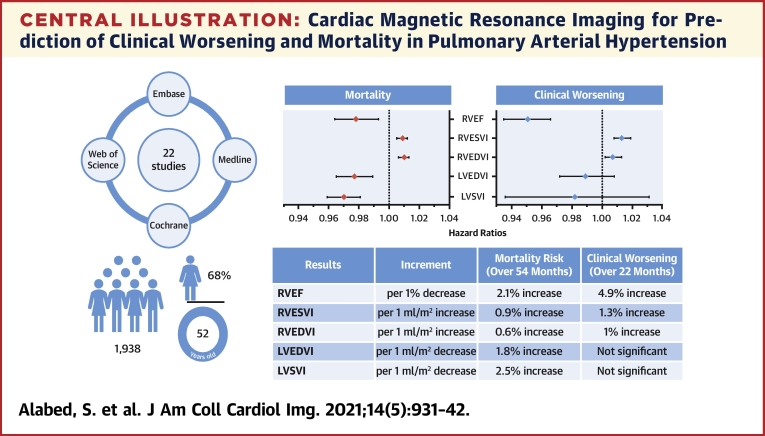
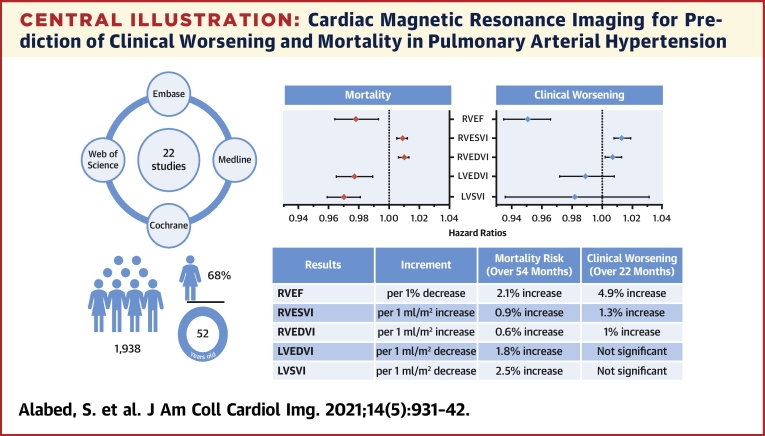
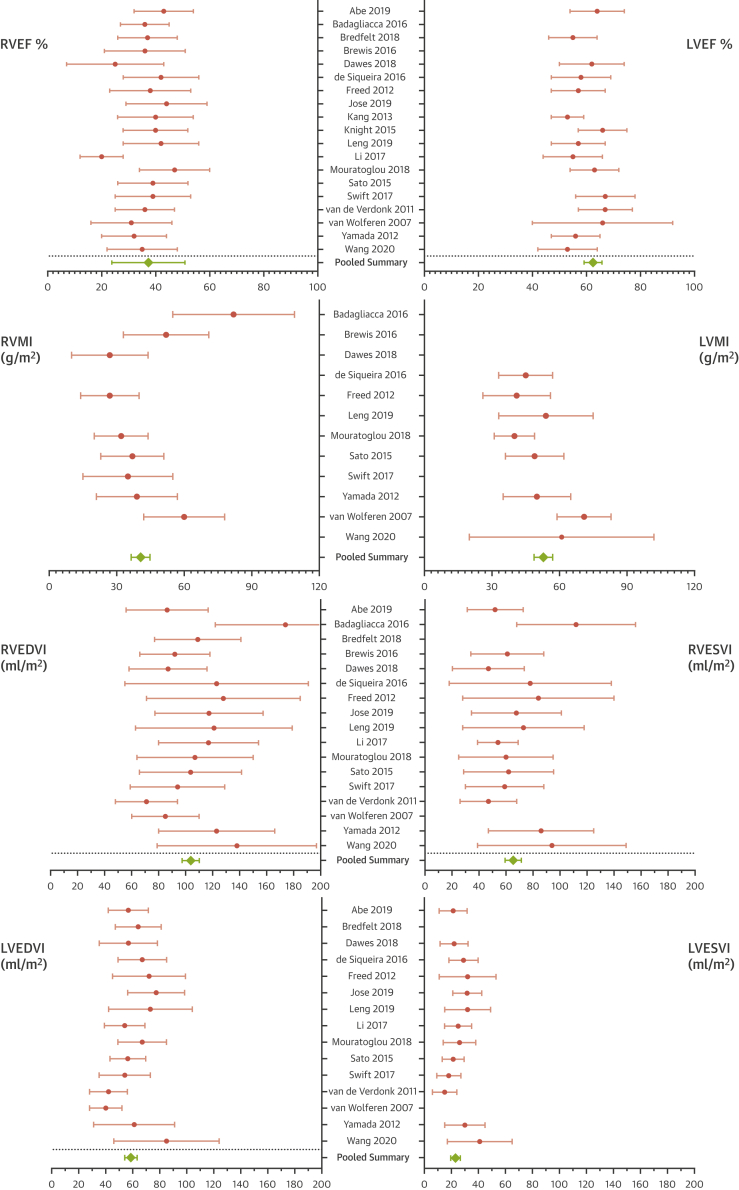
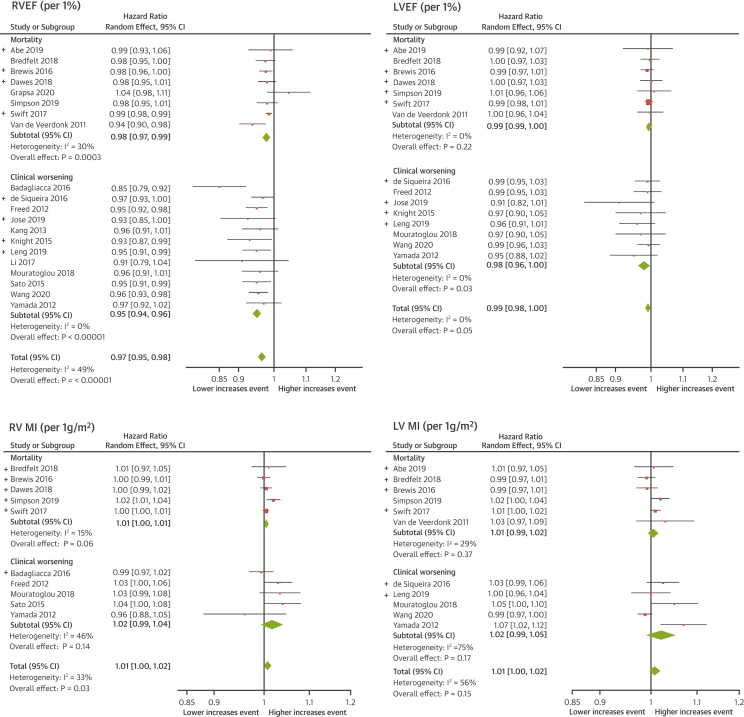
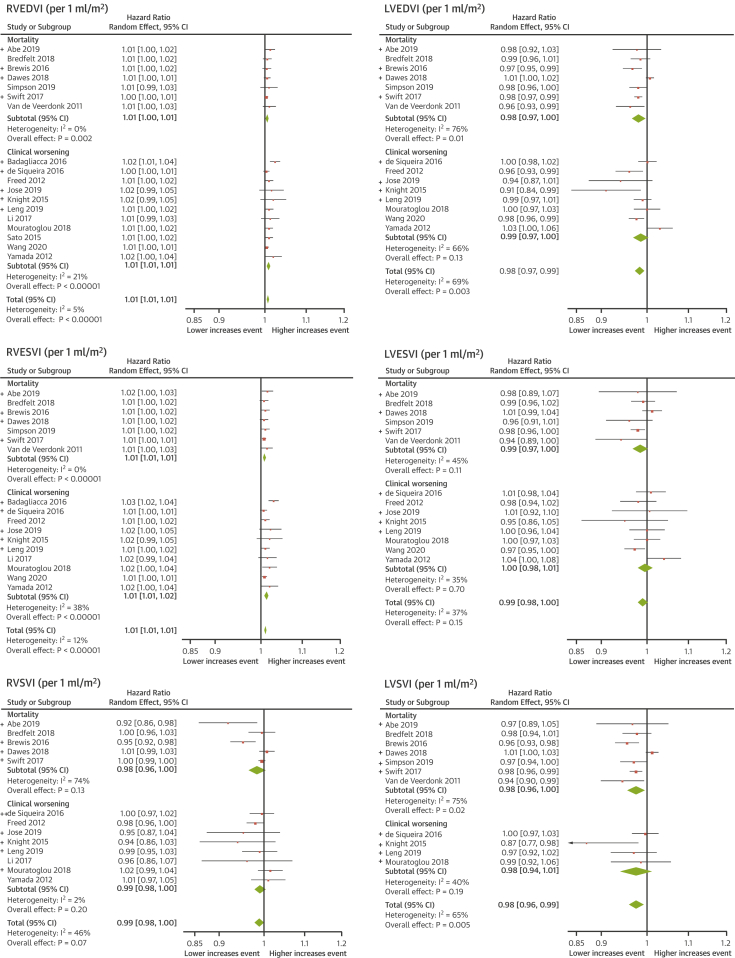
Twenty-two studies with 1,938 participants were included in the meta-analysis. There were 18 clinical worsening events and 8 deaths per 100 patient-years. The pooled hazard ratios show that every 1% decrease in right ventricular (RV) ejection fraction is associated with a 4.9% increase in the risk of clinical worsening over 22 months of follow-up and a 2.1% increase in the risk of death over 54 months. For every 1 ml/m increase in RV end-systolic volume index or RV end-diastolic volume index, the risk of clinical worsening increases by 1.3% and 1%, respectively, and the risk of mortality increases by 0.9% and 0.6%. Every 1 ml/m decrease in left ventricular stroke volume index or left ventricular end-diastolic volume index increased the risk of death by 2.5% and 1.8%. Left ventricular parameters were not associated with clinical worsening.
This review confirms CMR as a powerful prognostic marker in PAH in a large cohort of patients. In addition to confirming previous observations that RV function and RV and left ventricular volumes predict mortality, RV function and volumes also predict clinical worsening. This study provides a strong rationale for considering CMR as a clinically relevant endpoint for trials of PAH therapies.
本荟萃分析评估肺动脉高压(PAH)的评估,重点是临床恶化和死亡率。
心脏磁共振(CMR)在 PAH 患者评估中有预后价值。然而,关于临床恶化的预测,即 PAH 治疗试验中使用的重要复合终点,数据有限。
2020 年 5 月,检索了 Cochrane 中央对照试验注册库、MEDLINE、EMBASE 和 Web of Science 数据库。纳入了所有评估临床恶化和 PAH 患者预后的 CMR 研究。计算了 CMR 测量值对临床恶化和死亡率预测的单变量回归分析的汇总风险比。
荟萃分析纳入了 22 项研究,共 1938 名参与者。每 100 名患者中有 18 例临床恶化事件和 8 例死亡。汇总风险比显示,右心室(RV)射血分数每降低 1%,与 22 个月随访期间临床恶化风险增加 4.9%,54 个月随访期间死亡风险增加 2.1%相关。RV 收缩末期容积指数或 RV 舒张末期容积指数每增加 1ml/m,临床恶化风险分别增加 1.3%和 1%,死亡风险分别增加 0.9%和 0.6%。左心室每减少 1ml/m 的收缩期容积指数或舒张末期容积指数,死亡风险增加 2.5%和 1.8%。左心室参数与临床恶化无关。
本综述在一个大型 PAH 患者队列中证实 CMR 是一种强大的预后标志物。除了证实先前观察到的 RV 功能和 RV 及左心室容积预测死亡率外,RV 功能和容积也预测临床恶化。本研究为将 CMR 作为 PAH 治疗试验的临床相关终点提供了强有力的理由。