Laboratory of Microbial Genetics and Gene Expression, Institute of Microbiology of the Czech Academy of Sciences, 142 20, Prague 4, Czech Republic.
Laboratory of Molecular Structure Characterization, Institute of Microbiology of the Czech Academy of Sciences, 142 20, Prague 4, Czech Republic.
Nat Commun. 2020 Oct 2;11(1):4963. doi: 10.1038/s41467-020-18800-2.
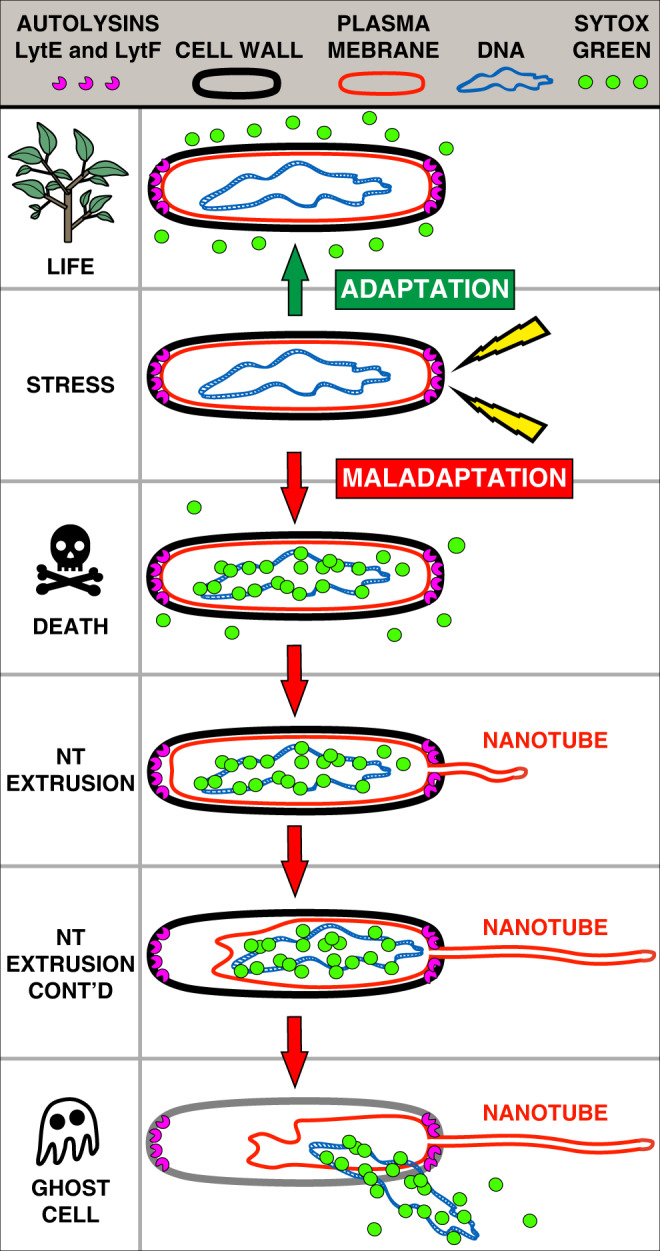
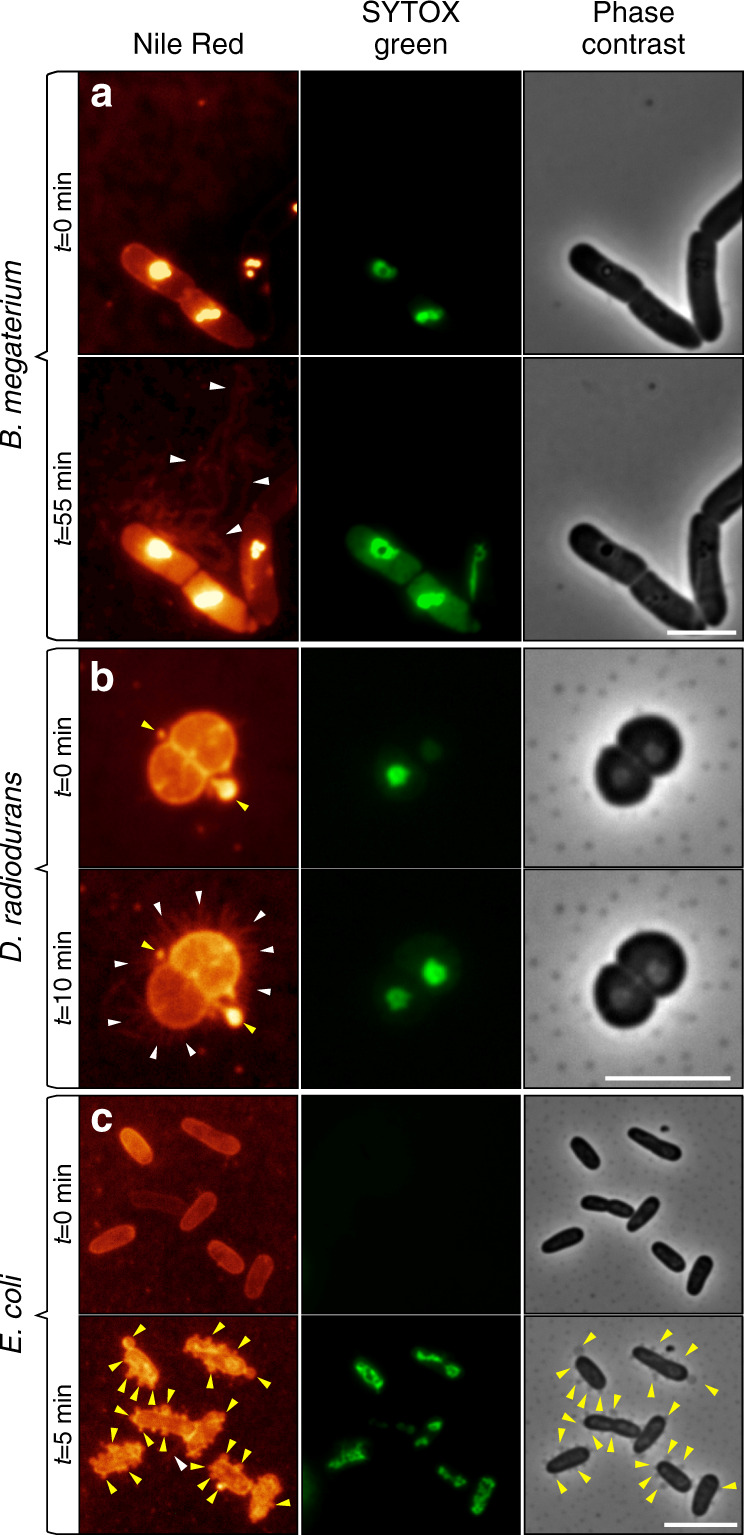
Bacterial nanotubes are membranous structures that have been reported to function as conduits between cells to exchange DNA, proteins, and nutrients. Here, we investigate the morphology and formation of bacterial nanotubes using Bacillus subtilis. We show that nanotube formation is associated with stress conditions, and is highly sensitive to the cells' genetic background, growth phase, and sample preparation methods. Remarkably, nanotubes appear to be extruded exclusively from dying cells, likely as a result of biophysical forces. Their emergence is extremely fast, occurring within seconds by cannibalizing the cell membrane. Subsequent experiments reveal that cell-to-cell transfer of non-conjugative plasmids depends strictly on the competence system of the cell, and not on nanotube formation. Our study thus supports the notion that bacterial nanotubes are a post mortem phenomenon involved in cell disintegration, and are unlikely to be involved in cytoplasmic content exchange between live cells.
细菌纳米管是一种膜状结构,据报道,它可以作为细胞之间的通道,用于交换 DNA、蛋白质和营养物质。在这里,我们使用枯草芽孢杆菌研究了细菌纳米管的形态和形成。我们发现,纳米管的形成与应激条件有关,并且对细胞的遗传背景、生长阶段和样品制备方法高度敏感。值得注意的是,纳米管似乎是从即将死亡的细胞中挤出的,可能是由于生物物理力的作用。它们的出现非常迅速,在几秒钟内通过吞噬细胞膜而发生。随后的实验表明,非接合质粒的细胞间转移严格依赖于细胞的感受态系统,而不依赖于纳米管的形成。因此,我们的研究支持这样一种观点,即细菌纳米管是一种与细胞解体有关的死后现象,不太可能参与活细胞之间的细胞质内容物交换。