
鉴定具有植物生物活性的虎杖为一种限制登革热病毒进入的抗病毒来源。
Identification of the phytobioactive Polygonum cuspidatum as an antiviral source for restricting dengue virus entry.
机构信息
Department of Medical Imaging, Chi Mei Medical Center, Tainan, Taiwan.
Graduate Institute of Medical Sciences, College of Medicine, Taipei Medical University, Taipei, Taiwan.
出版信息
Sci Rep. 2020 Oct 2;10(1):16378. doi: 10.1038/s41598-020-71849-3.
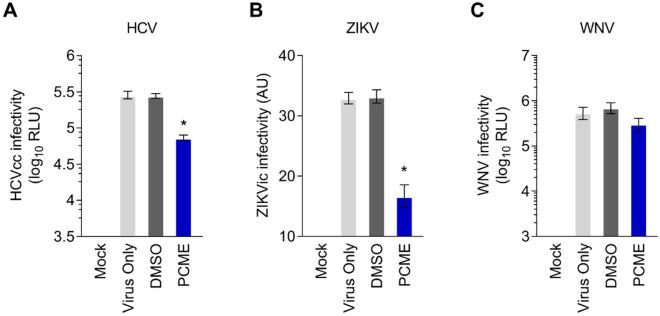
Dengue virus (DENV) is a mosquito-borne pathogen that is becoming a serious global threat, owing to its rising incidence in inter-tropical regions that yield over 50 million annual infections. There are currently no approved antiviral agents for the management of dengue, and recent shortcomings in its immunization called for immediate action to develop effective drugs with prophylactic ability to better manage its infection. In an attempt to discover novel antiviral sources, we identified the medicinal herb Polygonum cuspidatum (PC) as a bioactive botanical material against DENV infectivity. Specifically, the methanolic extract from PC rhizomes (PCME) potently inhibited DENV infection without causing significant cytotoxicity. Further examination on the viral life cycle demonstrated that PCME particularly targeted the initial stages of DENV infection, while pre- and post-infection treatments had no effect. More importantly, the PCME could efficiently inactivate DENV free virus particles and block the viral attachment and entry/fusion events without apparently influencing viral replication, egress, and cell-to-cell spread. The antiviral effect of PCME was also recapitulated in infection analysis using DENV pseudoparticles displaying viral structural proteins that mediate DENV particle entry. Besides, PCME treatment also inhibited direct DENV entry into several cell types relevant to its infection and reduced viral infectivity of other members of the Flaviviridae family, including the hepatitis C virus (HCV) and Zika virus (ZIKV). Due to its potency against DENV entry, we suggest that the phytobioactive extract from PC is an excellent starting point as an antiviral source material for further development of therapeutic strategies in the prophylactic management of DENV infection.
登革热病毒(DENV)是一种通过蚊子传播的病原体,由于其在热带地区的发病率上升,每年导致超过 5000 万例感染,因此成为一个严重的全球威胁。目前,尚无针对登革热的批准抗病毒药物,最近其免疫接种的缺陷呼吁立即采取行动,开发具有预防能力的有效药物,以更好地管理其感染。为了寻找新的抗病毒来源,我们发现药用植物虎杖(PC)是一种具有抗 DENV 感染活性的植物材料。具体来说,PC 根茎的甲醇提取物(PCME)强烈抑制 DENV 感染而不引起明显的细胞毒性。进一步研究病毒生命周期表明,PCME 特别针对 DENV 感染的初始阶段,而感染前和感染后的处理均无效果。更重要的是,PCME 可以有效地灭活游离的 DENV 病毒颗粒,并阻止病毒附着和进入/融合事件,而不会明显影响病毒复制、出芽和细胞间传播。使用显示介导 DENV 颗粒进入的病毒结构蛋白的 DENV 假型颗粒进行感染分析也证实了 PCME 的抗病毒作用。此外,PCME 处理还抑制了几种与感染相关的细胞类型中直接的 DENV 进入,并降低了其他黄病毒科成员(包括丙型肝炎病毒(HCV)和寨卡病毒(ZIKV))的病毒感染力。由于其对 DENV 进入的效力,我们建议从 PC 提取的植物生物活性提取物是进一步开发预防 DENV 感染治疗策略的抗病毒源材料的绝佳起点。


 Zotero 插件