Virus-Host Interaction Research Group, Jeffrey Cheah School of Medicine and Health Sciences, Monash University Malaysia, Jalan Lagoon Selatan, 47500, Bandar Sunway, Selangor, Malaysia.
Department of Chemistry, Universiti Putra Malaysia, 43400, Serdang, Malaysia.
Virol J. 2017 Nov 21;14(1):229. doi: 10.1186/s12985-017-0895-1.
The rapid rise and spread in dengue cases, together with the unavailability of safe vaccines and effective antiviral drugs, warrant the need to discover and develop novel anti-dengue treatments. In this study the antiviral activity of geraniin, extracted from the rind of Nephelium lappaceum, against dengue virus type-2 (DENV-2) was investigated.
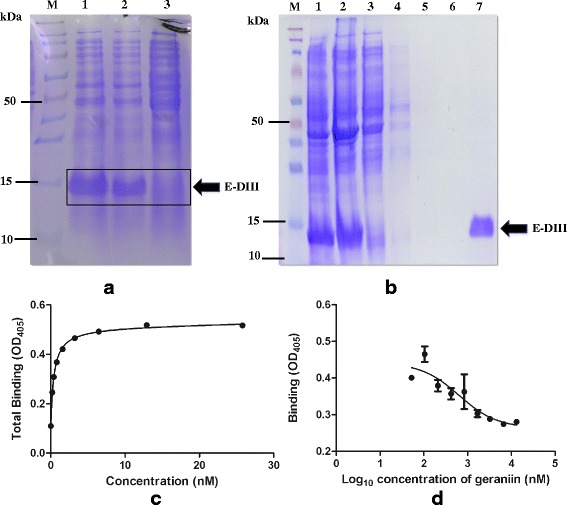
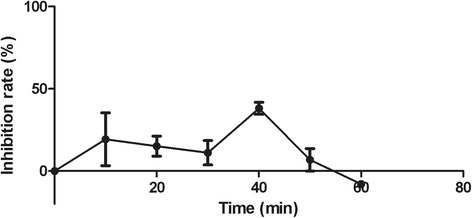
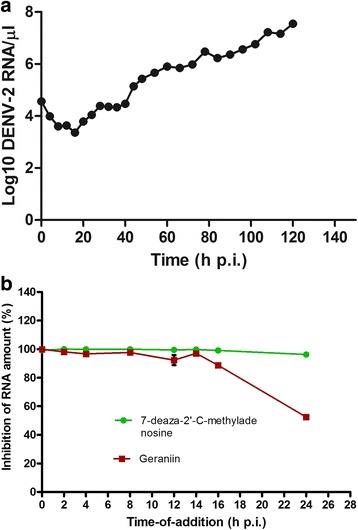
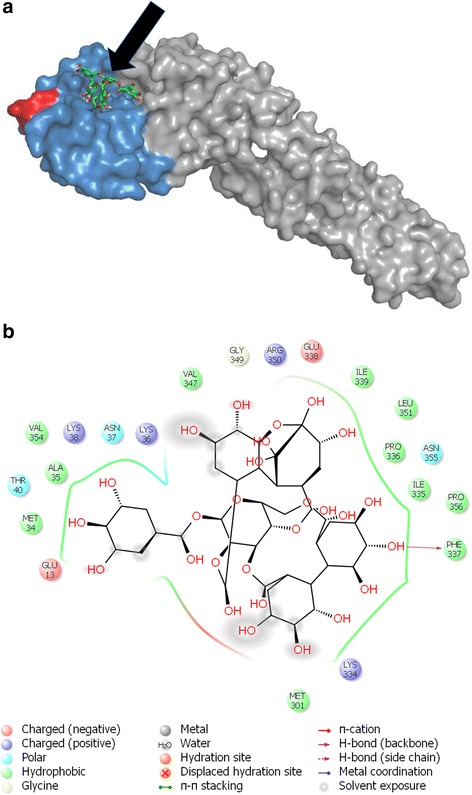
Geraniin was prepared from Nephelium lappaceum rind by reverse phase C-18 column chromatography. Cytotoxicity of geraniin towards Vero cells was evaluated using MTT assay while IC value was determined by plaque reduction assay. The mode-of-action of geraniin was characterized using the virucidal, attachment, penetration and the time-of-addition assays'. Docking experiments with geraniin molecule and the DENV envelope (E) protein was also performed. Finally, recombinant E Domain III (rE-DIII) protein was produced to physiologically test the binding of geraniin to DENV-2 E-DIII protein, through ELISA competitive binding assay.
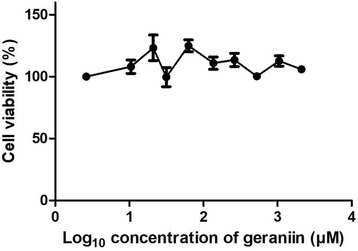
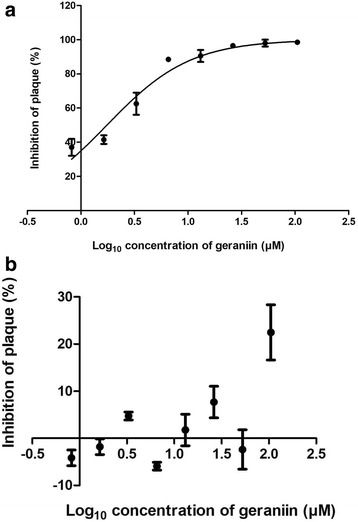
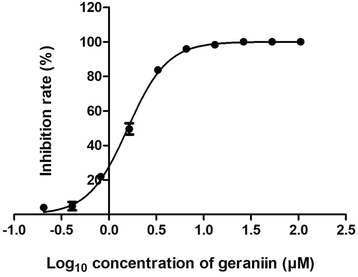
Cytotoxicity assay confirmed that geraniin was not toxic to Vero cells, even at the highest concentration tested. The compound exhibited DENV-2 plaque formation inhibition, with an IC of 1.75 μM. We further revealed that geraniin reduced viral infectivity and inhibited DENV-2 from attaching to the cells but had little effect on its penetration. Geraniin was observed to be most effective when added at the early stage of DENV-2 infection. Docking experiments showed that geraniin binds to DENV E protein, specifically at the DIII region, while the ELISA competitive binding assay confirmed geraniin's interaction with rE-DIII with high affinity.
Geraniin from the rind of Nephelium lappaceum has antiviral activity against DENV-2. It is postulated that the compound inhibits viral attachment by binding to the E-DIII protein and interferes with the initial cell-virus interaction. Our results demonstrate that geraniin has the potential to be developed into an effective antiviral treatment, particularly for early phase dengue viral infection.
登革热病例的迅速增加和传播,加上缺乏安全的疫苗和有效的抗病毒药物,使得有必要发现和开发新的抗登革热治疗方法。在这项研究中,研究了从余甘子果皮中提取的鹤虱素对登革热病毒 2 型(DENV-2)的抗病毒活性。
通过反相 C-18 柱色谱法从余甘子果皮中制备鹤虱素。用 MTT 法评估鹤虱素对 Vero 细胞的细胞毒性,并用蚀斑减少法测定 IC 值。通过病毒杀伤、附着、渗透和加药时间测定法来表征鹤虱素的作用方式。还进行了鹤虱素分子与 DENV 包膜(E)蛋白的对接实验。最后,用 ELISA 竞争结合实验生产重组 E 结构域 III(rE-DIII)蛋白,以生理方式测试鹤虱素与 DENV-2 E-DIII 蛋白的结合。
细胞毒性试验证实,即使在测试的最高浓度下,鹤虱素对 Vero 细胞也没有毒性。该化合物表现出对 DENV-2 斑块形成的抑制作用,IC 为 1.75 μM。我们进一步表明,鹤虱素降低了病毒感染力,并抑制了 DENV-2 与细胞的附着,但对其渗透影响不大。鹤虱素在 DENV-2 感染的早期阶段添加时效果最佳。对接实验表明,鹤虱素与 DENV E 蛋白结合,特别是在 DIII 区,而 ELISA 竞争结合实验证实了鹤虱素与 rE-DIII 的高亲和力相互作用。
来自余甘子果皮的鹤虱素对 DENV-2 具有抗病毒活性。据推测,该化合物通过与 E-DIII 蛋白结合抑制病毒附着,并干扰初始的细胞-病毒相互作用。我们的结果表明,鹤虱素有可能被开发成一种有效的抗病毒治疗方法,特别是用于登革热病毒感染的早期阶段。