Department of Orthopedics and Trauma-Surgery, Medical University of Vienna, Vienna, Austria.
Sci Rep. 2020 Oct 2;10(1):16407. doi: 10.1038/s41598-020-73536-9.
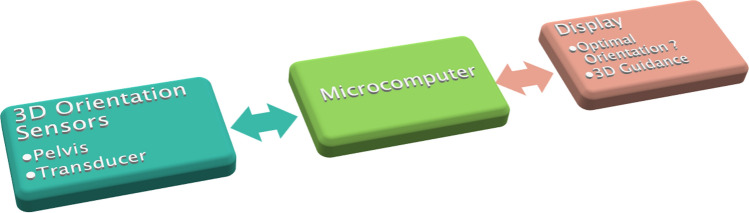
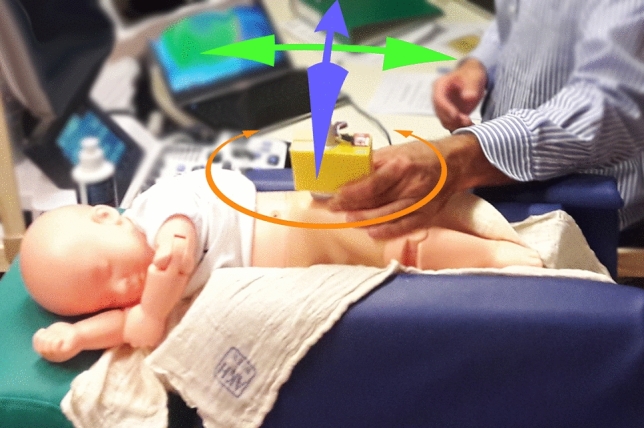
To develop an electronic navigation system to increase reliability and comparability in the ultrasound screening of developmental dysplasia of the hip (DDH). The impact of the navigation system on transducer positioning and on sonographic measurements according to Graf was analyzed. Twenty hips in newborns were examined sonographically using a new navigation system capable of detecting the transducer and pelvis position in order to calculate the relative tilt in the frontal, axial, and sagittal-plane. In each newborn an ultrasound image was obtained conventionally according to Graf and a second image using the sonographic navigation system. Relative roll and pitch angles and sonographic measurements were analyzed using paired T-tests and Levene-tests. Relative tilt angles in the conventional group ranged from - 8.9° to 14.3° (frontal-plane) and - 23.8° to 14.2° (axial-plane). In the navigation-assisted group ranges from - 3.0° to 3.5° and - 2.8° to 4.5° were observed. Variances were significantly lower in the navigation-assisted group (p < 0.001 and p = 0.004 respectively). The navigation system allowed for a significant reduction of relative tilt angles between the transducer and the newborn pelvis, thus supporting an optimal transducer positioning. This is a promising approach to improve reproducibility and reliability in the ultrasound screening for DDH.
为了开发一种电子导航系统,以提高髋关节发育不良(DDH)超声筛查的可靠性和可比性。分析了导航系统对换能器定位和 Graf 超声测量的影响。使用一种新的导航系统,能够检测换能器和骨盆的位置,从而计算出额状面、矢状面和冠状面的相对倾斜度,对 20 例新生儿髋关节进行了超声检查。在每个新生儿中,根据 Graf 常规获得一个超声图像,并使用超声导航系统获得第二个图像。使用配对 T 检验和 Levene 检验分析相对滚动和俯仰角及超声测量值。在常规组中,相对倾斜角度在额状面为-8.9°至 14.3°,在矢状面为-23.8°至 14.2°。在导航辅助组中,观察到的范围分别为-3.0°至 3.5°和-2.8°至 4.5°。导航辅助组的方差明显较低(p<0.001 和 p=0.004)。导航系统允许换能器和新生儿骨盆之间的相对倾斜角度显著减小,从而支持最佳的换能器定位。这是一种提高 DDH 超声筛查可重复性和可靠性的有前途的方法。