Department of Health Education and Health Sociology, School of Public Health, Graduate School of Medicine, The University of Tokyo.
Department of Health and Social Behavior, School of Public Health, Graduate School of Medicine, The University of Tokyo.
J Epidemiol. 2022 Jan 5;32(1):4-11. doi: 10.2188/jea.JE20200170. Epub 2021 Mar 4.
Sedentary behaviors are prevalent among children and can have a detrimental effect on their health. Little is known about the influence of parental time on children's sedentary behavior. This study examined the association between parental working hours and children's sedentary time.
Cross-sectional data were drawn from the Japanese Study on Stratification, Health, Income, and Neighborhood (J-SHINE) in 2010 and 2011. Participants were 886 children aged 7-18 years and their parents. The primary outcome was self-reported sedentary time after school that comprised screen time and non-screen time. The main explanatory variable was parental working hours. We used multiple regression analysis adjusting for sociodemographic factors.
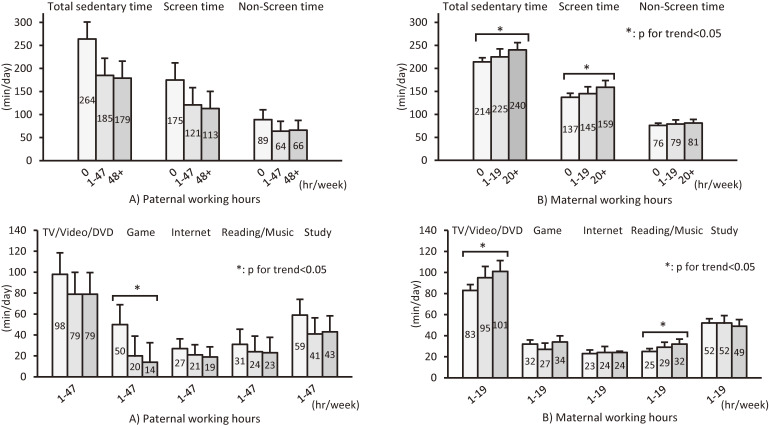
Children's mean sedentary time was 222 (standard deviation [SD], 123) min/day; 144 (SD, 108) min/day screen time and 78 (SD, 65) min/day non-screen time. Children whose mothers worked ≥20 hours/week had 28 (95% CI, 9 to 48) min/day longer sedentary time than children of homemakers (240 min/day vs 214 min/day). The longer maternal working hours, the longer sedentary time (P for trend <0.01). In contrast, children whose fathers worked ≥48 hours/week had 82 (95% CI, -156 to -7) min/day shorter sedentary time than children of non-working fathers (179 min/day vs 264 min/day). When limited to children whose fathers worked, there was no statistically significant association between children's sedentary time and paternal working hours.
Children with mothers who work long hours or fathers not working tend to sit more. Supplementing the shortages in resources for childcare may be necessary among those families.
久坐行为在儿童中很普遍,会对他们的健康产生不利影响。人们对父母时间对儿童久坐行为的影响知之甚少。本研究调查了父母工作时间与儿童久坐时间之间的关系。
本研究的数据来自于 2010 年和 2011 年的日本分层、健康、收入和邻里关系研究(J-SHINE)。参与者为 886 名 7-18 岁的儿童及其父母。主要结局是放学后的自我报告久坐时间,包括屏幕时间和非屏幕时间。主要解释变量是父母的工作时间。我们使用多元回归分析,调整了社会人口统计学因素。
儿童平均久坐时间为 222(标准差 [SD],123)分钟/天;144(SD,108)分钟/天屏幕时间和 78(SD,65)分钟/天非屏幕时间。母亲每周工作≥20 小时的儿童比家庭主妇的孩子每天多坐 28(95%置信区间,9 至 48)分钟(240 分钟/天比 214 分钟/天)。母亲工作时间越长,儿童久坐时间越长(趋势 P <0.01)。相比之下,父亲每周工作≥48 小时的儿童比没有工作的父亲的孩子每天少坐 82(95%置信区间,-156 至-7)分钟(179 分钟/天比 264 分钟/天)。当仅限于父亲工作的儿童时,儿童久坐时间与父亲工作时间之间没有统计学意义上的关联。
母亲工作时间长或父亲不工作的儿童往往坐得更多。这些家庭可能需要补充儿童保育资源的不足。