Prasad Narayan, Gopalakrishnan N, Sahay Manisha, Gupta Amit, Agarwal Sanjay K
Professor of Nephrology, SGPGIMS, Lucknow, Uttar Pradesh, India.
Madras Medical College, Chennai, Tamil Nadu, India.
Indian J Nephrol. 2020 May-Jun;30(3):143-154. doi: 10.4103/ijn.IJN_191_20. Epub 2020 Jun 1.
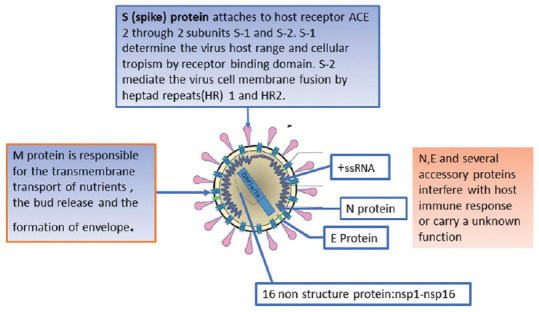
COVID-19 is caused by a novel beta coronavirus (SARS-CoV-2) strain that was first discovered in 2019 in the Wuhan city of China. Based on virus genome sequencing studies, the bat is suspected as the natural host of virus, and infection might be transmitted from bats via unknown intermediate hosts like reptiles and snakes etc., to infect humans. COVID-19 is transmitted from person to person contact, primarily via droplet infection within the incubation period or after clinical manifestations of fever, cough, sneezing, sputum, dyspnea, and pneumonia and through contaminated fomites. COVID-19 enters the respiratory tract through the ACE2 receptor on alveoli through binding of s-protein of the virus and causes injuries though the cytopathic effect, as well as cytokines and other mediators, released after developing sepsis. ACE 2 is almost 100-fold higher in kidneys than lung, and the virus can also involve the kidney in the same manner. Kidney involvement manifests in the form of proteinuria, hematuria, and an acute rise in serum creatinine. Kidney involvement is an independent risk factor for mortality. Diagnosis is primarly made by detecting viral RNA by reverse transcriptase polymerase chain reaction (rtPCR) in nasopharyngeal swab samples. Role of antibodies, both IgM and IgG are still evolving and at best restricted for epidemiological purpose. Though a large number of treatments, including hydroxychloroquine, anti-viral, convalescent plasma etc., are being tried, as of now treatment is symptomatic only.
新型冠状病毒肺炎(COVID-19)由一种新型β冠状病毒(严重急性呼吸综合征冠状病毒2,SARS-CoV-2)毒株引起,该毒株于2019年首次在中国武汉市被发现。基于病毒基因组测序研究,蝙蝠被怀疑是该病毒的自然宿主,感染可能通过未知的中间宿主(如爬行动物和蛇等)从蝙蝠传播给人类。新型冠状病毒肺炎主要通过人与人之间的接触传播,主要是在潜伏期或出现发热、咳嗽、打喷嚏、咳痰、呼吸困难和肺炎等临床表现后,通过飞沫感染传播,也可通过受污染的污染物传播。新型冠状病毒通过病毒的s蛋白与肺泡上的血管紧张素转换酶2(ACE2)受体结合进入呼吸道,并通过细胞病变效应以及脓毒症发生后释放的细胞因子和其他介质造成损伤。ACE2在肾脏中的含量几乎比肺高100倍,病毒也可通过同样的方式累及肾脏。肾脏受累表现为蛋白尿、血尿和血清肌酐急性升高。肾脏受累是死亡的独立危险因素。诊断主要通过在鼻咽拭子样本中采用逆转录聚合酶链反应(rtPCR)检测病毒RNA来进行。IgM和IgG抗体的作用仍在演变,目前最多仅用于流行病学目的。尽管正在尝试大量治疗方法,包括羟氯喹、抗病毒药物、康复期血浆等,但截至目前,治疗仍仅为对症治疗。