Bioinformatics and Biomedical Data Science Division, Health Informatics Department, Universidade Federal de São Paulo-UNIFESP, São Paulo, SP, Brazil.
Department of Neurology and Neurosurgery, Universidade Federal de São Paulo-UNIFESP, São Paulo, SP, Brazil.
Braz J Microbiol. 2020 Dec;51(4):1593-1599. doi: 10.1007/s42770-020-00321-1. Epub 2020 Jun 26.
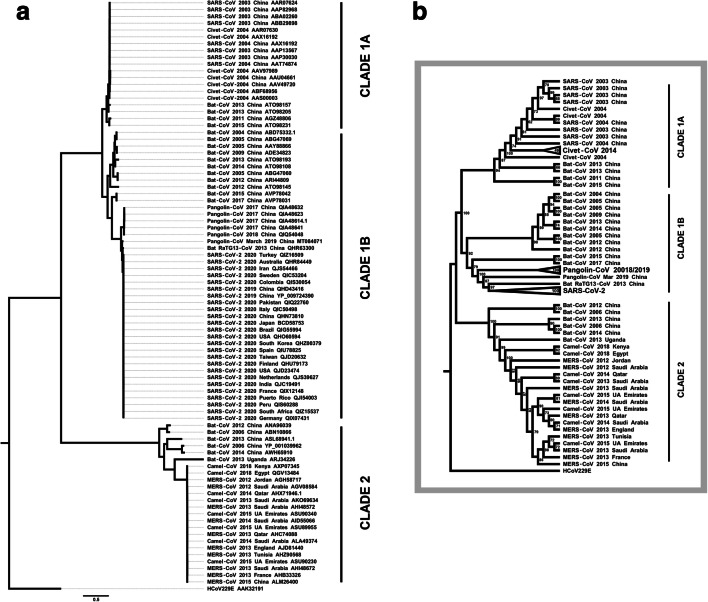
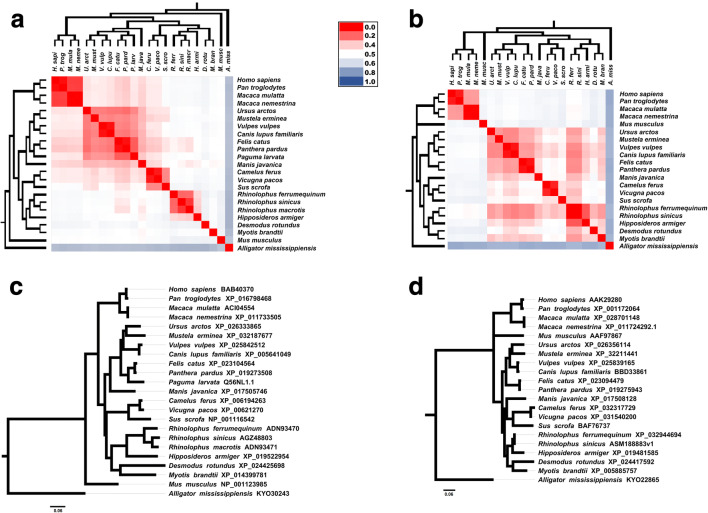
An emergence of a novel coronavirus, causative agent of COVID19, named as severe acute respiratory syndrome coronavirus 2 (SARS-CoV-2), occurred due to cross-species transmission. Coronaviruses are a large family of viruses able to infect a great number of hosts. Entrance of SARS-CoV-2 depends on the surface (S) protein interaction with host ACE2 protein and cleavage by TMPRSS2. ACE2 could be a species-specific barrier that interferes with bat-to-human coronavirus cross-species transmission. Molecular analysis supported bats as natural hosts for SARS-CoV and involved them in MERS-CoV origin. The genomic similarity between bat RaTG13 CoV strain and SARS-CoV-2 implicates bats in the origin of the new outbreak. Additionally, there is a hypothesis for the zoonotic transmission based on contact with Malayan pangolins by humans in Huanan seafood market in Wuhan, China. To investigate bats and pangolin as hosts in SARS-CoV-2 cross-species transmission, we perform an evolutionary analysis combining viral and host phylogenies and divergence of ACE2 and TMPRSS2 amino acid sequences between CoV hosts. Phylogeny showed SARS-like-CoV-2 strains that infected pangolin and bats are close to SARS-CoV-2. In contrast to TMPRSS2, pangolin ACE2 amino acid sequence has low evolutionary divergence compared with humans and is more divergent from bats. Comparing SARS-CoV with SARS-CoV-2 origins, pangolin has yet lower ACE2 evolutionary divergence with humans than civet-the main intermediary host of SARS-CoV. Thus, pangolin has become an opportune host to intermediates bat-to-human SARS-CoV-2 jump and entry.
一种新型冠状病毒(SARS-CoV-2)的出现,是导致 COVID19 的病原体,它是通过跨物种传播而产生的。冠状病毒是一个能够感染大量宿主的大病毒家族。SARS-CoV-2 的进入取决于表面(S)蛋白与宿主 ACE2 蛋白的相互作用和 TMPRSS2 的切割。ACE2 可能是一种物种特异性的屏障,干扰了蝙蝠到人类冠状病毒的跨物种传播。分子分析支持蝙蝠是 SARS 冠状病毒和 MERS 冠状病毒的天然宿主,并参与了它们的起源。蝙蝠 RaTG13 CoV 株与 SARS-CoV-2 的基因组相似性表明蝙蝠可能是新爆发的起源。此外,还有一种关于人畜共患病传播的假设,即人类在武汉华南海鲜市场接触马来亚穿山甲。为了研究蝙蝠和穿山甲在 SARS-CoV-2 跨物种传播中的宿主作用,我们结合病毒和宿主系统发育以及 ACE2 和 TMPRSS2 氨基酸序列在 CoV 宿主之间的分化进行了进化分析。系统发育显示,感染穿山甲和蝙蝠的 SARS-CoV-2 株与 SARS-CoV-2 密切相关。与 TMPRSS2 不同,穿山甲 ACE2 氨基酸序列与人类的进化分化程度较低,与蝙蝠的进化分化程度更高。与 SARS-CoV 的起源相比,穿山甲的 ACE2 与人类的进化分化程度比 SARS-CoV 的主要中间宿主果子狸更低。因此,穿山甲已成为蝙蝠到人类 SARS-CoV-2 跳跃和进入的中间宿主。