Applied Systems Biology, Leibniz Institute for Natural Product Research and Infection Biology-Hans Knöll Institute, Jena, Germany.
Faculty of Biological Sciences, Institute of Microbiology, Friedrich-Schiller-University Jena, Jena, Germany.
Front Immunol. 2020 Sep 2;11:1911. doi: 10.3389/fimmu.2020.01911. eCollection 2020.
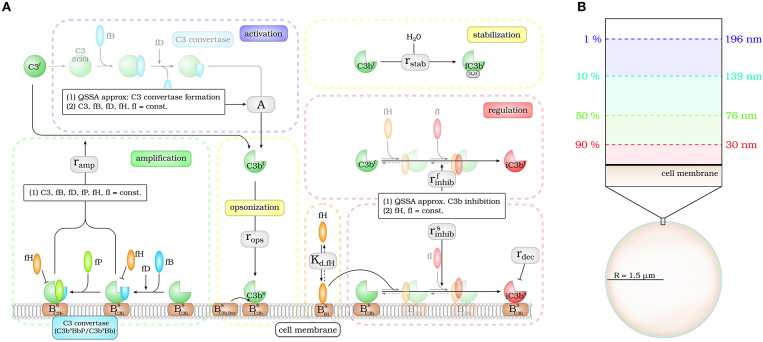
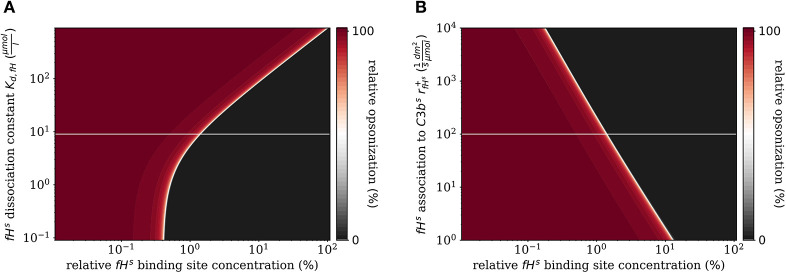
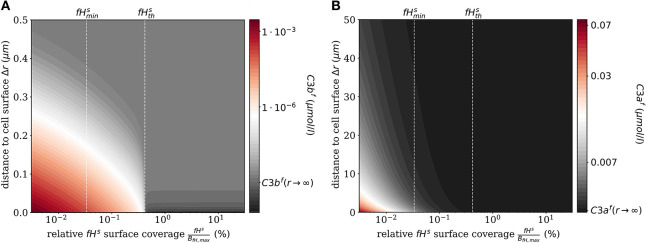
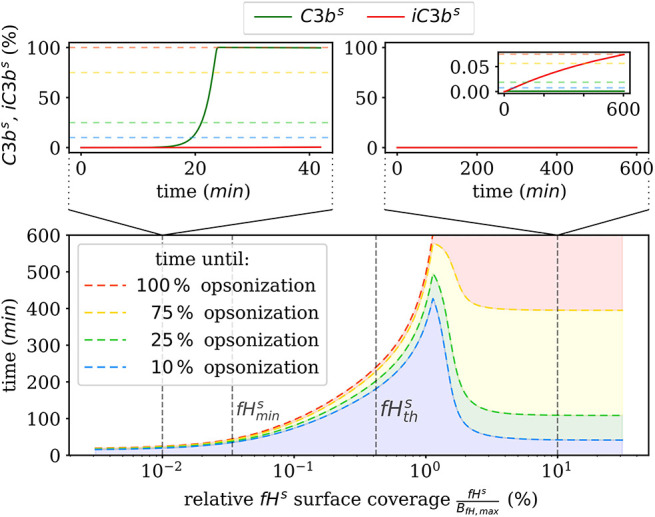
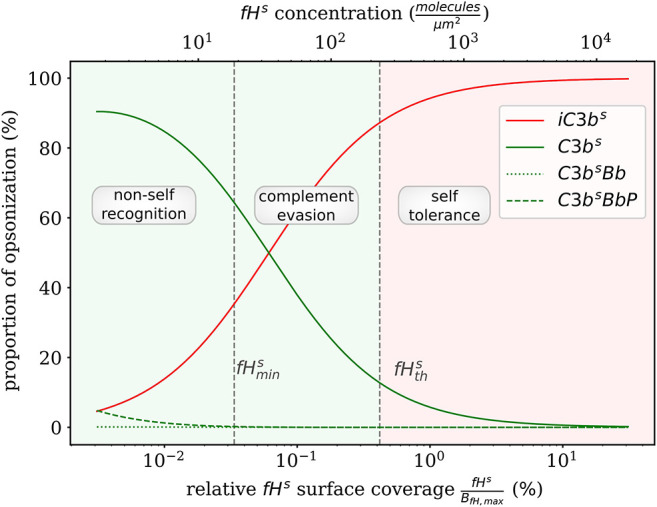
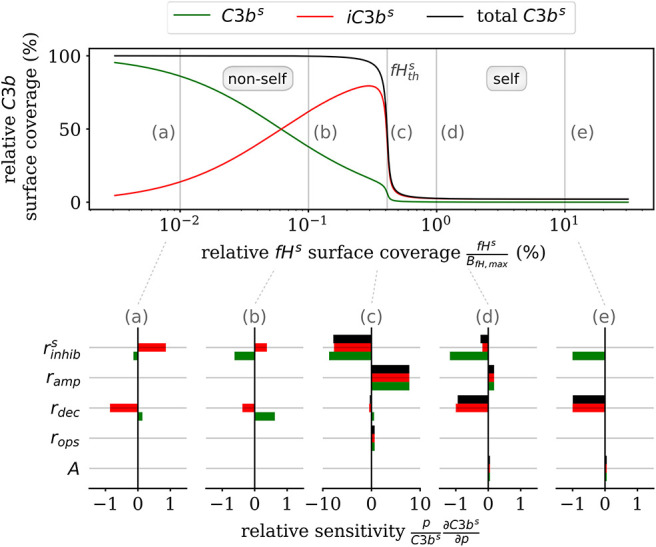
The complement system is part of the innate immune system and plays an important role in the host defense against infectious pathogens. One of the main effects is the opsonization of foreign invaders and subsequent uptake by phagocytosis. Due to the continuous default basal level of active complement molecules, a tight regulation is required to protect the body's own cells (self cells) from opsonization and from complement damage. A major complement regulator is Factor H, which is recruited from the fluid phase and attaches to cell surfaces where it effectively controls complement activation. Besides self cells, pathogens also have the ability to bind Factor H; they can thus escape opsonization and phagocytosis causing severe infections. In order to advance our understanding of the opsonization process at a quantitative level, we developed a mathematical model for the dynamics of the complement system-termed -that is based on ordinary differential equations for cell surface-bound molecules and on partial differential equations for concentration profiles of the fluid phase molecules in the environment of cells. This hybrid differential equation approach allows to model the complement cascade focusing on the role of active C3b in the fluid phase and on the cell surface as well as on its inactivation on the cell surface. The enables us to quantitatively predict the conditions under which Factor H mediated complement evasion occurs. Furthermore, investigating the quantitative impact of model parameters by a sensitivity analysis, we identify the driving processes of complement activation and regulation in both the self and non-self regime. The two regimes are defined by a critical Factor H concentration on the cell surface and we use the model to investigate the differential impact of complement model parameters on this threshold value. The dynamic modeling on the surface of pathogens are further relevant to understand pathophysiological situations where Factor H mutants and defective Factor H binding to target surfaces results in pathophysiology such as renal and retinal disease. In the future, this DynaCoSys model will be extended to also enable evaluating treatment strategies of complement-related diseases.
补体系统是先天免疫系统的一部分,在宿主防御感染性病原体中起着重要作用。其主要作用之一是对外来侵略者进行调理作用,随后被吞噬作用所吞噬。由于活性补体分子的持续默认基础水平,需要进行严格的调控,以保护机体自身细胞(自身细胞)免受调理作用和补体损伤。主要的补体调节剂是因子 H,它从流体相中招募,并附着在细胞表面,在那里它可以有效地控制补体的激活。除了自身细胞外,病原体也有结合因子 H 的能力;因此,它们可以逃避调理作用和吞噬作用,从而导致严重感染。为了在定量水平上推进我们对调理作用过程的理解,我们开发了一个补体系统动力学的数学模型,该模型称为 - 基于细胞表面结合分子的常微分方程和细胞环境中流体相分子浓度分布的偏微分方程。这种混合微分方程方法允许我们模拟补体级联,重点关注流体相中的活性 C3b 以及细胞表面上的 C3b 的作用及其在细胞表面上的失活。该模型使我们能够定量预测因子 H 介导的补体逃避发生的条件。此外,通过敏感性分析研究模型参数的定量影响,我们确定了在自身和非自身两种状态下补体激活和调节的驱动过程。这两种状态由细胞表面上的临界因子 H 浓度定义,我们使用该模型研究补体模型参数对该阈值的差异影响。对病原体表面的动态建模进一步有助于理解因子 H 突变体和缺陷因子 H 与靶表面结合导致肾脏和视网膜疾病等病理生理学情况。在未来,这个 DynaCoSys 模型将被扩展,以能够评估补体相关疾病的治疗策略。