Menzel Annette, Yuan Ye, Hamann Andreas, Ohl Ulrike, Matiu Michael
Ecoclimatology, Department of Ecology and Ecosystem Management, TUM School of Life Sciences, Technical University of Munich, Freising, Germany.
Institute for Advanced Study, Technical University of Munich, Garching, Germany.
Front Plant Sci. 2020 Sep 4;11:561413. doi: 10.3389/fpls.2020.561413. eCollection 2020.
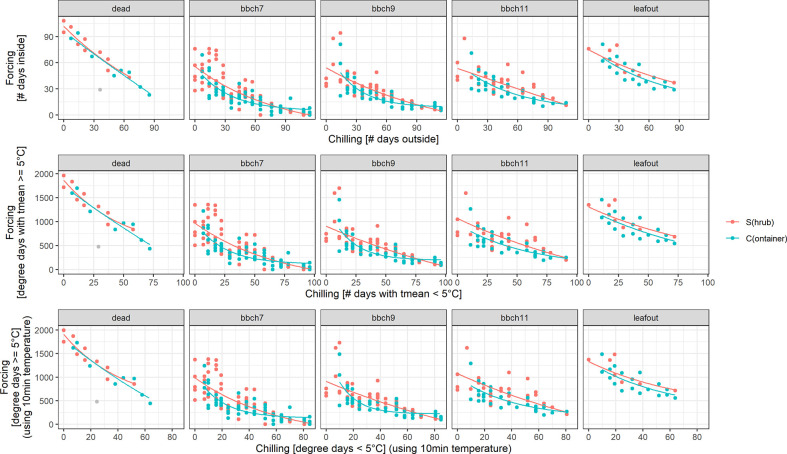
Low-cost phenological experiments with cut twigs are increasingly used to study bud development in response to spring warming and photoperiod. However, a broader variety of species needs to be tackled and in particular the influence of insufficient winter chilling deserves more attention. Therefore, we investigated if and how chilling requirements can be efficiently investigated by cut twigs and how this low-tech approach could be successfully implemented as a citizen science or school project. We conducted an experiment on bud burst and leaf development of L. twigs, with natural chilling outdoors on a shrub (S) and another chilling treatment as cut twigs in containers (C), and subsequent forcing indoors. Subsampling of the number of cutting dates and number of twigs was used to infer minimum required sample sizes. Apart from insufficiently chilled twigs, ~80% of the twigs (both S and C) reached leaf out. For multiple definitions of chilling and forcing, a negative exponential relationship was revealed between chilling and amount of forcing needed to reach certain developmental stages. At least 5 out of 15 cutting dates or alternatively half of the 10 twig repetitions, but especially those mirroring low chilling conditions, were needed to describe the chilling-forcing relationship with some degree of robustness. In addition, for cutting dates with long chilling, i.e., from January onwards, freshly cut twigs (S) required significantly more forcing to reach bud burst than twigs from containers (C), although the effect was small. In general, chilling conditions of mature shrubs were well captured by cut twigs, therefore opening the possibility of chilling through refrigeration. We conclude that experimental protocols as outlined here are feasible for citizen scientists, school projects, and science education, and would have the potential to advance the research field if carried out on a large scale. We provide an easy-to-use Shiny simulation app to enable citizen scientists to build up a bud development model based on their own experimental data and then simulate future phenological development with winter and/or spring warming. This may encourage them to further study other aspects of climate change and the impacts of climate change.
利用剪下的嫩枝进行低成本物候实验越来越多地被用于研究芽发育对春季变暖和光周期的响应。然而,需要研究更多种类的物种,尤其是冬季低温不足的影响值得更多关注。因此,我们研究了是否以及如何通过剪下的嫩枝有效地研究低温需求,以及这种低技术方法如何作为公民科学或学校项目成功实施。我们对L.嫩枝的芽萌发和叶片发育进行了一项实验,在户外灌木上进行自然低温处理(S),另一种低温处理是将剪下的嫩枝放在容器中(C),随后在室内进行催芽处理。通过对剪取日期数量和嫩枝数量进行子采样来推断所需的最小样本量。除了低温不足的嫩枝外,约80%的嫩枝(S和C)都达到了展叶状态。对于多种低温和催芽的定义,在达到特定发育阶段所需的低温和催芽量之间发现了负指数关系。为了在一定程度上稳健地描述低温 - 催芽关系,需要15个剪取日期中的至少5个,或者10个嫩枝重复样本中的一半,但特别是那些反映低温条件较低的样本。此外,对于低温期长的剪取日期,即从1月开始,新鲜剪下的嫩枝(S)比容器中的嫩枝(C)达到芽萌发所需的催芽量显著更多,尽管这种影响较小。一般来说,剪下的嫩枝能够很好地反映成熟灌木的低温条件,因此开启了通过冷藏进行低温处理的可能性。我们得出结论,这里概述的实验方案对于公民科学家、学校项目和科学教育是可行的,如果大规模开展,有可能推动该研究领域的发展。我们提供了一个易于使用的Shiny模拟应用程序,使公民科学家能够根据自己的实验数据建立芽发育模型,然后模拟未来随着冬季和/或春季变暖的物候发育。这可能会鼓励他们进一步研究气候变化的其他方面以及气候变化的影响。