Berry Neil, Kempster Sarah, Ham Claire, Jenkins Adrian, Hall Jo, Page Mark, Mattiuzzo Giada, Adedeji Yemisi, Hewson Roger, Giles Elaine, Ferguson Debbie, Almond Neil
Division of Infectious Disease Diagnostics, National Institute for Biological Standards and Control, Blanche Lane, South Mimms, Herts EN6 3QG UK.
Division of Virology, National Institute for Biological Standards and Control, Blanche Lane, South Mimms, Herts EN6 3QG UK.
NPJ Vaccines. 2020 Sep 15;5:86. doi: 10.1038/s41541-020-00234-y. eCollection 2020.
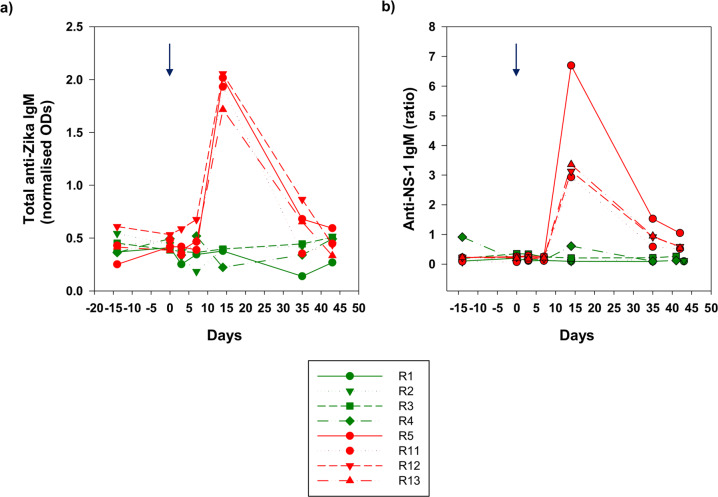
Zika virus (ZIKV) causes neurological complications in susceptible individuals, highlighted in the recent South American epidemic. Natural ZIKV infection elicits host responses capable of preventing subsequent re-infection, raising expectations for effective vaccination. Defining protective immune correlates will inform viral intervention strategies, particularly vaccine development. Non-human primate (NHP) species are susceptible to ZIKV and represent models for vaccine development. The protective efficacy of a human anti-ZIKV convalescent plasma pool (16/320-14) developed as a candidate reference material for a WHO International Standard was evaluated in macaques. Convalescent plasma administered to four cynomolgus macaques () intra-peritoneally 24 hrs prior to sub-cutaneous challenge with 10 pfu ZIKV protected against detectable infection, with absence of detectable ZIKV RNA in blood and lymphoid tissues. Passively immunised anti-ZIKV immunoglobulin administered prior to time of challenge remained present only at very low levels 42 days post-challenge. Absence of de novo antibody responses in passively immunised macaques indicate sterilising immunity compared with naïve challenge controls that exhibited active ZIKV-specific IgM and IgG responses post-challenge. Demonstration that the presence of convalescent anti-ZIKV at levels of 400 IU/mL neutralising antibody protects against virus challenge provides a scientific framework for development of anti-ZIKV vaccines and facilitates regulatory approval.
寨卡病毒(ZIKV)可使易感个体出现神经并发症,这在近期的南美疫情中凸显出来。自然感染寨卡病毒会引发宿主反应,从而能够预防后续的再次感染,这增加了人们对有效疫苗的期望。确定保护性免疫相关因素将为病毒干预策略提供依据,特别是疫苗研发。非人灵长类动物(NHP)对寨卡病毒易感,是疫苗研发的模型。对一种作为世界卫生组织国际标准候选参考材料开发的人抗寨卡病毒恢复期血浆池(16/320 - 14)在猕猴中的保护效力进行了评估。在用10个空斑形成单位(pfu)寨卡病毒皮下攻击前24小时,给4只食蟹猕猴腹腔注射恢复期血浆,可预防可检测到的感染,血液和淋巴组织中未检测到寨卡病毒RNA。在攻击前给予的被动免疫抗寨卡病毒免疫球蛋白在攻击后42天仅以非常低的水平存在。与攻击后出现活性寨卡病毒特异性IgM和IgG反应的未免疫攻击对照相比,被动免疫猕猴中无新生抗体反应表明具有灭菌免疫。证明400国际单位/毫升中和抗体水平的恢复期抗寨卡病毒抗体可预防病毒攻击,为抗寨卡病毒疫苗的研发提供了科学框架,并有助于监管审批。