Kikuchi Kasumi, Dong Zhenyu, Shinmei Yasuhiro, Murata Miyuki, Kanda Atsuhiro, Noda Kosuke, Harada Takayuki, Ishida Susumu
Laboratory of Ocular Cell Biology & Visual Science, Department of Ophthalmology, Faculty of Medicine and Graduate School of Medicine, Hokkaido University, Sapporo, Japan.
Visual Research Project, Tokyo Metropolitan Institute of Medical Science, Tokyo, Japan.
J Ophthalmol. 2020 Sep 19;2020:9539681. doi: 10.1155/2020/9539681. eCollection 2020.
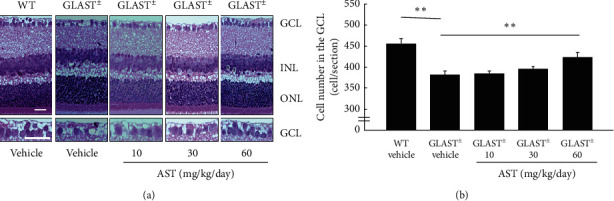
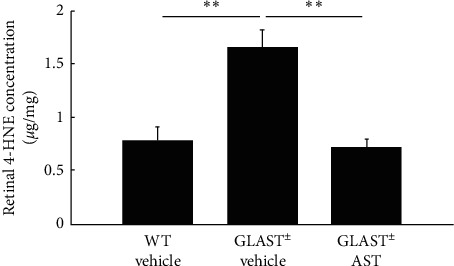
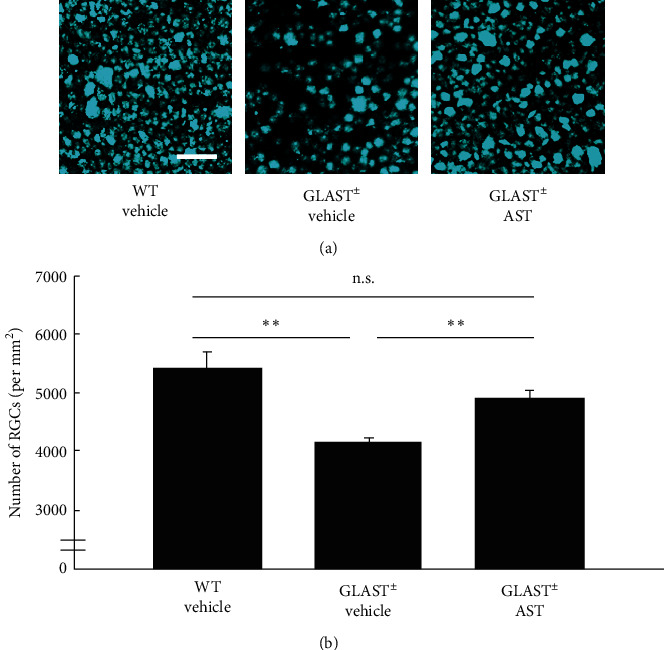
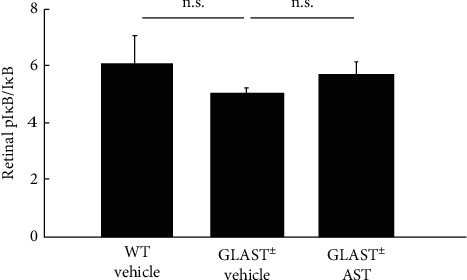
Glaucoma is characterized by axonal degeneration of retinal ganglion cells (RGCs) and apoptotic death of their cell bodies. Lowering intraocular pressure is currently the only way to treat glaucoma, but it is often insufficient to inhibit the progression of the disease. Glaucoma is a multifactorial disease, and the involvement of oxidative stress has recently received much attention. In the present study, we investigated the cytoprotective effect of astaxanthin (AST) on RGC degeneration using a normal-tension glaucoma (NTG) mouse model, which lacks the (Glast) and demonstrates spontaneous RGC and optic nerve degeneration without elevated intraocular pressure. Three-week-old Glast mice were given intraperitoneal injections of AST at 10, 30, or 60 mg/kg/day or vehicle alone, and littermate control mice were given vehicle alone for 14 days, respectively. Five weeks after birth, the number of RGCs was counted in paraffin sections of retinal tissues stained with hematoxylin and eosin. We also used a retrograde labeling technique to quantify the number of RGCs. Additionally, the phosphorylated (p) IB/total IB ratio and the 4-hydroxynonenal (HNE) were measured in retinal tissues. The number of RGCs in Glast mice was significantly decreased compared with that in control mice. RGC loss was suppressed by the administration of AST at 60 mg/kg/day, compared with vehicle alone. Following AST administration, the concentration of 4-HNE in the retina was also suppressed, but the pIB/IB ratio did not change. Our study revealed that the antioxidative stress effects of AST inhibit RGC degeneration in the retina and may be useful in the treatment of NTG.
青光眼的特征是视网膜神经节细胞(RGCs)的轴突退化及其细胞体的凋亡死亡。降低眼压是目前治疗青光眼的唯一方法,但往往不足以抑制疾病的进展。青光眼是一种多因素疾病,氧化应激的参与最近受到了广泛关注。在本研究中,我们使用正常眼压性青光眼(NTG)小鼠模型研究了虾青素(AST)对RGCs退化的细胞保护作用,该模型缺乏谷氨酸天冬氨酸转运体(Glast),表现出RGCs和视神经的自发性退化且眼压不升高。给3周龄的Glast小鼠腹腔注射10、30或60mg/kg/天的AST或单独注射溶剂,同窝对照小鼠单独注射溶剂,持续14天。出生后5周,对苏木精和伊红染色的视网膜组织石蜡切片中的RGCs数量进行计数。我们还使用逆行标记技术来量化RGCs的数量。此外,测量视网膜组织中磷酸化(p)IκB/总IκB比值和4-羟基壬烯醛(HNE)。与对照小鼠相比,Glast小鼠的RGCs数量显著减少。与单独注射溶剂相比,每天给予60mg/kg的AST可抑制RGCs的损失。给予AST后,视网膜中4-HNE的浓度也受到抑制,但pIκB/IκB比值没有变化。我们的研究表明,AST的抗氧化应激作用可抑制视网膜中的RGCs退化,可能对NTG的治疗有用。