Peeters Geeske, Almirall Sanchez Arianna, Llibre Guerra Jorge, Lawlor Brian, Kenny Rose Anne, Yaffe Kristine, Llibre Rodriguez Juan
Global Brain Health Institute, Trinity College Dublin, Dublin, Ireland.
Global Brain Health Institute, University of California San Francisco, San Francisco, CA, United States.
Front Public Health. 2020 Sep 10;8:481. doi: 10.3389/fpubh.2020.00481. eCollection 2020.
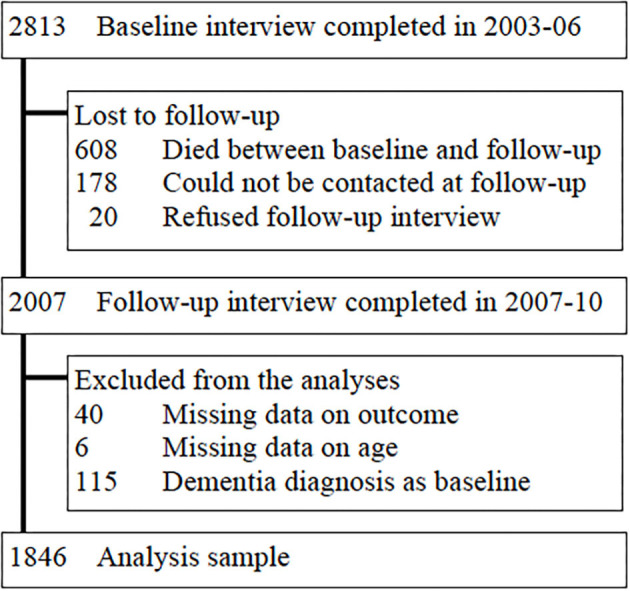
Little is known about risk factors of dementia in Latin American countries. We aimed to identify socio-demographic, health and lifestyle risk factors of incident dementia in Cuban older adults. Data were from 1,846 participants in the Cuban cohort of the 10/66 Dementia Research Group. Participants completed questionnaires, health examinations, and cognitive tests at baseline (2003-2006) and 4.5 years later (2007-2010). Associations between risk factors (baseline) and incident dementia (follow-up) were examined using logistic regression. Just over 9% of participants developed dementia. Overall, older age and low physical activity were associated with incident dementia. In those 65-74 years of age, depression, stroke and low physical activity were associated with incident dementia. In those ≥75 years of age, low physical activity, never eating fish, and smoking were associated with incident dementia. Modifiable lifestyle factors play an important role in developing dementia in Cuban older adults. This knowledge opens up opportunities for preventive strategies.
在拉丁美洲国家,人们对痴呆症的风险因素知之甚少。我们旨在确定古巴老年人中发生痴呆症的社会人口学、健康和生活方式风险因素。数据来自10/66痴呆症研究小组古巴队列中的1846名参与者。参与者在基线时(2003 - 2006年)以及4.5年后(2007 - 2010年)完成了问卷调查、健康检查和认知测试。使用逻辑回归分析风险因素(基线)与新发痴呆症(随访)之间的关联。略多于9%的参与者患上了痴呆症。总体而言,年龄较大和身体活动量低与新发痴呆症有关。在65 - 74岁的人群中,抑郁、中风和身体活动量低与新发痴呆症有关。在75岁及以上的人群中,身体活动量低、从不吃鱼和吸烟与新发痴呆症有关。可改变的生活方式因素在古巴老年人患痴呆症的过程中起着重要作用。这一认识为预防策略提供了机会。