Rose Maddison, Burgess Joshua T, O'Byrne Kenneth, Richard Derek J, Bolderson Emma
Cancer & Ageing Research Program, School of Biomedical Sciences, Institute of Health and Biomedical Innovation, Translational Research Institute, Queensland University of Technology, Brisbane, QLD, Australia.
Princess Alexandra Hospital, Brisbane, QLD, Australia.
Front Cell Dev Biol. 2020 Sep 9;8:564601. doi: 10.3389/fcell.2020.564601. eCollection 2020.
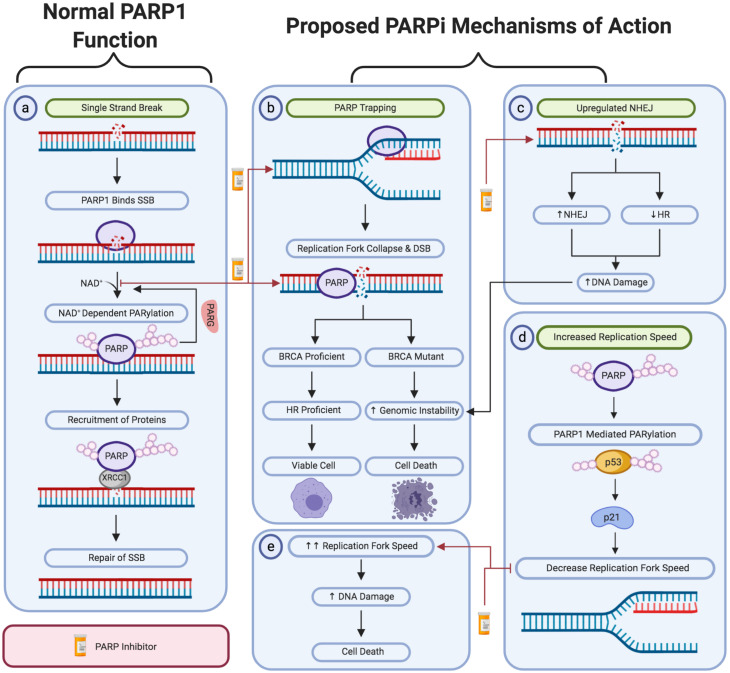
The Poly (ADP-ribose) polymerase (PARP) family has many essential functions in cellular processes, including the regulation of transcription, apoptosis and the DNA damage response. PARP1 possesses Poly (ADP-ribose) activity and when activated by DNA damage, adds branched PAR chains to facilitate the recruitment of other repair proteins to promote the repair of DNA single-strand breaks. PARP inhibitors (PARPi) were the first approved cancer drugs that specifically targeted the DNA damage response in BRCA1/2 mutated breast and ovarian cancers. Since then, there has been significant advances in our understanding of the mechanisms behind sensitization of tumors to PARP inhibitors and expansion of the use of PARPi to treat several other cancer types. Here, we review the recent advances in the proposed mechanisms of action of PARPi, biomarkers of the tumor response to PARPi, clinical advances in PARPi therapy, including the potential of combination therapies and mechanisms of tumor resistance.
聚(ADP - 核糖)聚合酶(PARP)家族在细胞过程中具有许多重要功能,包括转录调控、细胞凋亡和DNA损伤反应。PARP1具有聚(ADP - 核糖)活性,当被DNA损伤激活时,会添加分支的PAR链以促进其他修复蛋白的募集,从而促进DNA单链断裂的修复。PARP抑制剂(PARPi)是首批获批的专门针对BRCA1/2突变的乳腺癌和卵巢癌中DNA损伤反应的癌症药物。从那时起,我们对肿瘤对PARP抑制剂敏感化背后的机制的理解以及PARPi在治疗其他几种癌症类型中的应用扩展都取得了重大进展。在这里,我们综述了PARPi作用机制、肿瘤对PARPi反应的生物标志物、PARPi治疗的临床进展(包括联合治疗的潜力和肿瘤耐药机制)的最新进展。