Schmiege Dennis, Perez Arredondo Ana Maria, Ntajal Joshua, Minetto Gellert Paris Juliana, Savi Merveille Koissi, Patel Krupali, Yasobant Sandul, Falkenberg Timo
Center for Development Research (ZEF), University of Bonn, Genscherallee 3, 53113 Bonn, Germany.
Department of Geography, University of Bonn, Meckenheimer Allee 166, 53115 Bonn, Germany.
One Health. 2020 Dec;10:100170. doi: 10.1016/j.onehlt.2020.100170. Epub 2020 Sep 26.
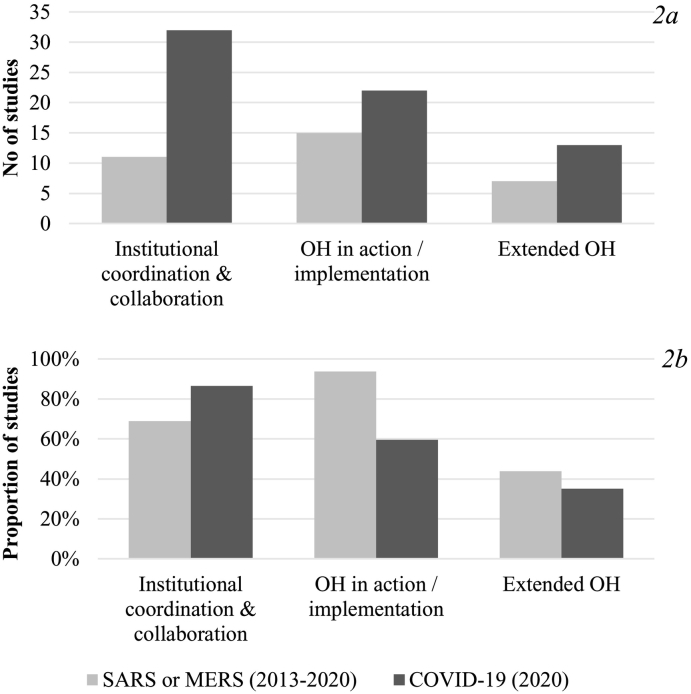
The ongoing coronavirus disease 2019 (COVID-19) pandemic threatens global health thereby causing unprecedented social, economic, and political disruptions. One way to prevent such a pandemic is through interventions at the human-animal-environment interface by using an integrated One Health (OH) approach. This systematic literature review documented the three coronavirus outbreaks, i.e. SARS, MERS, COVID-19, to evaluate the evolution of the OH approach, including the identification of key OH actions taken for prevention, response, and control. The OH understandings identified were categorized into three distinct patterns: institutional coordination and collaboration, OH in action/implementation, and extended OH (i.e. a clear involvement of the environmental domain). Across all studies, OH was most often framed as OH in action/implementation and least often in its extended meaning. Utilizing OH as institutional coordination and collaboration and the extended OH both increased over time. OH actions were classified into twelve sub-groups and further categorized as classical OH actions (i.e. at the human-animal interface), classical OH actions with outcomes to the environment, and extended OH actions. The majority of studies focused on human-animal interaction, giving less attention to the natural and built environment. Different understandings of the OH approach in practice and several practical limitations might hinder current efforts to achieve the operationalization of OH by combining institutional coordination and collaboration with specific OH actions. The actions identified here are a valuable starting point for evaluating the stage of OH development in different settings. This study showed that by moving beyond the classical OH approach and its actions towards a more extended understanding, OH can unfold its entire capacity thereby improving preparedness and mitigating the impacts of the next outbreak.
持续的2019冠状病毒病(COVID-19)大流行威胁着全球健康,从而造成了前所未有的社会、经济和政治混乱。预防此类大流行的一种方法是通过采用综合的“同一健康”(OH)方法,在人类-动物-环境界面进行干预。这项系统的文献综述记录了三次冠状病毒爆发,即严重急性呼吸综合征(SARS)、中东呼吸综合征(MERS)、COVID-19,以评估OH方法的演变,包括确定为预防、应对和控制采取的关键OH行动。确定的OH理解分为三种不同模式:机构协调与合作、行动/实施中的OH以及扩展的OH(即环境领域的明确参与)。在所有研究中,OH最常被界定为行动/实施中的OH,而在其扩展意义上的界定最少。随着时间的推移,将OH用作机构协调与合作以及扩展的OH的情况都有所增加。OH行动被分为12个子组,并进一步归类为经典OH行动(即在人类-动物界面)、对环境有影响的经典OH行动以及扩展的OH行动。大多数研究关注人类与动物的相互作用,而对自然环境和人造环境的关注较少。在实践中对OH方法的不同理解以及一些实际限制可能会阻碍当前通过将机构协调与合作与特定的OH行动相结合来实现OH操作化的努力。这里确定的行动是评估不同环境中OH发展阶段的宝贵起点。这项研究表明,通过超越经典的OH方法及其行动,转向更广泛的理解,OH可以充分发挥其全部能力,从而提高防范能力并减轻下一次疫情的影响。