Wadhwa Vaibhav, Alagappan Muthuraman, Gonzalez Adalberto, Gupta Kapil, Brown Jeremy R Glissen, Cohen Jonah, Sawhney Mandeep, Pleskow Douglas, Berzin Tyler M
Department of Gastroenterology and Hepatology, Cleveland Clinic Florida, Weston, Florida, United States.
Center for Advanced Endoscopy, Beth Israel Deaconess Medical Center/Harvard Medical School, Boston, Massachusetts, United States.
Endosc Int Open. 2020 Oct;8(10):E1379-E1384. doi: 10.1055/a-1223-1926. Epub 2020 Sep 22.
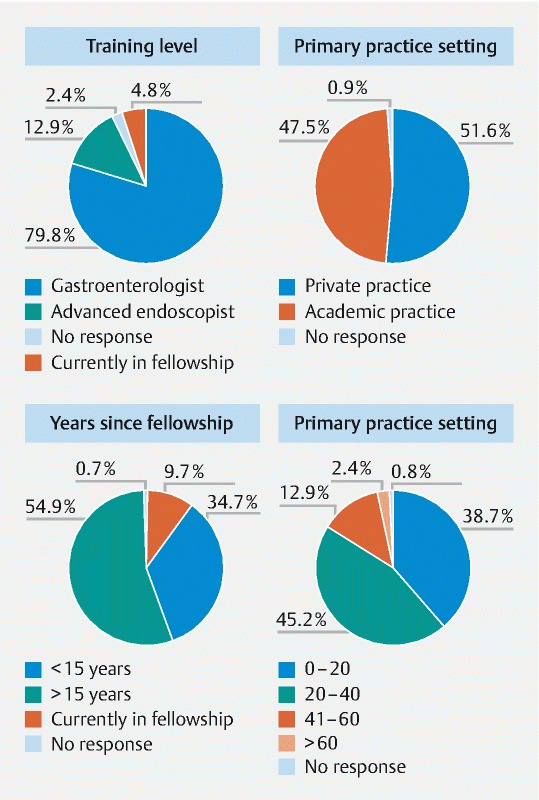
Early studies have shown that artificial intelligence (AI) has the potential to augment the performance of gastroenterologists during endoscopy. Our aim was to determine how gastroenterologists view the potential role of AI in gastrointestinal endoscopy. In this cross-sectional study, an online survey was sent to US gastroenterologists. The survey included questions about physician level of training, experience, and practice characteristics and physician perception of AI. Descriptive statistics were used to summarize sentiment about AI. Univariate and multivariate analyses were used to assess whether background information about physicians correlated to their sentiment. Surveys were emailed to 330 gastroenterologists nationwide. Between December 2018 and January 2019, 124 physicians (38 %) completed the survey. Eighty-six percent of physicians reported interest in AI-assisted colonoscopy; 84.7 % agreed that computer-assisted polyp detection (CADe) would improve their endoscopic performance. Of the respondents, 57.2 % felt comfortable using computer-aided diagnosis (CADx) to support a "diagnose and leave" strategy for hyperplastic polyps. Multivariate analysis showed that post-fellowship experience of fewer than 15 years was the most important factor in determining whether physicians were likely to believe that CADe would lead to more removed polyps (odds ratio = 5.09; = .01). The most common concerns about implementation of AI were cost (75.2 %), operator dependence (62.8 %), and increased procedural time (60.3 %). Gastroenterologists have strong interest in the application of AI to colonoscopy, particularly with regard to CADe for polyp detection. The primary concerns were its cost, potential to increase procedural time, and potential to develop operator dependence. Future developments in AI should prioritize mitigation of these concerns.
早期研究表明,人工智能(AI)有潜力在内镜检查过程中提升胃肠病学家的表现。我们的目的是确定胃肠病学家如何看待AI在胃肠内镜检查中的潜在作用。在这项横断面研究中,向美国胃肠病学家发送了一份在线调查问卷。该调查包括有关医生培训水平、经验、执业特点以及医生对AI的看法等问题。使用描述性统计来总结对AI的看法。单因素和多因素分析用于评估医生的背景信息是否与其看法相关。调查问卷通过电子邮件发送给全国330名胃肠病学家。在2018年12月至2019年1月期间,124名医生(38%)完成了调查。86%的医生表示对AI辅助结肠镜检查感兴趣;84.7%的医生同意计算机辅助息肉检测(CADe)会提高他们的内镜检查表现。在受访者中,57.2%的人对使用计算机辅助诊断(CADx)来支持增生性息肉的“诊断后离开”策略感到放心。多因素分析表明, fellowship后少于15年的经验是决定医生是否可能认为CADe会导致切除更多息肉的最重要因素(优势比 = 5.09;P = 0.01)。对AI实施的最常见担忧是成本(75.2%)、对操作者的依赖(62.8%)和检查时间增加(60.3%)。胃肠病学家对AI在结肠镜检查中的应用有浓厚兴趣,特别是在用于息肉检测的CADe方面。主要担忧是其成本、可能增加检查时间以及可能产生对操作者的依赖。AI的未来发展应优先缓解这些担忧。