• 文献检索
  • 文档翻译
  • 深度研究
  • 学术资讯
  • Suppr Zotero 插件Zotero 插件
  • 邀请有礼
  • 套餐&价格
  • 历史记录
应用&插件
Suppr Zotero 插件Zotero 插件浏览器插件Mac 客户端Windows 客户端微信小程序
定价
高级版会员购买积分包购买API积分包
服务
文献检索文档翻译深度研究API 文档MCP 服务
关于我们
关于 Suppr公司介绍联系我们用户协议隐私条款
关注我们

Suppr 超能文献

核心技术专利:CN118964589B侵权必究
粤ICP备2023148730 号-1Suppr @ 2026

文献检索

告别复杂PubMed语法,用中文像聊天一样搜索,搜遍4000万医学文献。AI智能推荐,让科研检索更轻松。

立即免费搜索

文件翻译

保留排版,准确专业,支持PDF/Word/PPT等文件格式,支持 12+语言互译。

免费翻译文档

深度研究

AI帮你快速写综述,25分钟生成高质量综述,智能提取关键信息,辅助科研写作。

立即免费体验

沙特四大医院医护人员对儿科患者使用止痛和退烧药的看法及认知。

Healthcare professionals' views and perceptions of analgesic and antipyretic use in paediatric patients in four major Saudi hospitals.

作者信息

Tobaiqy Mansour, Radwi Mansoor, Attieh Zouhair, Almalki Ashwaq M, Alhasan Ahmed H

机构信息

Department of Pharmacology, College of Medicine, University of Jeddah, Saudi Arabia.

Department of Haematology, College of Medicine, University of Jeddah, Saudi Arabia.

出版信息

Heliyon. 2020 Sep 28;6(9):e05073. doi: 10.1016/j.heliyon.2020.e05073. eCollection 2020 Sep.

DOI:10.1016/j.heliyon.2020.e05073
PMID:33015398
原文链接:https://pmc.ncbi.nlm.nih.gov/articles/PMC7522381/
Abstract

BACKGROUND

Antipyretics and analgesics, including non-steroidal anti-inflammatory drugs, are medications commonly used in the Kingdom of Saudi Arabia (KSA) and elsewhere to manage fever and pain in the paediatric age group.Research work investigating misuse of these medications in paediatric populations and pertinent healthcare professionals' (HCPs) perceptions as a major determinant of the severity of these errors is scarce.

OBJECTIVES

The aim of this study was to explore the perceptions of HCPs about analgesic and antipyretic use in paediatric patients at four major hospitals in Jeddah, KSA. The study also sought to explore factors believed by HCPs to be associated with occurrence of medication errors and adverse drug reactions (ADRs) due to analgesic and antipyretic use.

METHODS

A cross-sectional survey employing a pre-piloted online questionnaire with an information sheet was delivered to HCPs in four hospitals in the western region of KSA. The questionnaire comprised a mix of a tick list and open and closed questions with Likert scales for attitudinal statements, and it also comprised items including demographics, healthcare professions and the respondents' work experience, HCPs' views and perceptions relating to occurrence of ADRs and medication errors in children who attended the hospital in the preceding three months and the severity and outcomes of the ADRs.

RESULTS

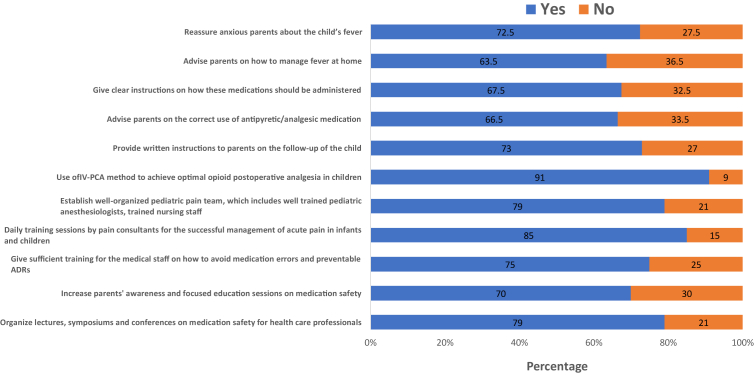
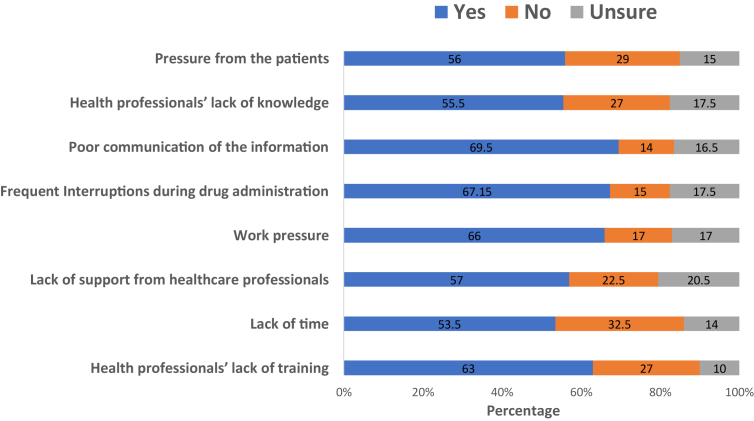
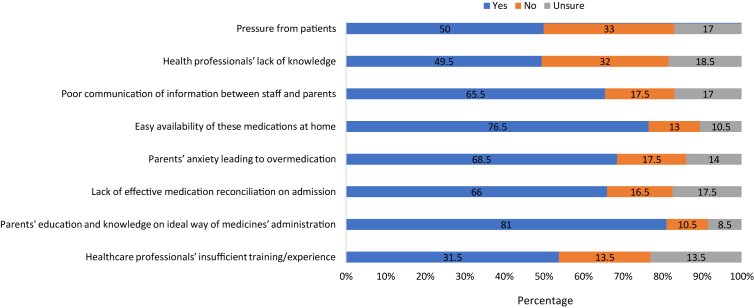
Two-hundred seventy-four HCPs were approached, and 200 agreed to participate, yielding a response rate of 73%, including physicians (50%), nurses (24.5%), and pharmacists (16.5%).The majority of HCPs reported that ADRs could be minimized with appropriate actions. They believed that their lack of experience may have contributed to ADRs. Most HCPs (81%) reported that parental knowledge was a key factor contributing to the decreased occurrence of ADRs in children. They also believed that other factors contributed to the occurrence of ADRs, such as lack of reconciliation (65%), parents' anxiety leading to overmedication (69%) and the easy availability of these medications at home (77%).Twenty-nine respondents (n = 29, 14.5%) reported medication errors related to the use of analgesics or antipyretics. Specifically, they reported that possible contributing factors included poor communication of information (69.5%); interruptions (67.5%) and work pressure (66.0%).

CONCLUSION

HCPs reported that ADRs and medication errors related to using analgesics and antipyretics in paediatric patients are not uncommon. In their opinion, several factors were associated with occurrence of these events, including parental knowledge about medications and insufficient training of HCPs.

摘要

背景

退热药和镇痛药,包括非甾体抗炎药,是沙特阿拉伯王国(KSA)和其他地区常用于治疗儿童发热和疼痛的药物。针对这些药物在儿科人群中的误用情况以及相关医疗保健专业人员(HCPs)的认知作为这些错误严重程度的主要决定因素的研究工作很少。

目的

本研究的目的是探讨吉达市四家主要医院的HCPs对儿科患者使用镇痛药和退热药的看法。该研究还试图探究HCPs认为与因使用镇痛药和退热药而发生的用药错误和药物不良反应(ADR)相关的因素。

方法

采用预先试点的在线问卷并附带信息表,对沙特阿拉伯王国西部地区四家医院的HCPs进行横断面调查。问卷包括勾选清单、开放式和封闭式问题以及用于态度陈述的李克特量表,还包括人口统计学、医疗职业、受访者工作经验、HCPs对前三个月到医院就诊儿童发生ADR和用药错误的看法和认知,以及ADR的严重程度和结果等项目。

结果

共接触了274名HCPs,200人同意参与,回复率为73%,其中包括医生(50%)、护士(24.5%)和药剂师(16.5%)。大多数HCPs报告称,通过适当措施可将ADR降至最低。他们认为自身经验不足可能导致了ADR。大多数HCPs(81%)报告称,家长的认知是减少儿童ADR发生的关键因素。他们还认为其他因素也导致了ADR的发生,如缺乏用药核对(65%)、家长焦虑导致用药过量(69%)以及这些药物在家中容易获取(77%)。29名受访者(n = 29,14.5%)报告了与使用镇痛药或退热药相关的用药错误。具体而言,他们报告称可能的促成因素包括信息沟通不畅(69.5%)、干扰(67.5%)和工作压力(66.0%)。

结论

HCPs报告称,儿科患者使用镇痛药和退热药相关的ADR和用药错误并不罕见。在他们看来,这些事件的发生与多个因素相关,包括家长对药物的认知以及HCPs培训不足。
https://cdn.ncbi.nlm.nih.gov/pmc/blobs/0b04/7522381/b4de4b2e4aca/gr3.jpg
https://cdn.ncbi.nlm.nih.gov/pmc/blobs/0b04/7522381/fd901c9d039f/gr1.jpg
https://cdn.ncbi.nlm.nih.gov/pmc/blobs/0b04/7522381/a96f6068dfe7/gr2.jpg
https://cdn.ncbi.nlm.nih.gov/pmc/blobs/0b04/7522381/b4de4b2e4aca/gr3.jpg
https://cdn.ncbi.nlm.nih.gov/pmc/blobs/0b04/7522381/fd901c9d039f/gr1.jpg
https://cdn.ncbi.nlm.nih.gov/pmc/blobs/0b04/7522381/a96f6068dfe7/gr2.jpg
https://cdn.ncbi.nlm.nih.gov/pmc/blobs/0b04/7522381/b4de4b2e4aca/gr3.jpg

相似文献

1
Healthcare professionals' views and perceptions of analgesic and antipyretic use in paediatric patients in four major Saudi hospitals.沙特四大医院医护人员对儿科患者使用止痛和退烧药的看法及认知。
Heliyon. 2020 Sep 28;6(9):e05073. doi: 10.1016/j.heliyon.2020.e05073. eCollection 2020 Sep.
2
Parental Experience of Potential Adverse Drug Reactions Related to Their Oral Administration of Antipyretic Analgesic Medicines in Children in Saudi Arabia.沙特阿拉伯父母关于其给孩子口服解热镇痛药相关潜在药物不良反应的经历。
Curr Ther Res Clin Exp. 2020 Jun 20;92:100592. doi: 10.1016/j.curtheres.2020.100592. eCollection 2020.
3
Medication Error Concept and Reporting Practices in Saudi Arabia: A Multiregional Study Among Healthcare Professionals.沙特阿拉伯的用药错误概念与报告实践:一项针对医疗保健专业人员的多地区研究
Risk Manag Healthc Policy. 2021 Jun 4;14:2395-2406. doi: 10.2147/RMHP.S281154. eCollection 2021.
4
Knowledge, attitudes & practices of healthcare professionals in hospitals towards the reporting of adverse drug reactions in Saudi Arabia: A multi-centre cross sectional study.沙特阿拉伯医院医护人员对药品不良反应报告的知识、态度和做法:一项多中心横断面研究。
Saudi Pharm J. 2018 Nov;26(7):925-931. doi: 10.1016/j.jsps.2018.04.012. Epub 2018 Apr 26.
5
Knowledge, Attitude, and Barriers Toward ADRs Reporting Among Health-Care Professionals at Tertiary Care Health Settings in Peshawar, Pakistan: A Web Based Study.巴基斯坦白沙瓦三级医疗保健机构医护人员对药品不良反应报告的认知、态度及障碍:一项基于网络的研究
Hosp Pharm. 2021 Aug;56(4):384-391. doi: 10.1177/0018578720910401. Epub 2020 Apr 21.
6
Healthcare professionals' knowledge, attitude and acceptance of influenza vaccination in Saudi Arabia: a multicenter cross-sectional study.沙特阿拉伯医疗保健专业人员对流感疫苗接种的知识、态度和接受度:一项多中心横断面研究。
BMC Health Serv Res. 2019 Apr 15;19(1):229. doi: 10.1186/s12913-019-4054-9.
7
Evaluation of patient reporting of adverse drug reactions to the UK 'Yellow Card Scheme': literature review, descriptive and qualitative analyses, and questionnaire surveys.评估患者向英国“黄卡计划”报告药物不良反应的情况:文献回顾、描述性和定性分析以及问卷调查。
Health Technol Assess. 2011 May;15(20):1-234, iii-iv. doi: 10.3310/hta15200.
8
Healthcare Professionals' Views on the Management of Medication Complexities in the Elderly With Mental Health Disorders: A Cross-Sectional Study.医疗保健专业人员对患有精神健康障碍的老年人用药复杂性管理的看法:一项横断面研究。
Front Psychiatry. 2022 May 23;13:885216. doi: 10.3389/fpsyt.2022.885216. eCollection 2022.
9
Knowledge and attitude of health-care professionals in hospitals towards pharmacovigilance in Saudi Arabia.沙特阿拉伯医院医护人员对药物警戒的认知与态度。
Int J Clin Pharm. 2015 Dec;37(6):1104-10. doi: 10.1007/s11096-015-0165-5. Epub 2015 Jul 28.
10
Medication Misadventures Among COVID-19 Patients in Saudi Arabia.沙特阿拉伯新冠肺炎患者的用药不良事件
Cureus. 2021 Jun 8;13(6):e15513. doi: 10.7759/cureus.15513. eCollection 2021 Jun.

引用本文的文献

1
Assessment of the Community Pharmacists' Knowledge and Attitudes Toward Pain and Pain Management in Saudi Arabia.沙特阿拉伯社区药剂师对疼痛及疼痛管理的知识与态度评估
Int J Gen Med. 2022 Dec 7;15:8527-8537. doi: 10.2147/IJGM.S387066. eCollection 2022.

本文引用的文献

1
General public's perspectives of issues relating to misuse of medicines: a cross-sectional survey in Jeddah, Saudi Arabia.公众对与药物滥用相关问题的看法:沙特阿拉伯吉达的一项横断面调查。
Int J Clin Pharm. 2019 Oct;41(5):1148-1151. doi: 10.1007/s11096-019-00893-5. Epub 2019 Oct 1.
2
Top 10 most used drugs in the Kingdom of Saudi Arabia 2010-2015.2010 - 2015年沙特阿拉伯王国使用最频繁的十大药物。
Saudi Pharm J. 2018 Feb;26(2):211-216. doi: 10.1016/j.jsps.2017.12.009. Epub 2017 Dec 15.
3
Analgesic antipyretic use among young children in the TEDDY study: no association with islet autoimmunity.
TEDDY研究中幼儿的解热镇痛药物使用情况:与胰岛自身免疫无关。
BMC Pediatr. 2017 May 16;17(1):127. doi: 10.1186/s12887-017-0884-y.
4
A clinical and safety review of paracetamol and ibuprofen in children.对乙酰氨基酚和布洛芬在儿童中的临床与安全性综述
Inflammopharmacology. 2017 Feb;25(1):1-9. doi: 10.1007/s10787-016-0302-3. Epub 2017 Jan 6.
5
Attention to postoperative pain control in children.关注儿童术后疼痛控制。
Korean J Anesthesiol. 2014 Mar;66(3):183-8. doi: 10.4097/kjae.2014.66.3.183. Epub 2014 Mar 28.
6
Exploring health professionals' experiences of medication errors in Saudi Arabia.探索沙特阿拉伯卫生专业人员在药物错误方面的经验。
Int J Clin Pharm. 2013 Aug;35(4):542-5. doi: 10.1007/s11096-013-9781-0. Epub 2013 May 7.
7
Accuracy of acetaminophen dosing in children by caregivers in Saudi Arabia.沙特阿拉伯护理人员给儿童服用对乙酰氨基酚剂量的准确性。
Ann Saudi Med. 2011 Sep-Oct;31(5):513-7. doi: 10.4103/0256-4947.84630.
8
Fever and antipyretic use in children.儿童发热与解热药使用。
Pediatrics. 2011 Mar;127(3):580-7. doi: 10.1542/peds.2010-3852. Epub 2011 Feb 28.
9
Paracetamol plus ibuprofen for the treatment of fever in children (PITCH): randomised controlled trial.对乙酰氨基酚加布洛芬治疗儿童发热(PITCH):随机对照试验
BMJ. 2008 Sep 2;337:a1302. doi: 10.1136/bmj.a1302.
10
Adverse drug reactions to nonsteroidal anti-inflammatory drugs, COX-2 inhibitors and paracetamol in a paediatric hospital.一家儿科医院中对非甾体抗炎药、COX-2抑制剂和扑热息痛的药物不良反应
Br J Clin Pharmacol. 2005 Jun;59(6):718-23. doi: 10.1111/j.1365-2125.2005.02444.x.