Lundgren Markus, Steed Leigh Johnson, Tamura Roy, Jonsdottir Berglind, Gesualdo Patricia, Crouch Claire, Sjöberg Maija, Hansson Gertie, Hagopian William A, Ziegler Anette G, Rewers Marian J, Lernmark Åke, Toppari Jorma, She Jin-Xiong, Akolkar Beena, Krischer Jeffrey P, Haller Michael J, Elding Larsson Helena
Department of Clinical Sciences, Diabetes and Celiac disease unit, Lund University, Clinical Research Centre, Jan Waldenströms gata 35, 205 02, Malmö, Sweden.
Center for Biotechnology and Genomic Medicine, Medical College of Georgia, Augusta University, Augusta, GA, USA.
BMC Pediatr. 2017 May 16;17(1):127. doi: 10.1186/s12887-017-0884-y.
The use of analgesic antipyretics (ANAP) in children have long been a matter of controversy. Data on their practical use on an individual level has, however, been scarce. There are indications of possible effects on glucose homeostasis and immune function related to the use of ANAP. The aim of this study was to analyze patterns of analgesic antipyretic use across the clinical centers of The Environmental Determinants of Diabetes in the Young (TEDDY) prospective cohort study and test if ANAP use was a risk factor for islet autoimmunity.
Data were collected for 8542 children in the first 2.5 years of life. Incidence was analyzed using logistic regression with country and first child status as independent variables. Holm's procedure was used to adjust for multiplicity of intercountry comparisons. Time to autoantibody seroconversion was analyzed using a Cox proportional hazards model with cumulative analgesic use as primary time dependent covariate of interest. For each categorization, a generalized estimating equation (GEE) approach was used.
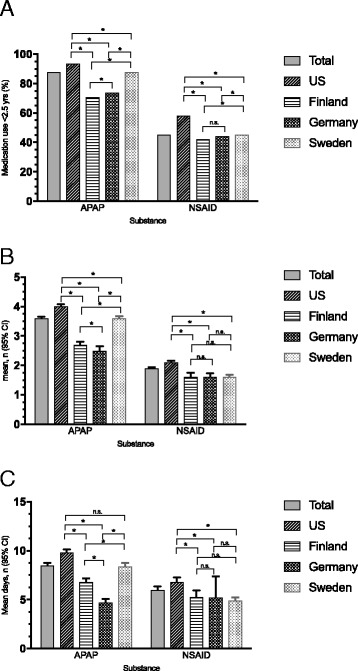
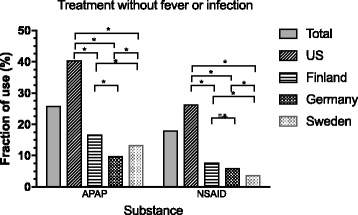
Higher prevalence of ANAP use was found in the U.S. (95.7%) and Sweden (94.8%) compared to Finland (78.1%) and Germany (80.2%). First-born children were more commonly given acetaminophen (OR 1.26; 95% CI 1.07, 1.49; p = 0.007) but less commonly Non-Steroidal Anti-inflammatory Drugs (NSAID) (OR 0.86; 95% CI 0.78, 0.95; p = 0.002). Acetaminophen and NSAID use in the absence of fever and infection was more prevalent in the U.S. (40.4%; 26.3% of doses) compared to Sweden, Finland and Germany (p < 0.001). Acetaminophen or NSAID use before age 2.5 years did not predict development of islet autoimmunity by age 6 years (HR 1.02, 95% CI 0.99-1.09; p = 0.27). In a sub-analysis, acetaminophen use in children with fever weakly predicted development of islet autoimmunity by age 3 years (HR 1.05; 95% CI 1.01-1.09; p = 0.024).
ANAP use in young children is not a risk factor for seroconversion by age 6 years. Use of ANAP is widespread in young children, and significantly higher in the U.S. compared to other study sites, where use is common also in absence of fever and infection.
长期以来,儿童使用解热镇痛药一直存在争议。然而,关于其在个体层面实际使用的数据却很稀少。有迹象表明,使用解热镇痛药可能会对葡萄糖稳态和免疫功能产生影响。本研究的目的是分析青少年糖尿病环境决定因素(TEDDY)前瞻性队列研究各临床中心解热镇痛药的使用模式,并检验使用解热镇痛药是否是胰岛自身免疫的危险因素。
收集了8542名儿童出生后头2.5年的数据。使用逻辑回归分析发病率,将国家和是否为头胎作为自变量。采用霍尔姆方法对国家间比较的多重性进行校正。使用Cox比例风险模型分析自身抗体血清转化时间,将累计解热镇痛药使用量作为主要的时间依赖性感兴趣协变量。对于每种分类,采用广义估计方程(GEE)方法。
与芬兰(78.1%)和德国(80.2%)相比,美国(95.7%)和瑞典(94.8%)的解热镇痛药使用率更高。头胎儿童更常使用对乙酰氨基酚(比值比1.26;95%置信区间1.07,1.49;p = 0.007),但较少使用非甾体抗炎药(NSAID)(比值比0.86;95%置信区间0.78,0.95;p = 0.002)。与瑞典、芬兰和德国相比,美国在无发热和感染情况下使用对乙酰氨基酚和NSAID更为普遍(40.4%;剂量的26.3%)(p < 0.001)。2.5岁前使用对乙酰氨基酚或NSAID并不能预测6岁时胰岛自身免疫的发生(风险比1.02,95%置信区间0.99 - 1.09;p = 0.27)。在一项亚分析中,发热儿童使用对乙酰氨基酚与3岁时胰岛自身免疫的发生有较弱的相关性(风险比1.05;95%置信区间1.01 - 1.09;p = 0.024)。
幼儿使用解热镇痛药不是6岁时血清转化的危险因素。解热镇痛药在幼儿中广泛使用,美国的使用率显著高于其他研究地点,在其他地点,即使无发热和感染时使用也很普遍。