School of Nursing & Midwifery, Deakin University, Geelong, Australia; Nursing Services, Alfred Health, Melbourne, Australia.
School of Engineering, Faculty of Science, Engineering and Built Environment, Deakin University, Geelong, Australia.
Am J Infect Control. 2021 May;49(5):597-602. doi: 10.1016/j.ajic.2020.09.012. Epub 2020 Oct 2.
NCIT are non-invasive devices for fever screening in children. However, evidence of their accuracy for fever screening in adults is lacking. This study aimed to compare the accuracy of non-contact infrared thermometers (NCIT) with temporal artery thermometers (TAT) in an adult hospital.
A prospective observational study was conducted on a convenience sample of non-infectious inpatients in 2 Australian hospitals. NCIT and TAT devices were used to collect body temperature recordings. Participant characteristics included age, gender, skin color, highest temperature, and antipyretic medications recorded in last 24-hour.
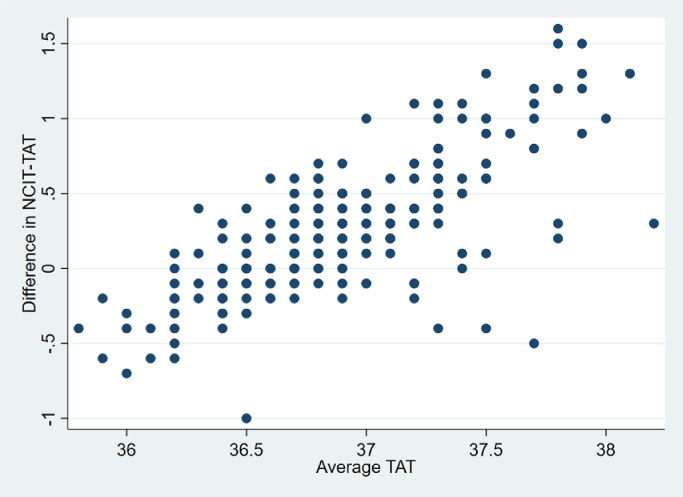
In 265 patients, a mean difference of ± 0.26°C was recorded between the NCIT (36.64°C) and the reference TAT (36.90°C) temperature devices. Bland-Altman analysis showed that NCIT and TAT temperatures were closely aligned at temperatures <37.5°C, but not at temperatures >37.5°C. NCIT had low sensitivity (16.13%) at temperatures ≥37.5°C. An AUROC score of 0.67 (SD 0.05) demonstrated poor accuracy of the NCIT device at temperatures ≥37.5°C.
This is the first study to compare accuracy of NCIT thermometers to TAT in adult patients. Although mass fever screening is currently underway using NCIT, these results indicate that the NCIT may not be the most accurate device for fever mass screening during a pandemic.
NCIT 是非侵入性的儿童发热筛查设备。然而,缺乏其在成人发热筛查中准确性的证据。本研究旨在比较非接触式红外体温计(NCIT)与颞动脉体温计(TAT)在成人医院中的准确性。
在澳大利亚的两家医院,对非传染性住院患者进行了一项前瞻性观察性研究。使用 NCIT 和 TAT 设备采集体温记录。参与者特征包括年龄、性别、肤色、最高体温和过去 24 小时内使用的退热药物。
在 265 名患者中,NCIT(36.64°C)和参考 TAT(36.90°C)温度设备之间记录的平均差值为±0.26°C。Bland-Altman 分析表明,在体温<37.5°C 时,NCIT 和 TAT 温度紧密一致,但在体温>37.5°C 时则不一致。NCIT 在体温≥37.5°C 时的敏感性较低(16.13%)。AUROC 评分为 0.67(SD 0.05),表明在体温≥37.5°C 时 NCIT 设备的准确性较差。
这是第一项比较 NCIT 体温计与 TAT 在成人患者中的准确性的研究。尽管目前正在使用 NCIT 进行大规模发热筛查,但这些结果表明,在大流行期间,NCIT 可能不是大规模发热筛查的最准确设备。