Division of Applied Mechanics, Office of Science and Engineering Laboratories, Center for Devices and Radiological Health, United States Food and Drug Administration, 10903 New Hampshire Ave, Silver Spring, MD, 20993, USA.
University of Maryland Baltimore County, Baltimore, MD, USA.
Sci Rep. 2021 Nov 11;11(1):22079. doi: 10.1038/s41598-021-99300-1.
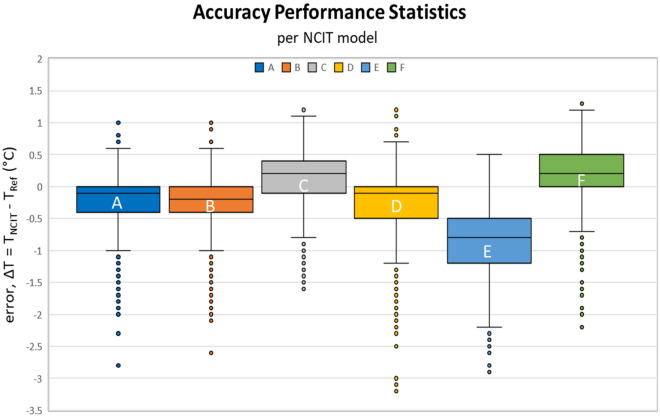
Non-contact infrared thermometers (NCITs) are being widely used during the COVID-19 pandemic as a temperature-measurement tool for screening and isolating patients in healthcare settings, travelers at ports of entry, and the general public. To understand the accuracy of NCITs, a clinical study was conducted with 1113 adult subjects using six different commercially available NCIT models. A total of 60 NCITs were tested with 10 units for each model. The NCIT-measured temperature was compared with the oral temperature obtained using a reference oral thermometer. The mean difference between the reference thermometer and NCIT measurement (clinical bias) was different for each NCIT model. The clinical bias ranged from just under - 0.9 °C (under-reporting) to just over 0.2 °C (over-reporting). The individual differences ranged from - 3 to + 2 °C in extreme cases, with the majority of the differences between - 2 and + 1 °C. Depending upon the NCIT model, 48% to 88% of the individual temperature measurements were outside the labeled accuracy stated by the manufacturers. The sensitivity of the NCIT models for detecting subject's temperature above 38 °C ranged from 0 to 0.69. Overall, our results indicate that some NCIT devices may not be consistently accurate enough to determine if subject's temperature exceeds a specific threshold of 38 °C. Model-to-model variability and individual model accuracy in the displayed temperature were found to be outside of acceptable limits. Accuracy and credibility of the NCITs should be thoroughly evaluated before using them as an effective screening tool.
在 COVID-19 大流行期间,非接触式红外体温计(NCIT)被广泛用作医疗环境中筛查和隔离患者、入境口岸旅行者和公众的体温测量工具。为了了解 NCIT 的准确性,对 1113 名成年受试者进行了一项临床研究,使用了六种不同的市售 NCIT 模型。总共测试了 60 个 NCIT,每个模型有 10 个单位。NCIT 测量的温度与使用参考口腔温度计获得的口腔温度进行了比较。参考温度计和 NCIT 测量之间的平均差异(临床偏差)因每个 NCIT 模型而异。临床偏差因 NCIT 模型而异,范围从略低于-0.9°C(报告不足)到略高于 0.2°C(报告过度)。在极端情况下,个体差异从-3°C 到+2°C 不等,大多数差异在-2°C 到+1°C 之间。根据 NCIT 模型的不同,48%至 88%的个体温度测量值超出制造商规定的标记精度范围。NCIT 模型检测受试者体温超过 38°C 的灵敏度从 0 到 0.69 不等。总体而言,我们的研究结果表明,一些 NCIT 设备可能不够准确,无法确定受试者的体温是否超过 38°C 的特定阈值。发现模型之间的可变性和显示温度的个体模型准确性超出了可接受的范围。在将 NCIT 用作有效的筛查工具之前,应彻底评估其准确性和可信度。