Chia Loo Wee, Mank Marko, Blijenberg Bernadet, Aalvink Steven, Bongers Roger S, Stahl Bernd, Knol Jan, Belzer Clara
Laboratory of Microbiology, Wageningen University and Research, 6708 WE Wageningen, The Netherlands.
Danone Nutricia Research, 3584 CT Utrecht, The Netherlands.
Microorganisms. 2020 Oct 1;8(10):1513. doi: 10.3390/microorganisms8101513.
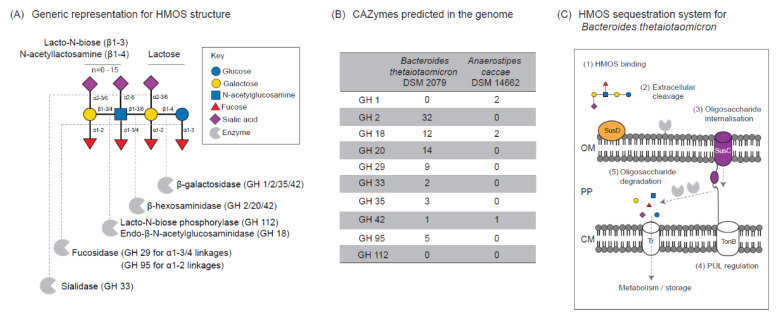
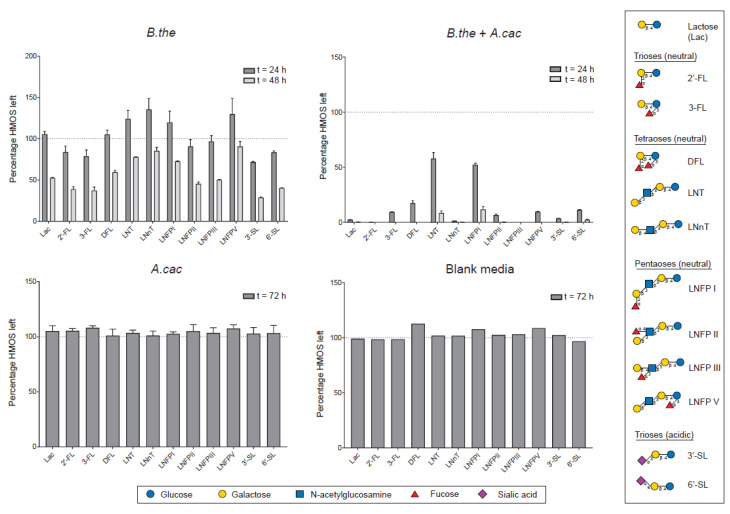
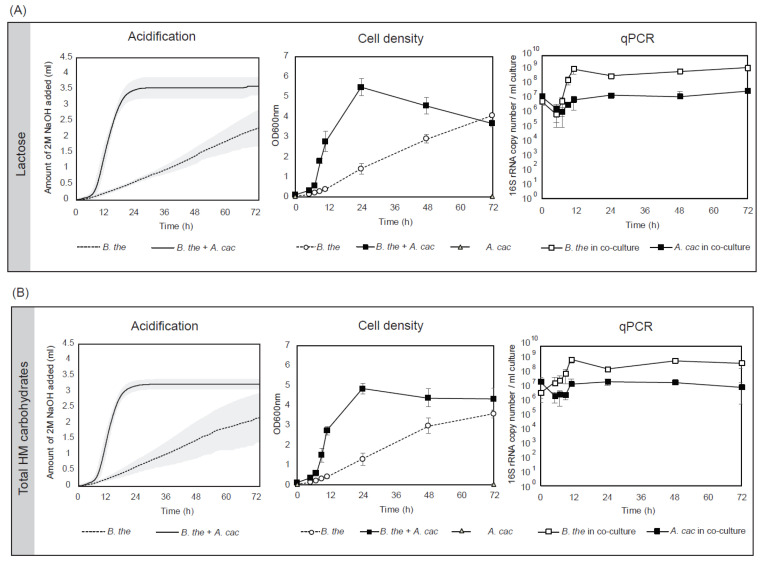
The development of infant gut microbiota is strongly influenced by nutrition. Human milk oligosaccharides (HMOSs) in breast milk selectively promote the growth of glycan-degrading microbes, which lays the basis of the microbial network. In this study, we investigated the trophic interaction between and the butyrate-producing in the presence of early-life carbohydrates. Anaerobic bioreactors were set up to study the monocultures of and the co-cultures of with in minimal media supplemented with lactose or a total human milk carbohydrate fraction. Bacterial growth (qPCR), metabolites (HPLC), and HMOS utilization (LC-ESI-MS) were monitored. displayed potent glycan catabolic capability with differential preference in degrading specific low molecular weight HMOSs, including the neutral trioses (2'-FL and 3-FL), neutral tetraoses (DFL, LNT, LNnT), neutral pentaoses (LNFP I, II, III, V), and acidic trioses (3'-SL and 6'-SL). In contrast, was not able to utilize lactose and HMOSs. However, the signature metabolite of , butyrate, was detected in co-culture with . As such, cross-fed on -derived monosaccharides, acetate, and d-lactate for growth and concomitant butyrate production. This study provides a proof of concept that could drive the butyrogenic metabolic network in the infant gut.
婴儿肠道微生物群的发育受到营养的强烈影响。母乳中的人乳寡糖(HMOSs)选择性地促进聚糖降解微生物的生长,这为微生物网络奠定了基础。在本研究中,我们研究了在早期碳水化合物存在的情况下,[具体菌种1]与产丁酸的[具体菌种2]之间的营养相互作用。建立厌氧生物反应器以研究[具体菌种1]的单培养以及[具体菌种1]与[具体菌种2]在补充乳糖或全人乳碳水化合物组分的基础培养基中的共培养。监测细菌生长(qPCR)、代谢产物(HPLC)和HMOS利用情况(LC-ESI-MS)。[具体菌种1]表现出强大的聚糖分解代谢能力,对降解特定的低分子量HMOSs有不同偏好,包括中性三糖(2'-FL和3-FL)、中性四糖(DFL、LNT、LNnT)、中性五糖(LNFP I、II、III、V)和酸性三糖(3'-SL和6'-SL)。相比之下,[具体菌种2]不能利用乳糖和HMOSs。然而,在与[具体菌种1]的共培养中检测到了[具体菌种2]的标志性代谢产物丁酸。因此,[具体菌种2]利用[具体菌种1]衍生的单糖、乙酸盐和d-乳酸进行生长并伴随产生丁酸。本研究提供了一个概念证明,即[具体菌种1]可以驱动婴儿肠道中的产丁酸代谢网络。