Department of Public and Occupational Health and Amsterdam Public Health research institute, Amsterdam UMC, Vrije Universiteit Amsterdam, Amsterdam, Netherlands.
Center of Expertise in Palliative Care, Amsterdam UMC, Vrije Universiteit Amsterdam, Amsterdam, The Netherlands.
BMJ Support Palliat Care. 2022 Sep;12(3):262-269. doi: 10.1136/bmjspcare-2020-002284. Epub 2020 Oct 5.
Patients with advanced diseases and frail older adults often face decisions regarding life-prolonging treatment. Our aim was to provide an overview of the feasibility and effectiveness of tools that support communication between healthcare professionals and patients regarding decisions on life-prolonging treatments in hospital settings.
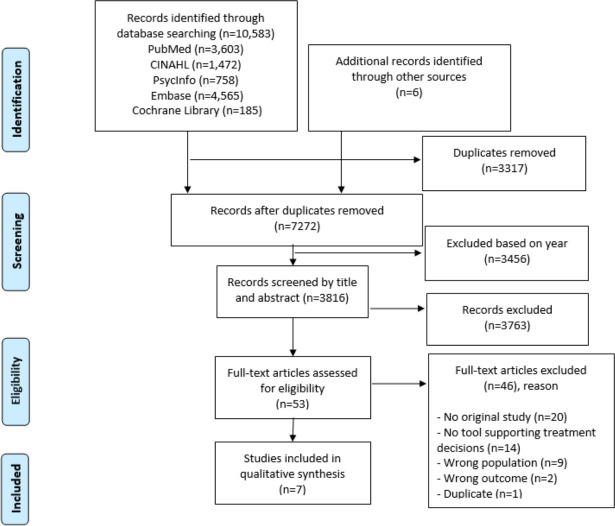
Systematic review: We searched PubMed, CINAHL, PsycINFO, Embase, Cochrane Library and Google Scholar (2009-2019) to identify studies that reported feasibility or effectiveness of tools that support communication about life-prolonging treatments in adult patients with advanced diseases or frail older adults in hospital settings. The Mixed Methods Appraisal Tool was used for quality appraisal of the included studies.
Seven studies were included, all involving patients with advanced cancer. The overall methodological quality of the included studies was moderate to high. Five studies described question prompt lists (QPLs), either as a stand-alone tool or as part of a multifaceted programme; two studies described decision aids (DAs). All QPLs and one DA were considered feasible by both patients with advanced cancer and healthcare professionals. Two studies reported on the effectiveness of QPL use, revealing a decrease in patient anxiety and an increase in cues for discussing end-of-life care with physicians. The effectiveness of one DA was reported; it led to more understanding of the treatment in patients.
Use of QPLs or DAs, as a single intervention or part of a programme, may help in communicating about treatment options with patients, which is an important precondition for making informed decisions.
患有晚期疾病和体弱老年人的患者经常面临有关延长生命治疗的决策。我们的目的是提供在医院环境中支持医疗保健专业人员与患者就延长生命治疗决策进行沟通的工具的可行性和有效性的概述。
系统评价:我们在 PubMed、CINAHL、PsycINFO、Embase、Cochrane 图书馆和 Google Scholar(2009-2019 年)中搜索了报告支持关于患有晚期疾病或体弱老年人的成年患者延长生命治疗的沟通的工具的可行性或有效性的研究。混合方法评估工具用于评估纳入研究的质量。
纳入了 7 项研究,均涉及晚期癌症患者。纳入研究的总体方法学质量为中等至高度。5 项研究描述了问题提示清单(QPL),无论是作为独立工具还是作为多方面计划的一部分;2 项研究描述了决策辅助工具(DA)。所有 QPL 和一个 DA 都被认为是可行的,既被晚期癌症患者,也被医疗保健专业人员所接受。有 2 项研究报告了 QPL 使用的效果,表明患者焦虑程度降低,与医生讨论临终关怀的线索增加。一项 DA 的有效性得到了报告;它使患者对治疗的理解有所增加。
作为单一干预措施或计划的一部分使用 QPL 或 DA,可能有助于与患者沟通治疗选择,这是做出明智决策的重要前提。