Department of Surgery, Memorial Sloan Kettering Cancer Center, New York, NY, USA.
Department of Pathology, Memorial Sloan Kettering Cancer Center, New York, NY, USA.
Mol Oncol. 2021 Apr;15(4):1024-1039. doi: 10.1002/1878-0261.12813. Epub 2021 Feb 19.
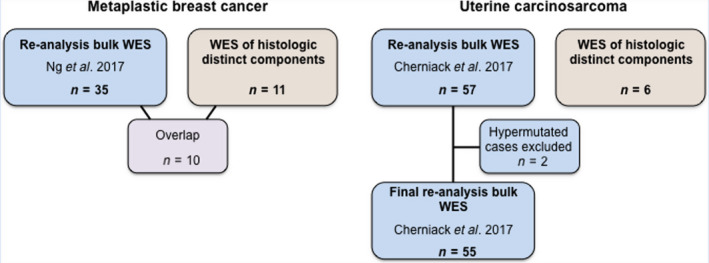
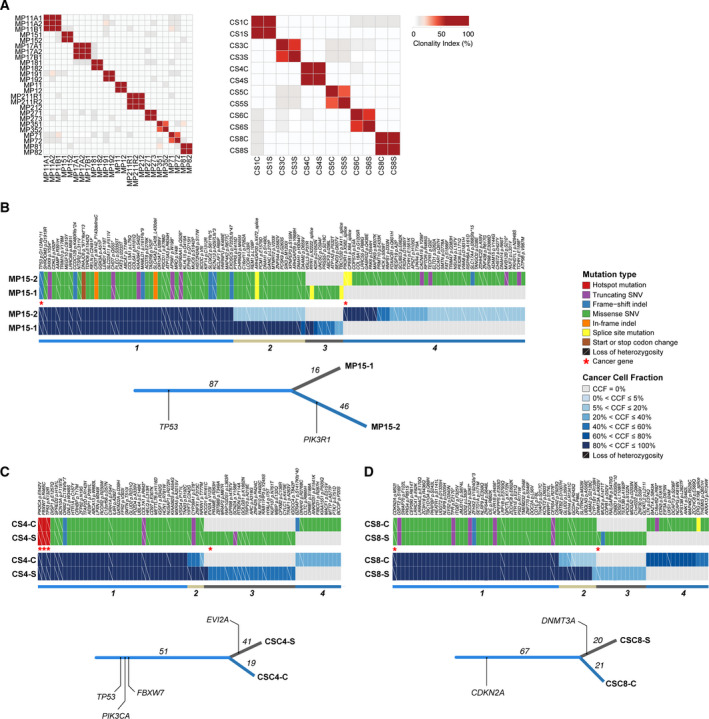
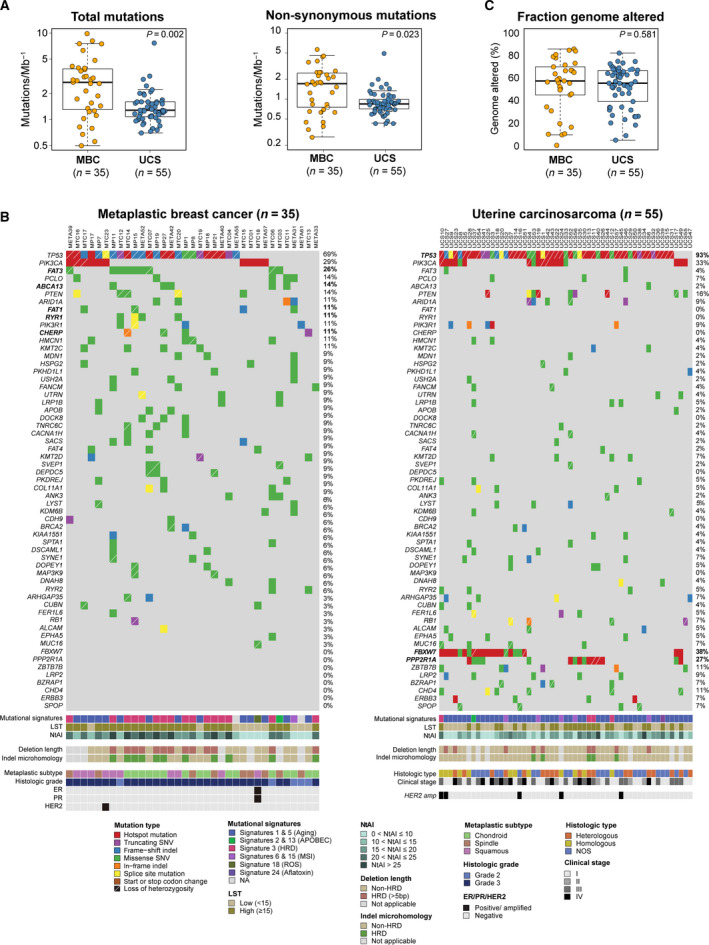
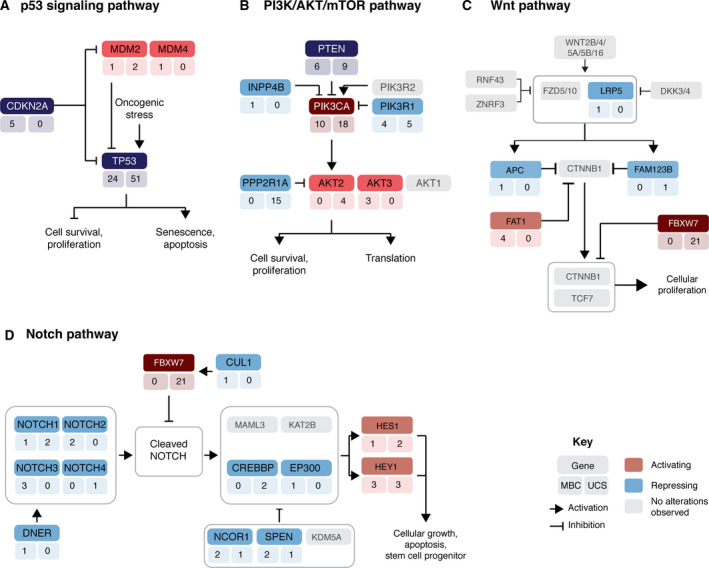
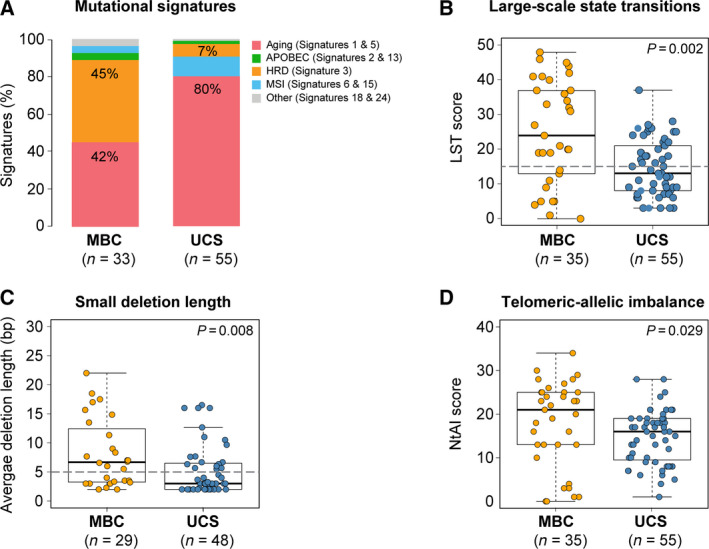
Metaplastic breast carcinoma (MBC) and uterine carcinosarcoma (UCS) are rare aggressive cancers, characterized by an admixture of adenocarcinoma and areas displaying mesenchymal/sarcomatoid differentiation. We sought to define whether MBCs and UCSs harbor similar patterns of genetic alterations, and whether the different histologic components of MBCs and UCSs are clonally related. Whole-exome sequencing (WES) data from MBCs (n = 35) and UCSs (n = 57, The Cancer Genome Atlas) were reanalyzed to define somatic genetic alterations, altered signaling pathways, mutational signatures, and genomic features of homologous recombination DNA repair deficiency (HRD). In addition, the carcinomatous and sarcomatous components of an additional cohort of MBCs (n = 11) and UCSs (n = 6) were microdissected separately and subjected to WES, and their clonal relatedness was assessed. MBCs and UCSs harbored recurrent genetic alterations affecting TP53, PIK3CA, and PTEN, similar patterns of gene copy number alterations, and an enrichment in alterations affecting the epithelial-to-mesenchymal transition (EMT)-related Wnt and Notch signaling pathways. Differences were observed, however, including a significantly higher prevalence of FAT3 and FAT1 somatic mutations in MBCs compared to UCSs, and conversely, UCSs significantly more frequently harbored somatic mutations affecting FBXW7 and PPP2R1A as well as HER2 amplification than MBCs. Genomic features of HRD and biallelic alterations affecting bona fide HRD-related genes were found to be more prevalent in MBCs than in UCSs. The distinct histologic components of MBCs and UCSs were clonally related in all cases, with the sarcoma component likely stemming from a minor subclone of the carcinoma component in the samples with interpretable chronology of clonal evolution. Despite the similar histologic features and pathways affected by genetic alterations, UCSs differ from MBCs on the basis of FBXW7 and PPP2R1A mutations, HER2 amplification, and lack of HRD, supporting the notion that these entities are more than mere phenocopies of the same tumor type in different anatomical sites.
化生性乳腺癌(MBC)和子宫癌肉瘤(UCS)是罕见的侵袭性癌症,其特征为腺癌和显示间叶/肉瘤样分化的区域混合存在。我们旨在确定 MBC 和 UCS 是否具有相似的遗传改变模式,以及 MBC 和 UCS 的不同组织学成分是否具有克隆相关性。对来自 MBC(n=35)和 UCS(n=57,癌症基因组图谱)的全外显子组测序(WES)数据进行重新分析,以确定体细胞遗传改变、改变的信号通路、突变特征和同源重组 DNA 修复缺陷(HRD)的基因组特征。此外,对另外一组 MBC(n=11)和 UCS(n=6)的癌性和肉瘤性成分进行单独显微解剖,并进行 WES,评估其克隆相关性。MBC 和 UCS 均存在影响 TP53、PIK3CA 和 PTEN 的复发性遗传改变,具有相似的基因拷贝数改变模式,并且上皮-间充质转化(EMT)相关 Wnt 和 Notch 信号通路的改变富集。然而,也观察到了一些差异,包括与 UCS 相比,MBC 中 FAT3 和 FAT1 体细胞突变的发生率明显更高,相反,UCS 中更频繁地出现影响 FBXW7 和 PPP2R1A 以及 HER2 扩增的体细胞突变。HRD 的基因组特征和影响真正的 HRD 相关基因的双等位基因改变在 MBC 中比在 UCS 中更为常见。所有情况下,MBC 和 UCS 的不同组织学成分均具有克隆相关性,在具有可解释克隆进化时间顺序的样本中,肉瘤成分可能源自癌性成分的次要亚克隆。尽管具有相似的组织学特征和受遗传改变影响的途径,但 UCS 在 FBXW7 和 PPP2R1A 突变、HER2 扩增和缺乏 HRD 方面与 MBC 不同,这支持了这样一种观点,即这些实体不仅仅是同一肿瘤类型在不同解剖部位的表型。