Salem Ahmed F, Gambini Luca, Billet Sandrine, Sun Yu, Oshiro Hiromichi, Zhao Ming, Hoffman Robert M, Bhowmick Neil A, Pellecchia Maurizio
Division of Biomedical Sciences, School of Medicine, University of California Riverside, 900 University Avenue, Riverside, CA 92521, USA.
Department of Medicine, Cedars-Sinai Medical Center, 8700 Beverly Boulevard, Los Angeles, CA 90048, USA.
Cancers (Basel). 2020 Oct 2;12(10):2854. doi: 10.3390/cancers12102854.
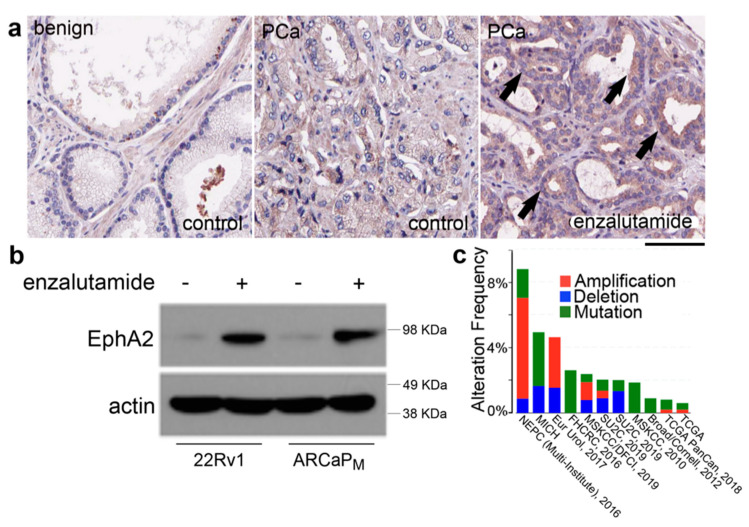
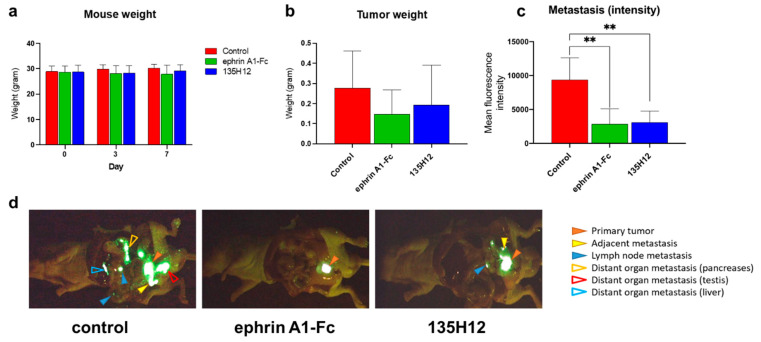
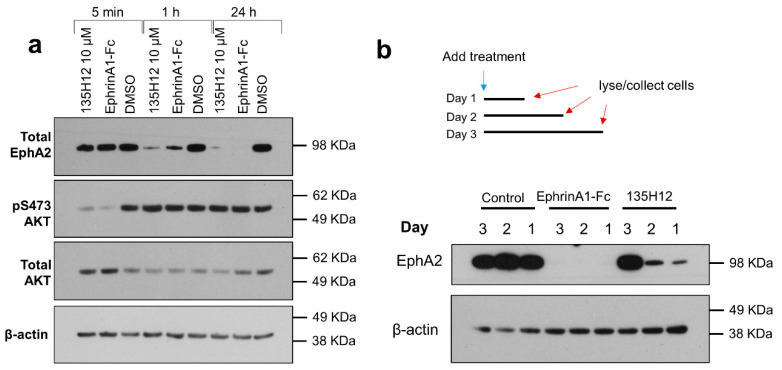
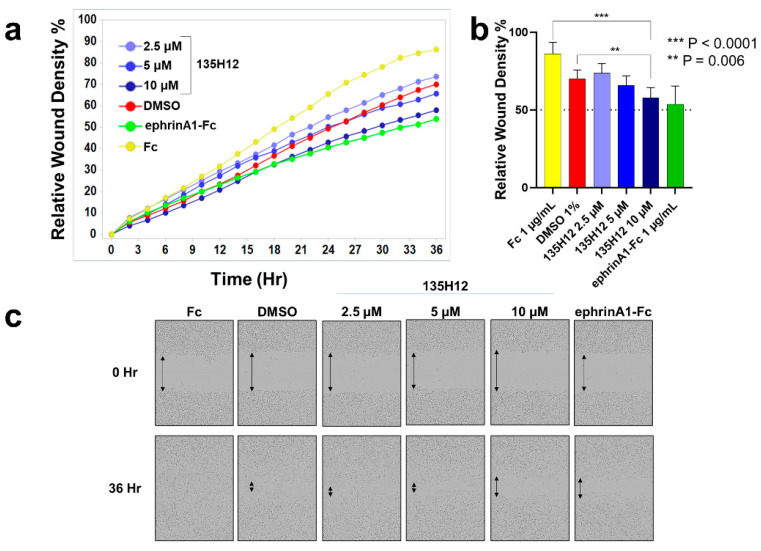
The EphA2 tyrosine kinase receptor is highly expressed in several types of solid tumors. In our recent studies, we targeted EphA2 in pancreatic cancer with agonistic agents and demonstrated that suppression of EphA2 significantly reduced cancer-cell migration in cell-based assays. In the present study, we focused on targeting EphA2 in prostate cancer. While not all prostate cancers express EphA2, we showed that enzalutamide induced EphA2 expression in prostate cancer cells and in a patient-derived xenograft (PDX) animal model, which provides further impetus to target EphA2 in prostate cancer. Western blot studies showed that agonistic dimeric synthetic (135H12) and natural (ephrinA1-Fc) ligands effectively degraded EphA2 receptor in the prostate cancer cell line PC-3. The agents also delayed cell migration of prostate cancer (PC-3) cells, while an in vivo PC-3 orthotopic metastatic nude-mouse model also revealed that administration of ephrinA1-Fc or 135H12 strongly reduced metastases. The present study further validates EphA2 as an important target in metastatic prostate cancer treatment. Our results should incentivize further efforts aimed at developing potent and effective EphA2 synthetic agonistic agents for the treatment of EphA2-driven aggressive metastatic tumors including prostate, pancreatic, and breast cancer.
EphA2酪氨酸激酶受体在多种实体瘤中高表达。在我们最近的研究中,我们用激动剂靶向胰腺癌中的EphA2,并证明在基于细胞的实验中抑制EphA2可显著降低癌细胞迁移。在本研究中,我们专注于靶向前列腺癌中的EphA2。虽然并非所有前列腺癌都表达EphA2,但我们发现恩杂鲁胺可诱导前列腺癌细胞和患者来源的异种移植(PDX)动物模型中EphA2的表达,这为在前列腺癌中靶向EphA2提供了进一步的动力。蛋白质印迹研究表明,激动性二聚体合成配体(135H12)和天然配体(ephrinA1-Fc)可有效降解前列腺癌细胞系PC-3中的EphA2受体。这些药物还延缓了前列腺癌(PC-3)细胞的迁移,而体内PC-3原位转移裸鼠模型也显示,给予ephrinA1-Fc或135H12可显著减少转移。本研究进一步验证了EphA2作为转移性前列腺癌治疗重要靶点的地位。我们的结果应激励进一步努力,旨在开发强效且有效的EphA2合成激动剂,用于治疗包括前列腺癌、胰腺癌和乳腺癌在内的由EphA2驱动的侵袭性转移性肿瘤。