School of Public Health, College of Health and Medical Sciences, Haramaya University, Harar, Ethiopia.
Research Centre for Generational Health and Ageing, School of Medicine and Public Health, Faculty of Health and Medicine, the University of Newcastle, Newcastle, Australia.
BMC Pregnancy Childbirth. 2020 Oct 6;20(1):588. doi: 10.1186/s12884-020-03276-1.
Several studies concluded that there is a reduction of maternal deaths with improved access to caesarean section, while other studies showed the existence of a direct association between the two variables. In Ethiopia, literature about the association between maternal mortality and caesarean section is scarce. This study was aimed to assess the association between maternal mortality ratios and caesarean section rates in hospitals in Ethiopia.
Analysis was done of a national maternal health dataset of 293 hospitals that accessed from the Ethiopian Public Health Institute. Hospital specific characteristics, maternal mortality ratios and caesarean section rates were described. Pearson's correlation coefficient was used to determine the direction of association between maternal mortality ratios and caesarean section rate, taking regions into consideration. Presence of a linear association between these variables was declared statistically significant at p-value < 0.05.
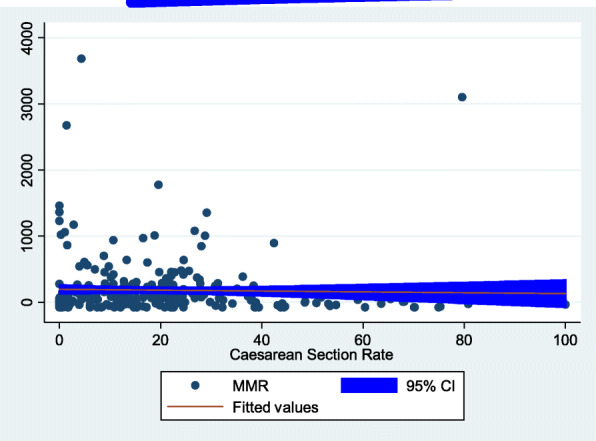
The overall maternal mortality ratio in Ethiopian hospitals was 149 (95% CI: 136-162) per 100,000 livebirths. There was significant regional variation in maternal mortality ratios, ranging from 74 (95% CI: 51-104) per 100,000 livebirths in Tigray region to 548 (95% CI: 251-1,037) in Afar region. The average annual caesarean section rate in hospitals was 20.3% (95% CI: 20.2-20.5). The highest caesarean section rate of 38.5% (95% CI: 38.1-38.9) was observed in Addis Ababa, while the lowest rate of 5.7% (95% CI: 5.2-6.2) occurred in Somali region. At national level, a statistically non-significant inverse association was observed between maternal mortality ratios and caesarean section rates. Similarly, unlike in other regions, there were inverse associations between maternal mortality ratios and caesarean section rates in Addis Ababa, Afar Oromia and Somali, although associations were not statistically significant.
At national level, a statistically non-significant inverse association was observed between maternal mortality ratios and caesarean section rates in hospitals, although there were regional variations. Additional studies with a stronger design should be conducted to assess the association between population-based maternal mortality ratios and caesarean section rates.
多项研究得出结论,提高剖宫产的可及性可降低产妇死亡率,而其他研究则表明这两个变量之间存在直接关联。在埃塞俄比亚,关于产妇死亡率与剖宫产率之间关联的文献很少。本研究旨在评估埃塞俄比亚医院的产妇死亡率与剖宫产率之间的关联。
对埃塞俄比亚公共卫生研究所获取的 293 家医院的国家产妇健康数据集进行了分析。描述了医院的具体特征、产妇死亡率和剖宫产率。考虑到地区因素,使用皮尔逊相关系数来确定产妇死亡率与剖宫产率之间的关联方向。如果这些变量之间存在线性关联,则在 p 值 < 0.05 时被认为具有统计学意义。
埃塞俄比亚医院的总体产妇死亡率为每 100,000 例活产 149 例(95%置信区间:136-162)。产妇死亡率存在显著的地区差异,从提格雷地区的每 100,000 例活产 74 例(95%置信区间:51-104)到阿法尔地区的 548 例(95%置信区间:251-1,037)不等。医院的平均年度剖宫产率为 20.3%(95%置信区间:20.2-20.5)。最高的剖宫产率为 38.5%(95%置信区间:38.1-38.9),出现在亚的斯亚贝巴,而最低的剖宫产率为 5.7%(95%置信区间:5.2-6.2),出现在索马里地区。在国家层面,观察到产妇死亡率与剖宫产率之间存在统计学上无显著的负相关。同样,与其他地区不同,在亚的斯亚贝巴、阿法尔奥罗莫和索马里,虽然关联没有统计学意义,但产妇死亡率与剖宫产率之间存在负相关。
在国家层面,观察到医院的产妇死亡率与剖宫产率之间存在统计学上无显著的负相关,尽管存在地区差异。应开展更多设计更强的研究来评估基于人群的产妇死亡率与剖宫产率之间的关联。