Clinical Division of Haematology and Haemostaseology, Department of Medicine I, Vienna, Austria.
Division of Cardiology, Department of Internal Medicine II, Vienna, Austria.
Rheumatology (Oxford). 2021 Apr 6;60(4):1687-1699. doi: 10.1093/rheumatology/keaa532.
Patients with APS are at increased risk of thromboembolism. Neutrophils have been shown to play a role in inducing thrombosis. We aimed to investigate differences in neutrophil subpopulations, their potential of activation and neutrophil extracellular trap (NET) formation comparing high and low-density neutrophils (HDNs/LDNs) as well as subpopulations in patients with APS and controls to gain deeper insight into their potential role in thrombotic manifestations in patients with APS.
HDNs and LDNs of 20 patients with APS and 20 healthy donors were isolated by density gradient centrifugation and stimulated. Neutrophil subpopulations, their activation and NET release were assessed by flow cytometry.
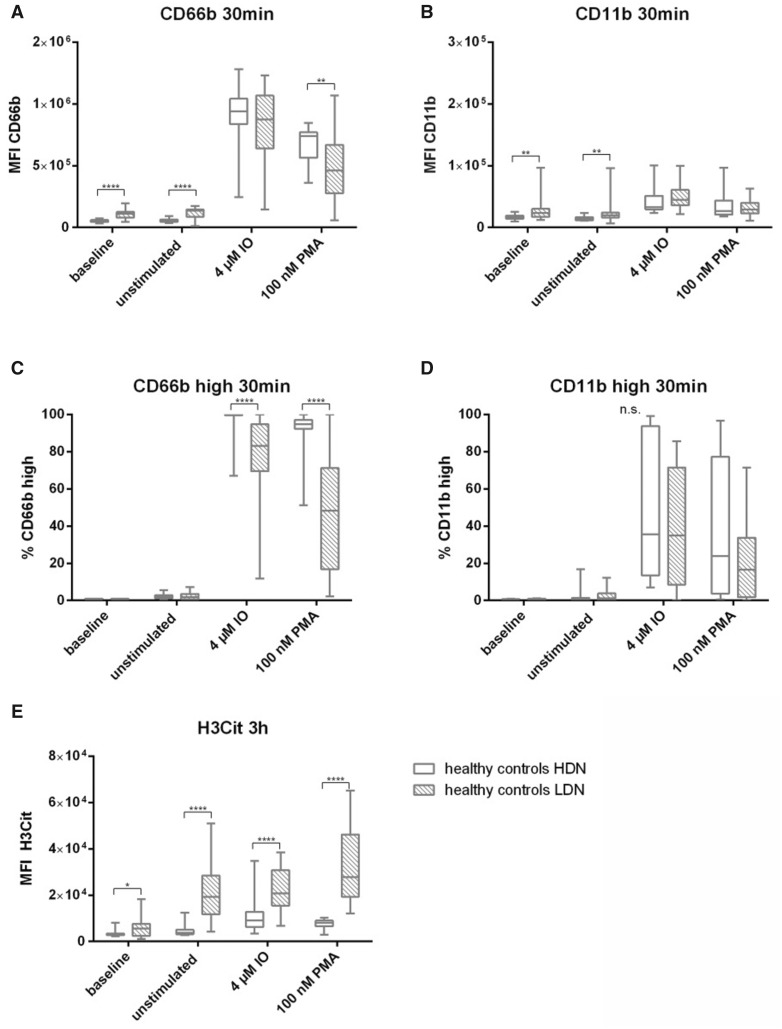
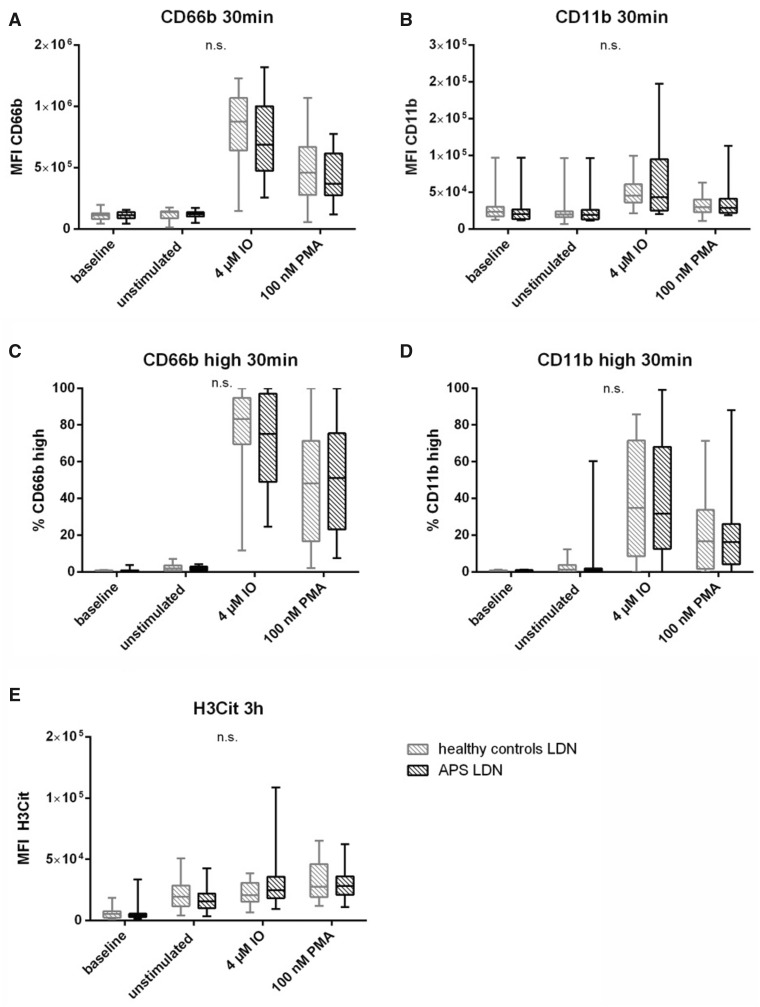
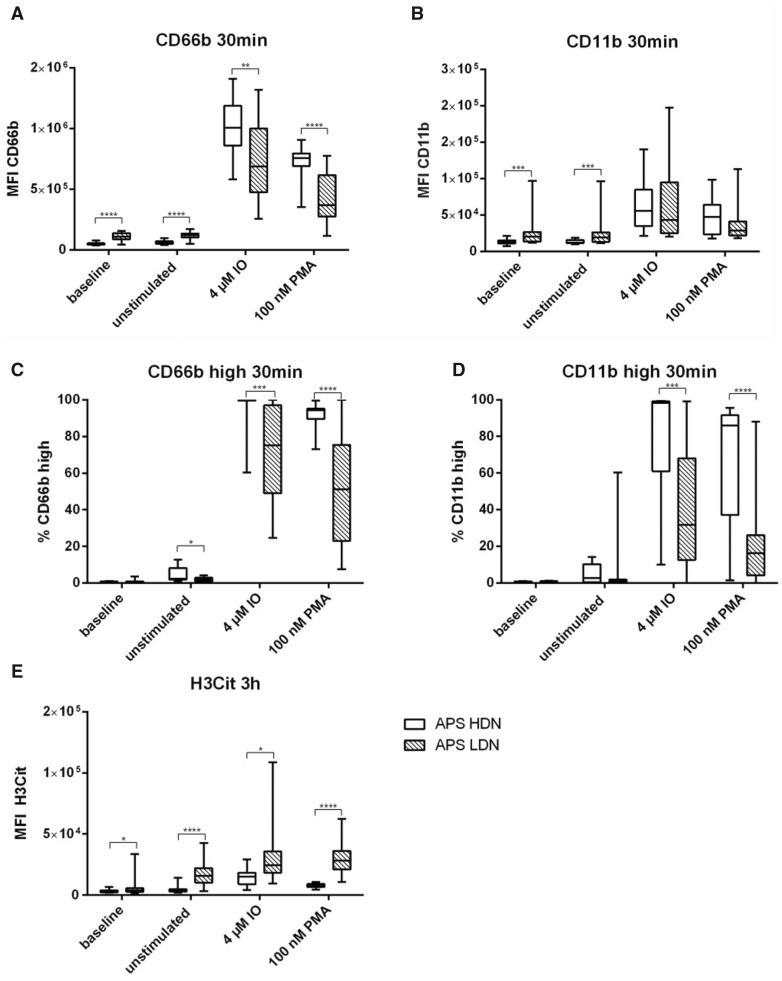
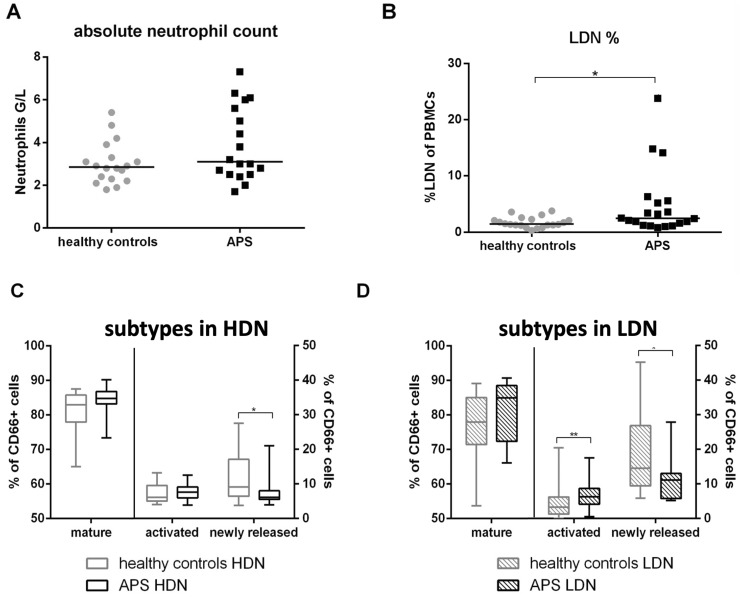
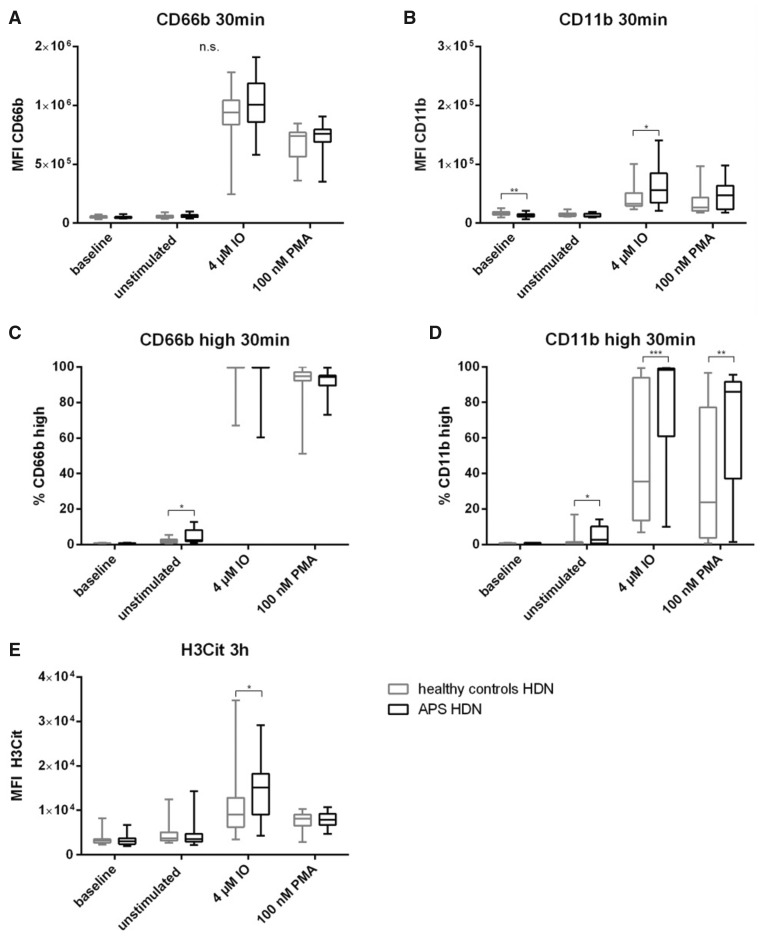
LDNs of both groups showed higher baseline activation, lower response to stimulation (regulation of activation markers CD11b/CD66b), but higher NET formation compared with HDNs. In patients with APS, the absolute number of LDNs was higher compared with controls. HDNs of APS patients showed higher spontaneous activation [%CD11b high: median (interquartile range): 2.78% (0.58-10.24) vs 0.56% (0.19-1.37)] and response to stimulation with ionomycin compared with HDNs of healthy donors [%CD11b high: 98.20 (61.08-99.13) vs 35.50% (13.50-93.85)], whereas no difference was found in LDNs. NET formation was increased in patients' HDNs upon stimulation.
HDNs and LDNs act differently, unstimulated and upon various stimulations in both healthy controls and APS patients. Differences in HDNs and LDNs between patients with APS and healthy controls indicate that neutrophils may enhance the risk of thrombosis in these patients and could thus be a target for prevention of thrombosis in APS.
抗磷脂综合征(APS)患者存在血栓栓塞风险增加。已有研究表明中性粒细胞在诱导血栓形成中发挥作用。我们旨在研究高、低密度中性粒细胞(HDNs/LDNs)以及 APS 患者和对照组中性粒细胞亚群之间的差异,评估其激活潜能和中性粒细胞胞外诱捕网(NET)形成,以深入了解其在 APS 患者血栓表现中的潜在作用。
采用密度梯度离心法分离 20 例 APS 患者和 20 名健康对照者的 HDNs 和 LDNs,进行刺激。采用流式细胞术评估中性粒细胞亚群、激活和 NET 释放。
两组 LDNs 基础激活水平较高,对刺激的反应较低(调节激活标志物 CD11b/CD66b),但 NET 形成较高。与对照组相比,APS 患者的 LDN 绝对数较高。APS 患者的 HDNs 自发激活率较高 [%CD11b 高:中位数(四分位距):2.78%(0.58-10.24)比 0.56%(0.19-1.37)],对离子霉素刺激的反应也较高 [%CD11b 高:98.20%(61.08-99.13)比 35.50%(13.50-93.85)],而 LDNs 则无差异。刺激后患者 HDNs 的 NET 形成增加。
在健康对照者和 APS 患者中,HDNs 和 LDNs 无论是在未受刺激时还是在受到各种刺激时,其作用均不同。APS 患者与健康对照者的 HDNs 和 LDNs 之间存在差异,表明中性粒细胞可能会增加这些患者的血栓形成风险,因此可能成为 APS 患者血栓预防的靶点。