Department of Otorhinolaryngology and Head and Neck Surgery, Leiden University Medical Center, P.O. Box 9600, 2300 RC, Leiden, The Netherlands.
Department of Otorhinolaryngology and Head and Neck Surgery, Erasmus Medical Center, Rotterdam, The Netherlands.
Eur Arch Otorhinolaryngol. 2021 Sep;278(9):3237-3244. doi: 10.1007/s00405-020-06401-0. Epub 2020 Oct 7.
In cases of small- to medium-sized vestibular schwannomas, three management strategies can be opted for: active surveillance, surgery or radiotherapy. In these cases, the patient's preference is pivotal in decision-making. The aim of this study was to identify factors that influence a patient's decision for a particular management strategy.
A qualitative inductive thematic analysis was performed based on semi-structured interviews. Eighteen patients with small- to medium-sized vestibular schwannomas were interviewed. All patients were diagnosed or treated at one of the two participating university medical centers in the Netherlands.
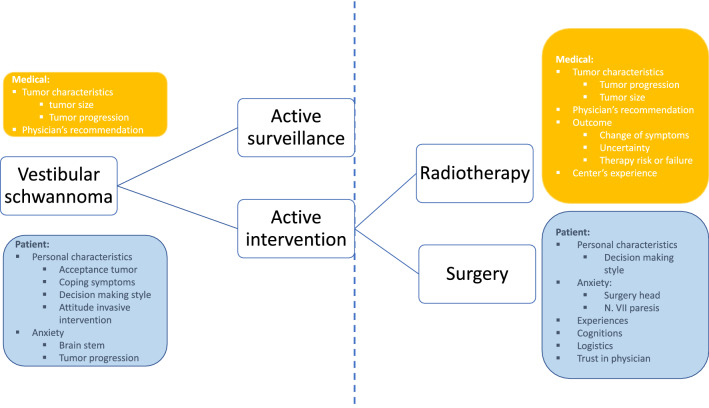
Ten themes were identified that influenced the decision, classified as either medical or patient-related. The medical themes that emerged were: tumor characteristics, the physician's recommendation, treatment outcomes and the perceived center's experience. The patient-related themes were: personal characteristics, anxiety, experiences, cognitions, logistics and trust in the physician.
Knowledge of the factors that influence decision-making helps physicians to tailor their consultations to arrive at a true shared decision on vestibular schwannoma management.
对于小至中型前庭神经鞘瘤,可选择三种管理策略:主动监测、手术或放疗。在这些情况下,患者的偏好对决策至关重要。本研究旨在确定影响患者选择特定管理策略的因素。
基于半结构化访谈进行定性归纳主题分析。对 18 名小至中型前庭神经鞘瘤患者进行了访谈。所有患者均在荷兰的两个参与大学医学中心之一被诊断或治疗。
确定了影响决策的 10 个主题,分为与医疗相关或与患者相关的主题。出现的医疗主题包括:肿瘤特征、医生的建议、治疗结果和感知中心的经验。与患者相关的主题是:个人特征、焦虑、经历、认知、后勤和对医生的信任。
了解影响决策的因素有助于医生根据患者的具体情况调整咨询内容,从而就前庭神经鞘瘤的管理达成真正的共同决策。