Mikosch Peter, Trifina-Mikosch Eva, Saidler Katharina, Kellner Jennifer, Suhrau Susanne
2. Medizinische Abteilung, Landesklinikum Mistelbach, Mistelbach, Österreich.
Medizinische Universität Wien, Externe Lehre, Wien, Österreich.
Wien Med Wochenschr. 2020 Nov;170(15-16):392-402. doi: 10.1007/s10354-020-00782-x. Epub 2020 Oct 7.
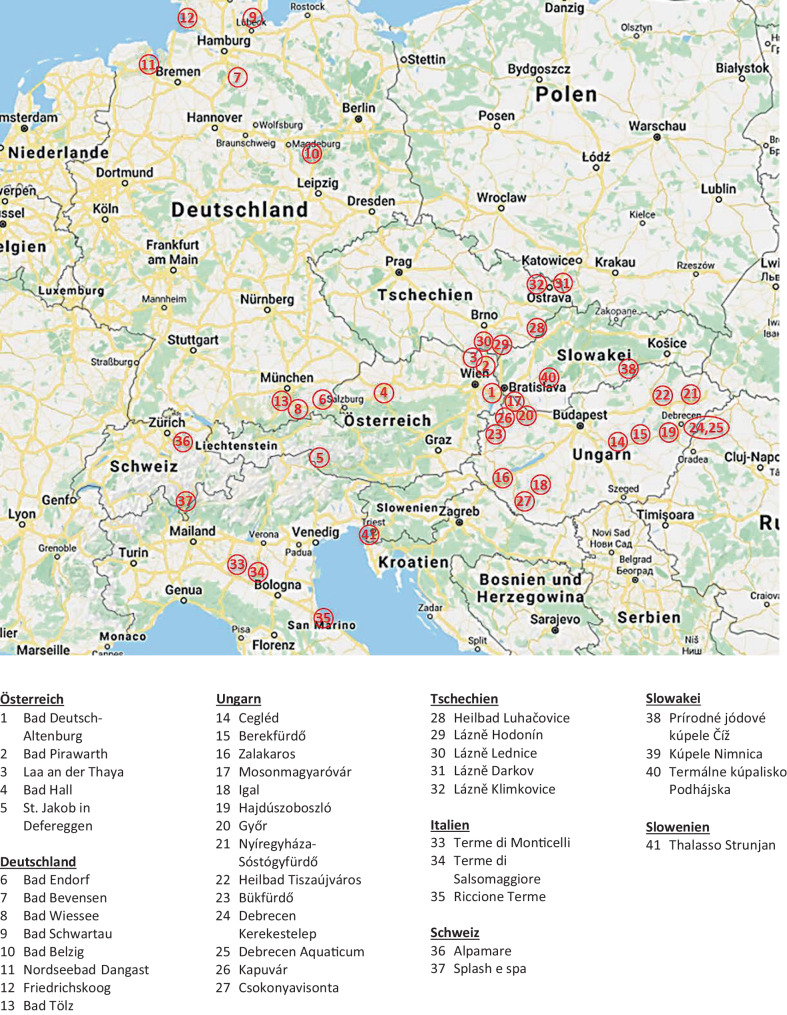
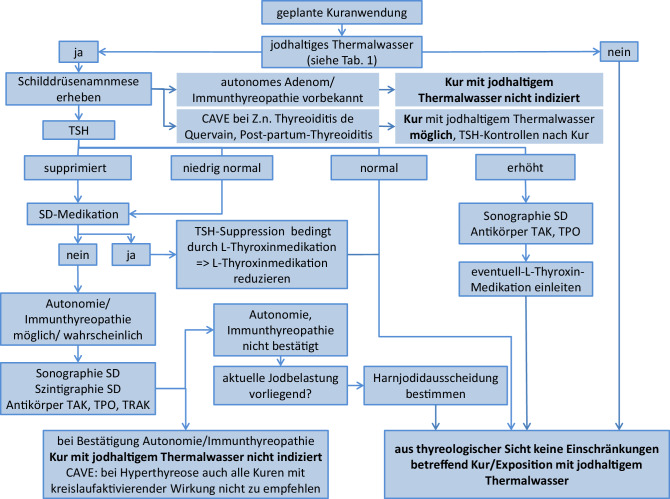
Excessive iodine intake should be avoided in certain thyroid disorders, such as Graves' disease, Hashimoto's thyroiditis and thyroid goiter with autonomous nodules. Regarding alimentary iodine intake broad information can be found in the literature or the internet. Cure and rehabilitation therapy is used in many clinical settings, such as chronic degenerative disorders of the musculoskeletal system, rehabilitation after trauma, after treatment of malignant tumors and many others. Iodine intake with iodine-rich thermal water during cure and rehabilitation is possible and the extent depends in particular on the route of application and the duration of treatment. Information on this topic can be hardly found in the literature. This article analyses iodine-rich cure and rehabilitation treatment with iodine-rich thermal water from the point of view of the thyroid gland. The positive and possible negative effects of treatment with iodine-rich thermal water on thyroid function are elucidated. Apart from an insight into the physiology and pathophysiology of iodine metabolism, the extent of iodine intake during cure and rehabilitation treatment is presented depending on the route of application and the clinical implications for certain thyroid disorders are discussed. An overview of cure and rehabilitation centers in Austria and neighboring countries is given. In addition, an algorithm for the clinical selection of patients unsuitable for high iodine intake and who should thus avoid an iodine-rich cure or rehabilitation treatment is presented in order to assist clinicians in optimally selecting patients for cure or rehabilitation treatment with iodine-rich thermal water.
在某些甲状腺疾病中,如格雷夫斯病、桥本甲状腺炎和伴有自主性结节的甲状腺肿,应避免碘摄入过量。关于膳食碘摄入,可在文献或互联网上找到广泛的信息。治愈和康复治疗在许多临床环境中都有应用,如肌肉骨骼系统的慢性退行性疾病、创伤后康复、恶性肿瘤治疗后等。在治愈和康复期间,饮用富含碘的温泉水时摄入碘是可能的,其摄入量尤其取决于应用途径和治疗持续时间。关于这一主题的信息在文献中很难找到。本文从甲状腺的角度分析了饮用富含碘的温泉水进行的富含碘的治愈和康复治疗。阐明了饮用富含碘的温泉水治疗对甲状腺功能的积极和可能的负面影响。除了深入了解碘代谢的生理和病理生理学外,还介绍了治愈和康复治疗期间根据应用途径的碘摄入量,并讨论了对某些甲状腺疾病的临床影响。给出了奥地利及周边国家治愈和康复中心的概述。此外,还提出了一种临床选择算法,用于筛选不适合高碘摄入、应避免进行富含碘的治愈或康复治疗的患者,以帮助临床医生为饮用富含碘的温泉水进行治愈或康复治疗的患者进行最佳选择。