Department of Psychiatry, University Medical Center Utrecht Brain Center, University Medical Center Utrecht, Utrecht University, Utrecht, Netherlands.
Norwegian Centre for Mental Disorders Research (NORMENT), Institute of Clinical Medicine, University of Oslo, Oslo, Norway.
Hum Brain Mapp. 2022 Jan;43(1):414-430. doi: 10.1002/hbm.25206. Epub 2020 Oct 7.
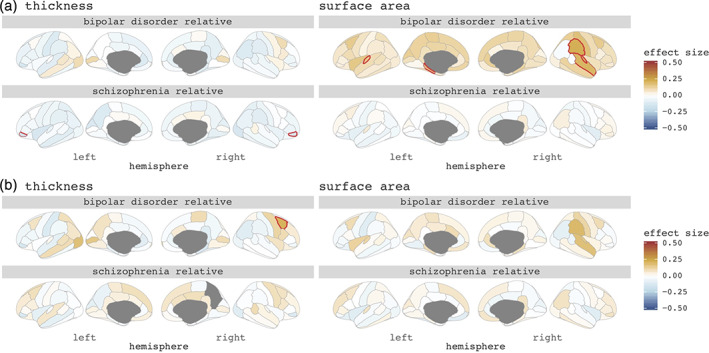
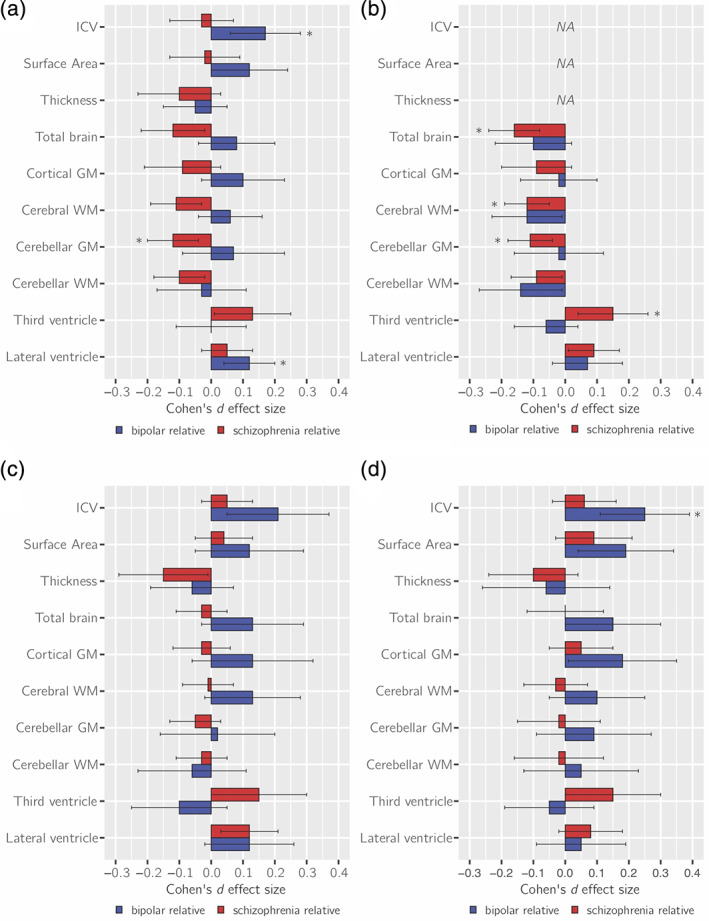
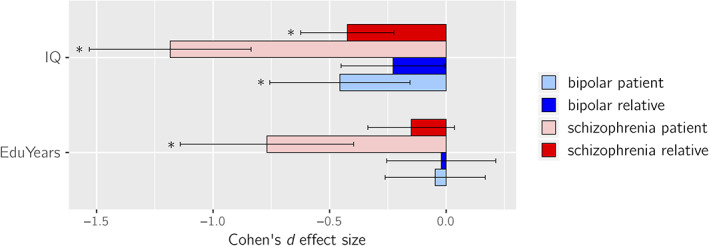
First-degree relatives of patients diagnosed with schizophrenia (SZ-FDRs) show similar patterns of brain abnormalities and cognitive alterations to patients, albeit with smaller effect sizes. First-degree relatives of patients diagnosed with bipolar disorder (BD-FDRs) show divergent patterns; on average, intracranial volume is larger compared to controls, and findings on cognitive alterations in BD-FDRs are inconsistent. Here, we performed a meta-analysis of global and regional brain measures (cortical and subcortical), current IQ, and educational attainment in 5,795 individuals (1,103 SZ-FDRs, 867 BD-FDRs, 2,190 controls, 942 schizophrenia patients, 693 bipolar patients) from 36 schizophrenia and/or bipolar disorder family cohorts, with standardized methods. Compared to controls, SZ-FDRs showed a pattern of widespread thinner cortex, while BD-FDRs had widespread larger cortical surface area. IQ was lower in SZ-FDRs (d = -0.42, p = 3 × 10 ), with weak evidence of IQ reductions among BD-FDRs (d = -0.23, p = .045). Both relative groups had similar educational attainment compared to controls. When adjusting for IQ or educational attainment, the group-effects on brain measures changed, albeit modestly. Changes were in the expected direction, with less pronounced brain abnormalities in SZ-FDRs and more pronounced effects in BD-FDRs. To conclude, SZ-FDRs and BD-FDRs show a differential pattern of structural brain abnormalities. In contrast, both had lower IQ scores and similar school achievements compared to controls. Given that brain differences between SZ-FDRs and BD-FDRs remain after adjusting for IQ or educational attainment, we suggest that differential brain developmental processes underlying predisposition for schizophrenia or bipolar disorder are likely independent of general cognitive impairment.
首先,我们对大脑整体和区域(皮质和皮质下)、当前智商和教育程度进行了荟萃分析,参与者为 36 个精神分裂症和/或双相情感障碍家系队列中的 5795 人,包括 1103 名精神分裂症一级亲属(SZ-FDRs)、867 名双相情感障碍一级亲属(BD-FDRs)、2190 名对照者、942 名精神分裂症患者和 693 名双相情感障碍患者。这些数据来自于标准化方法。
与对照组相比,SZ-FDRs 表现出广泛的皮质变薄模式,而 BD-FDRs 则表现出广泛的皮质表面积增大。SZ-FDRs 的智商较低(d=-0.42,p=3×10⁻⁴),BD-FDRs 的智商降低则证据较弱(d=-0.23,p=0.045)。与对照组相比,这两个相对群体的教育程度相似。当调整智商或教育程度时,大脑测量的组间效应发生了变化,尽管变化不大。这些变化与预期一致,SZ-FDRs 的大脑异常程度较轻,BD-FDRs 的大脑异常程度更明显。
总之,SZ-FDRs 和 BD-FDRs 表现出不同的结构脑异常模式。相比之下,与对照组相比,SZ-FDRs 和 BD-FDRs 的智商得分均较低,受教育程度相似。鉴于在调整智商或教育程度后,SZ-FDRs 和 BD-FDRs 之间的大脑差异仍然存在,我们认为精神分裂症或双相情感障碍倾向的潜在大脑发育过程可能独立于一般认知障碍。