Department of Pediatrics, Yonsei University Wonju College of Medicine, Wonju 26426, Korea.
Department of Pediatrics, Yonsei University College of Medicine, Severance Children's Hospital, Seoul 03722, Korea.
Nutrients. 2020 Oct 5;12(10):3048. doi: 10.3390/nu12103048.
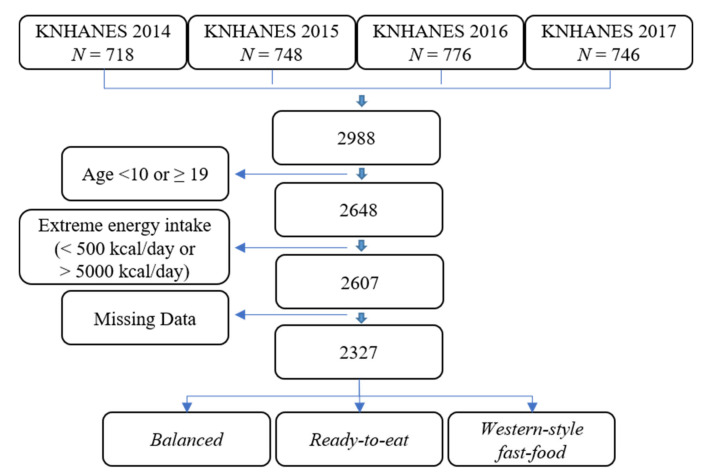
Non-invasive anthropometric measurement methods such as those for measuring height and weight are crucial in pediatric patients. However, research focusing on the association between the type of dietary pattern and handgrip strength and handgrip-to-weight ratio in adolescents has not been carried out yet. This cross-sectional analysis of the 2014-2017 Korean National Health and Nutrition Examination Survey assessed 2327 adolescents (aged 10-18 years) who had their handgrip strength measured and analyzed its association with dietary pattern. The clusters were examined for nutritional values, and the , and clusters were ultimately generated. Overall, 85.6% of the participants were assigned to a dietary pattern, 9.3% to a dietary pattern, and 5.1% to a dietary pattern. Compared with the participants following a dietary pattern, those following a dietary pattern were shown to have a significantly lower handgrip strength and handgrip-to-weight ratio. Decreased handgrip strength and handgrip-to-weight ratio values in participants following dietary patterns indicate a diffuse problem in adolescents' health and possibly imply an association between reduced muscle quality and dietary pattern. Therefore, the overall environmental factors potentially inducing such unhealthy dietary preferences should be investigated, and appropriate lifestyle changes in Korean adolescents should be encouraged.
非侵入性人体测量方法,如身高和体重的测量方法,对儿科患者至关重要。然而,目前还没有研究关注青少年的饮食模式类型与握力和握力与体重比之间的关系。本项横断面研究分析了 2014-2017 年韩国国家健康和营养检查调查的数据,共纳入了 2327 名青少年(年龄为 10-18 岁),这些青少年接受了握力测量,并分析了其与饮食模式的关系。根据营养值对聚类进行了检查,最终生成了 、 和 聚类。总的来说,85.6%的参与者被分配到了一种 饮食模式,9.3%的参与者被分配到了一种 饮食模式,5.1%的参与者被分配到了一种 饮食模式。与遵循 饮食模式的参与者相比,遵循 饮食模式的参与者的握力和握力与体重比明显较低。遵循 饮食模式的参与者的握力和握力与体重比值下降表明青少年的健康存在普遍问题,并且可能暗示肌肉质量下降与饮食模式之间存在关联。因此,应该调查可能导致这种不健康饮食偏好的整体环境因素,并鼓励韩国青少年进行适当的生活方式改变。