Duan Xu-Zhou, Zhang Xin, Tong Da-Ke, Ji Fang, Xu Kai-Hang, He Rong-Zhi
Department of Orthopedics, Changhai Hospital Affiliated to the Navy Military Medical University, Shanghai, China.
J Int Med Res. 2020 Oct;48(10):300060520945132. doi: 10.1177/0300060520945132.
To investigate the related risk factors and predictive nomogram of postoperative hypoxaemia in elderly patients with femoral neck fractures.
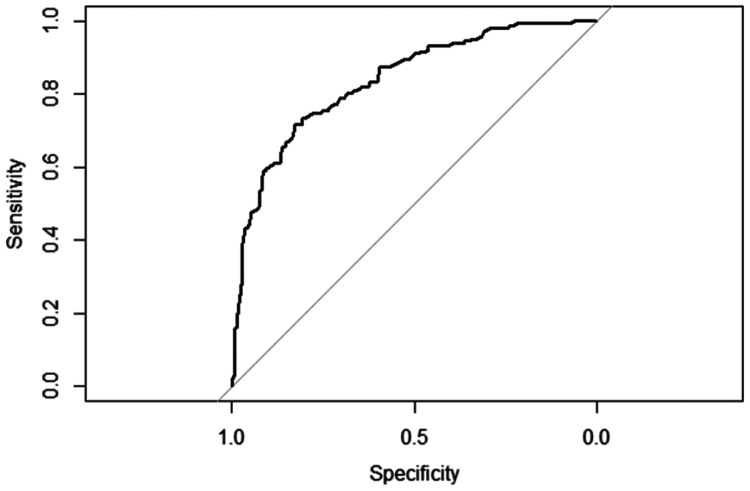
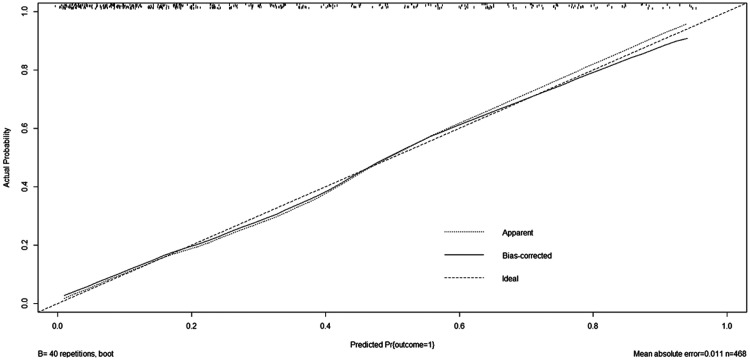
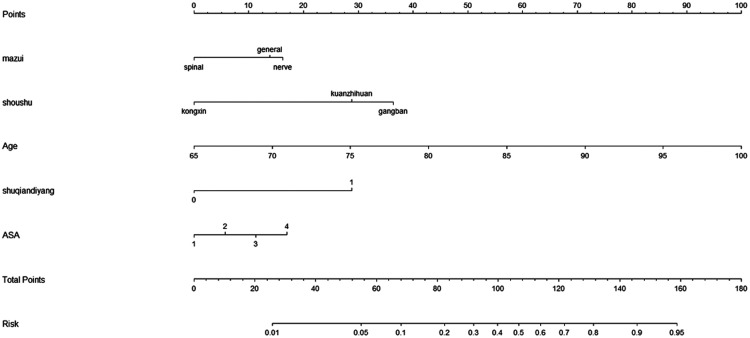
This study included patients aged ≥65 years who underwent surgical treatment of acute femoral neck fractures. Univariate and multivariate logistic analyses were performed to determine the incidence of and risk factors for postoperative hypoxaemia. A predictive nomogram was constructed based on the multivariable model. Using the bootstrap method, discrimination was determined by the C-index and calibration plot.
The logistic regression analysis showed that the anaesthesia type, surgical procedure, American Society of Anesthesiologists (ASA) classification, preoperative hypoxaemia occurrence, and age were independent predictors of development of postoperative hypoxaemia. The predictive formula for hypoxaemia was established as follows: hypoxaemia=-0.8668×spinal anaesthesia (whether)+0.1162×nerve anaesthesia (whether)+1.9555×plate/screw fixation (whether)+1.4950×hip replacement (whether)+0.4883×ASA classification+1.7153×preoperative oxygenation index+0.1608×age. With the bootstrap method, the prediction curve fit well with the ideal curve, suggesting that the prediction curve constructed in this study has good predictive ability.
Anaesthesia type, surgical procedure, ASA classification, preoperative hypoxaemia occurrence, and age were risk factors for postoperative hypoxaemia in elderly patients with femoral neck fractures. The predictive nomogram was designed for preoperative assessment of the risk of postoperative hypoxaemia by calculating the risk score.
探讨老年股骨颈骨折患者术后低氧血症的相关危险因素及预测列线图。
本研究纳入年龄≥65岁的急性股骨颈骨折手术治疗患者。进行单因素和多因素逻辑回归分析以确定术后低氧血症的发生率及危险因素。基于多变量模型构建预测列线图。采用自举法,通过C指数和校准图确定判别能力。
逻辑回归分析显示,麻醉类型、手术方式、美国麻醉医师协会(ASA)分级、术前低氧血症发生情况及年龄是术后低氧血症发生的独立预测因素。低氧血症的预测公式如下:低氧血症=-0.8668×脊髓麻醉(是否)+
0.1162×神经麻醉(是否)+ 1.9555×钢板/螺钉固定(是否)+ 1.4950×髋关节置换(是否)+ 0.4883×ASA分级+ 1.7153×术前氧合指数+ 0.1608×年龄。采用自举法,预测曲线与理想曲线拟合良好,表明本研究构建的预测曲线具有良好的预测能力。
麻醉类型、手术方式、ASA分级、术前低氧血症发生情况及年龄是老年股骨颈骨折患者术后低氧血症的危险因素。通过计算风险评分设计预测列线图用于术前评估术后低氧血症风险。