Verwoerd Martine, Wittink Harriet, Maissan Francois, Smeets Rob
Research Group Lifestyle and Health, Utrecht University of Applied Sciences, Heidelberglaan 7, Utrecht, the Netherlands.
Department of Rehabilitation Medicine, Research School CAPHRI, CIR Rehabilitation, Maastricht University, Eindhoven, The Netherlands.
BMC Musculoskelet Disord. 2020 Oct 7;21(1):656. doi: 10.1186/s12891-020-03682-8.
Identify and establish consensus regarding potential prognostic factors for the development of chronic pain after a first episode of idiopathic, non-traumatic neck pain.
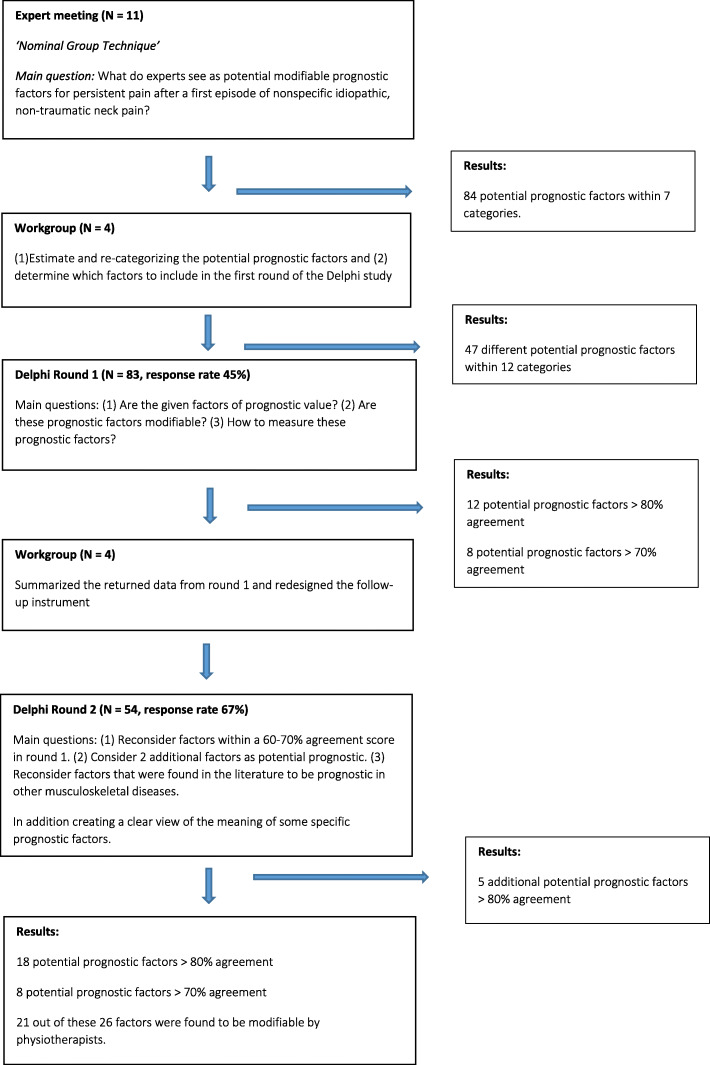
This study used two consensus group methods: a modified Nominal Group (m-NGT) and a Delphi Technique.
The goal of the m-NGT was to obtain and categorize a list of potential modifiable prognostic factors. These factors were presented to a multidisciplinary panel in a two-round Delphi survey, which was conducted between November 2018 and January 2020. The participants were asked whether factors identified are of prognostic value, whether these factors are modifiable, and how to measure these factors in clinical practice. Consensus was a priori defined as 70% agreement among participants.
Eighty-four factors were identified and grouped into seven categories during the expert meeting using the modified NGT. A workgroup reduced the list to 47 factors and grouped them into 12 categories. Of these factors, 26 were found to be potentially prognostic for chronification of neck pain (> 70% agreement). Twenty-one out of these 26 factors were found to be potentially modifiable by physiotherapists based on a two-round Delphi survey.
Based on an expert meeting (m-NGT) and a two-round Delphi survey, our study documents consensus (> 70%) on 26 prognostic factors. Twenty-one out of these 26 factors were found to be modifiable, and most factors were psychological in nature.
识别并就特发性、非创伤性颈部疼痛首次发作后慢性疼痛发展的潜在预后因素达成共识。
本研究采用了两种共识小组方法:改良名义小组法(m-NGT)和德尔菲技术。
m-NGT的目标是获取潜在的可改变预后因素列表并进行分类。在2018年11月至2020年1月期间,将这些因素提交给一个多学科小组进行两轮德尔菲调查。参与者被问及所确定的因素是否具有预后价值、这些因素是否可改变以及如何在临床实践中测量这些因素。共识被预先定义为参与者之间70%的一致意见。
在使用改良NGT的专家会议期间,共识别出84个因素并分为七类。一个工作组将列表缩减至47个因素,并将其分为12类。在这些因素中,发现26个因素对颈部疼痛慢性化具有潜在预后意义(>70%的一致意见)。基于两轮德尔菲调查,发现这26个因素中有21个因素理疗师可能可以改变。
基于专家会议(m-NGT)和两轮德尔菲调查,我们的研究记录了关于26个预后因素的共识(>70%)。发现这26个因素中有21个因素是可改变的,并且大多数因素本质上是心理方面的。