Laboratory Department, Kuwait University Hospital, Sana'a University, Sana'a, Yemen.
Department of Medical Parasitology, Faculty of Medicine and Health Sciences, Sana'a University, Sana'a, Yemen.
Malar J. 2020 Oct 7;19(1):358. doi: 10.1186/s12936-020-03431-1.
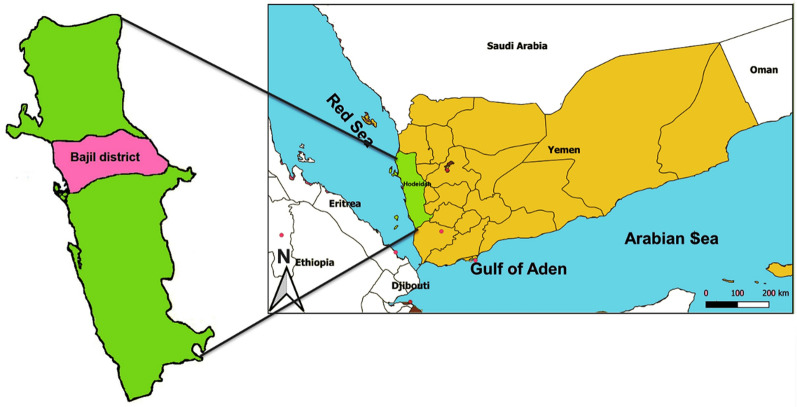
Malaria, malnutrition and anaemia are major public health problems in Yemen, with Hodeidah being the most malaria-afflicted governorate. To address the lack of relevant studies, this study was conducted to determine the prevalence of Plasmodium falciparum and its relation to nutritional status and haematological indices among schoolchildren in Bajil district of Hodeidah governorate, west of Yemen.
A cross-sectional study was conducted among 400 schoolchildren selected randomly from four schools in Bajil district. Data about demographic characteristics, risk factors and anthropometric measurements of age, height and weight were collected. Duplicate thick and thin blood films were prepared, stained with Giemsa and examined microscopically for malaria parasites. The density of P. falciparum asexual stages was estimated on thick films. EDTA-blood samples were examined for the haematological indices of haemoglobin (Hb) and blood cell counts.
Plasmodium falciparum was prevalent among 8.0% (32/400) of schoolchildren with a mean parasite density of 244.3 ± 299.3/µL of blood and most infections showing low-level parasitaemia, whereas Plasmodium vivax was detected in one child (0.25%). Residing near water collections was a significant independent predictor of falciparum malaria [adjusted odds ratio (AOR) = 2.6, 95.0% CI 1.20-5.72; p = 0.016] in schoolchildren. Mild anaemia was prevalent among more than half of P. falciparum-infected schoolchildren and significantly associated with falciparum malaria (AOR = 5.8, 95.0% CI 2.39-14.17; p < 0.001), with a mean Hb concentration of 10.7 ± 1.0 g/dL. Although the mean values of the total white blood cells, monocytes and platelets were significantly lower in infected than non-infected schoolchildren, they were within normal ranges. More than half of the children were malnourished, with stunting (39.3%) and underweight (36.0%) being the most prevalent forms of malnutrition; 6.3% of children were wasted. Underweight (AOR = 5.3, 95.0% CI 2.09-13.62; p < 0.001) but not stunting or wasting, was a significant predictor of falciparum malaria among schoolchildren.
Asymptomatic falciparum malaria is prevalent among schoolchildren in Bajil district of Hodeidah Governorate, with predominance of low parasitaemic infections and significant association with mild anaemia and underweight. Residence near water collection is a significant predictor of infection with falciparum malaria among schoolchildren. Further studies among children with severe malaria and those with high parasite densities are recommended.
疟疾、营养不良和贫血是也门主要的公共卫生问题,荷台达省是疟疾发病率最高的省份。为了解决相关研究的缺乏,本研究旨在确定在也门西部荷台达省巴吉尔区,恶性疟原虫的流行情况及其与学龄儿童营养状况和血液学指标的关系。
对巴吉尔区 400 名随机抽取的学龄儿童进行横断面研究。收集了人口统计学特征、危险因素和年龄、身高和体重的体格测量数据。制备了两份厚、薄血片,用吉姆萨染色,用显微镜检查疟原虫。在厚片中估计恶性疟原虫无性期的密度。用 EDTA 血样检测血红蛋白(Hb)和血细胞计数的血液学指标。
8.0%(32/400)的学龄儿童感染恶性疟原虫,平均寄生虫密度为 244.3±299.3/µL 血液,大多数感染表现为低水平的寄生虫血症,而只有 1 名儿童(0.25%)检测到间日疟原虫。居住在水源附近是儿童感染恶性疟原虫的一个显著独立预测因素[校正优势比(AOR)=2.6,95.0%置信区间 1.20-5.72;p=0.016]。超过一半的感染恶性疟原虫的学龄儿童患有轻度贫血,且与恶性疟原虫感染显著相关(AOR=5.8,95.0%置信区间 2.39-14.17;p<0.001),平均血红蛋白浓度为 10.7±1.0 g/dL。虽然感染儿童的总白细胞、单核细胞和血小板的平均数值明显低于非感染儿童,但仍在正常范围内。超过一半的儿童营养不良,其中发育迟缓(39.3%)和体重不足(36.0%)最为常见;6.3%的儿童消瘦。体重不足(AOR=5.3,95.0%置信区间 2.09-13.62;p<0.001)而非发育迟缓或消瘦,是儿童感染恶性疟原虫的一个显著预测因素。
荷台达省巴吉尔区的学龄儿童中存在无症状恶性疟原虫感染,以低寄生虫血症感染为主,与轻度贫血和体重不足显著相关。居住在水源附近是儿童感染恶性疟原虫的一个显著预测因素。建议对严重疟疾和高寄生虫密度的儿童进行进一步研究。