Department of Health Research Methods, Evidence and Impact, McMaster University, Hamilton, ON, Canada.
Department of Obstetrics and Gynecology, Faculty of Medicines and Biomedical Sciences, University of Yaoundé 1, Yaoundé, Cameroon.
Syst Rev. 2020 Oct 7;9(1):231. doi: 10.1186/s13643-020-01487-3.
Dextro-transposition of the great arteries (D-TGA) is the most frequent cyanotic congenital heart pathology in neonates. Surgical correction of this condition is possible using the arterial switch operation (ASO) which was first performed by Jatene in 1975.
The aim of this study was to summarise the evidence on short- (less than 1 year), medium- (1-20 years), and long-term (more than 20 years) outcomes of children with D-TGA treated with the ASO. The primary outcome was survival. Secondary outcomes were freedom from cardiac reoperations, occurrence of aortic insufficiency, pulmonary stenosis, coronary artery anomalies, neuropsychological development problems and quality of life.
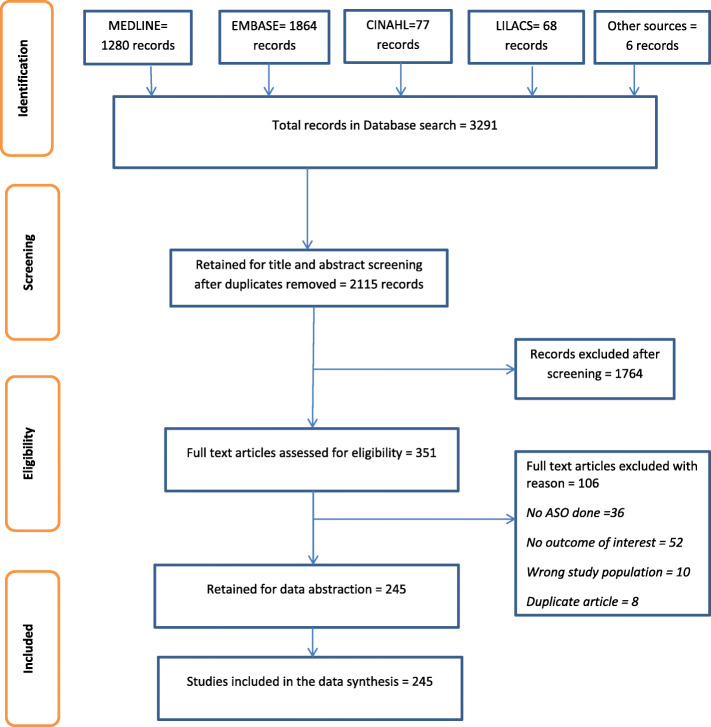
We searched MEDLINE, EMBASE, CINAHL, LILACS, and reference lists of included articles for studies reporting outcomes after ASO for D-TGA. Screening, data extraction and risk of bias assessment were done independently by two reviewers. We pooled data using a random-effects meta-analysis of proportions and, where not possible, outcomes were synthesized narratively. We used the Grading of Recommendations Assessment, Development and Evaluation (GRADE) system to assess the certainty of the evidence for each outcome.
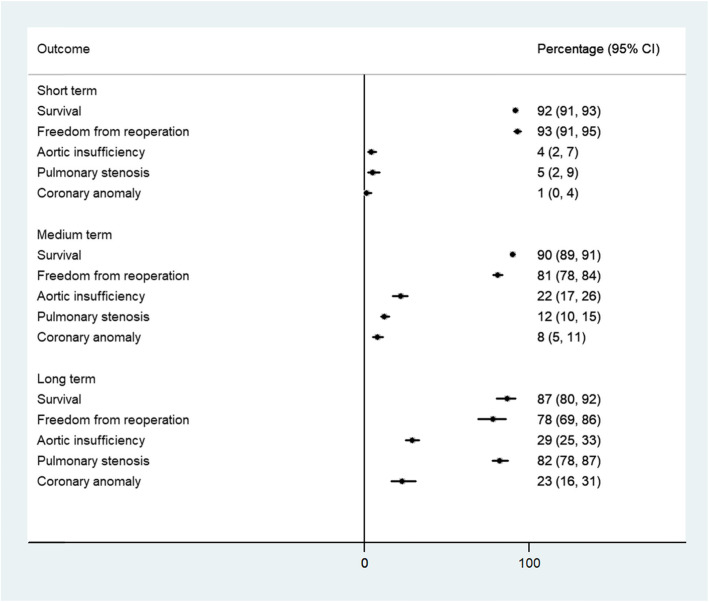
Following ASO for TGA, short-term survival was 92.0% (95% CI 91.0-93.0%; I = 85.8%, 151 studies, 30,186 participants; moderate certainty evidence). Medium-term survival was 90.0% (95% CI 89.0-91.0%; I = 84.3%, 133 studies; 23,686 participants, moderate certainty evidence), while long-term survival was 87.0% (95% CI 80.0-92.0 %; I = 84.5%, 4 studies, 933 participants, very low certainty evidence). Evaluation of the different secondary outcomes also showed satisfactory results in the short, medium and long term. Subgroup analysis suggests slightly higher survival following ASO for TGA in the second surgical era (1998 to 2018) than in the first surgical era (1975 to 1997) in the short and medium term [93.0% (95% CI 92.0-94.0) vs 90.0% (95% CI 89.0-92.0) and 93.0% (95% CI 91.0-94.0) vs 88.0% (87.0-90.0%) respectively] but not in the long term [81.0% (95% CI 76.0-86.0%) vs 89.0% (80.0-95.0%)].
Pooled data from many sources suggests that the ASO for D-TGA leads to high rates of survival in the short, medium, and long term.
大动脉转位(D-TGA)是新生儿中最常见的发绀性先天性心脏病。通过动脉调转手术(ASO)可以对这种病症进行外科矫正,该手术由 Jatene 于 1975 年首次实施。
本研究旨在总结接受 ASO 治疗的 D-TGA 患儿的短期(<1 年)、中期(1-20 年)和长期(>20 年)结局的证据。主要结局是生存率。次要结局是无心脏再次手术、主动脉瓣关闭不全、肺动脉瓣狭窄、冠状动脉异常、神经心理发育问题和生活质量。
我们检索了 MEDLINE、EMBASE、CINAHL、LILACS 和纳入文章的参考文献列表,以获取关于 D-TGA 接受 ASO 后结局的研究报告。两名评审员独立进行筛选、数据提取和偏倚风险评估。我们使用随机效应荟萃分析比例来汇总数据,如果不可能,则进行叙述性综合。我们使用推荐评估、制定和评估(GRADE)系统来评估每个结局的证据确定性。
大动脉转位接受 ASO 后,短期生存率为 92.0%(95%CI 91.0-93.0%;I=85.8%,151 项研究,30186 名参与者;中等确定性证据)。中期生存率为 90.0%(95%CI 89.0-91.0%;I=84.3%,133 项研究;23686 名参与者,中等确定性证据),而长期生存率为 87.0%(95%CI 80.0-92.0%;I=84.5%,4 项研究,933 名参与者,极低确定性证据)。对不同次要结局的评估也表明,在短期、中期和长期均取得了令人满意的结果。亚组分析表明,大动脉转位接受 ASO 后,第二个手术时代(1998 年至 2018 年)的生存率略高于第一个手术时代(1975 年至 1997 年),无论是短期还是中期[93.0%(95%CI 92.0-94.0)vs 90.0%(95%CI 89.0-92.0)和 93.0%(95%CI 91.0-94.0)vs 88.0%(87.0-90.0%)],但在长期内没有差异[81.0%(95%CI 76.0-86.0%)vs 89.0%(80.0-95.0%)]。
来自多个来源的汇总数据表明,大动脉转位接受 ASO 治疗可在短期、中期和长期获得较高的生存率。