Schuermans Art, Santens Béatrice, den Eynde Jef Van, Jacquemyn Xander, der Palen Roel L F Van, Honigberg Michael C, Van De Bruaene Alexander, Claus Piet, Bogaert Jan, Budts Werner
Department of Cardiovascular Sciences, KU Leuven, Leuven, Belgium.
Program in Medical and Population Genetics and Cardiovascular Disease Initiative, Broad Institute of Harvard and MIT, Cambridge, MA, USA.
Int J Cardiol Congenit Heart Dis. 2024 Oct 23;18:100550. doi: 10.1016/j.ijcchd.2024.100550. eCollection 2024 Dec.
The objective of this study was to assess the associations of birth weight with cardiac structure and function in adults with dextro-transposition of the great arteries (D-TGA) who underwent the arterial switch operation (ASO).
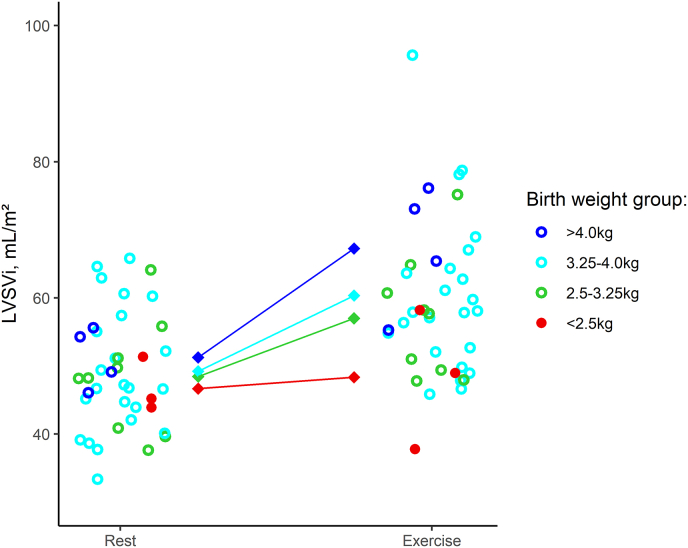
Thirty-nine ASO patients (age 24.4 ± 3.3 years) were included during routine clinical follow-up from July 2019 to December 2021. All patients underwent cardiopulmonary exercise testing and cardiac magnetic resonance imaging at rest and during exercise. Early-life characteristics, including birth weight, were extracted from electronic medical health records. Linear regression analysis showed that lower birth weight was associated with smaller left ventricular (LV) and right ventricular (RV) end-diastolic volume index (LV: -14.5 mL/m [95 % confidence interval, CI: -26.5 to -2.5] per 1-kg decrease in birth weight, = 0.04; RV: -11.2 mL/m [-20.7 to -1.7] per 1-kg decrease in birth weight, = 0.03). Lower birth weight was associated with greater LV and RV ejection fraction at rest (LV: +8.5 % [+4.4 to +12.5] per 1-kg decrease in birth weight, < 0.001); RV: +8.1 % [+2.8 to +13.4] per 1-kg decrease in birth weight, = 0.005). Furthermore, lower birth weight was associated with an attenuated increase in LV stroke volume index from rest to peak exercise (-5.2 mL/m [-9.3 to -1.2] per 1-kg decrease in birth weight, = 0.02).
Birth weight may be a novel risk factor for adverse cardiac remodeling in adult ASO patients. Further research is needed to delineate the mechanisms underlying the associations between birth weight and cardiac remodeling ASO patients as well as the broader adult CHD population.
本研究的目的是评估大动脉转位(D-TGA)且接受了动脉调转术(ASO)的成人患者出生体重与心脏结构和功能之间的关联。
纳入了2019年7月至2021年12月常规临床随访期间的39例ASO患者(年龄24.4±3.3岁)。所有患者均接受了心肺运动试验以及静息和运动时的心脏磁共振成像检查。从电子医疗健康记录中提取包括出生体重在内的早期生活特征。线性回归分析显示,出生体重越低,左心室(LV)和右心室(RV)舒张末期容积指数越小(左心室:出生体重每降低1千克,容积指数降低-14.5 mL/m[95%置信区间,CI:-26.5至-2.5],P = 0.04;右心室:出生体重每降低1千克,容积指数降低-11.2 mL/m[-20.7至-1.7],P = 0.03)。出生体重越低,静息时左心室和右心室射血分数越高(左心室:出生体重每降低1千克,射血分数增加+8.5%[+4.4至+12.5],P<0.001;右心室:出生体重每降低1千克,射血分数增加+8.1%[+2.8至+13.4],P = 0.005)。此外,出生体重越低,从静息到运动峰值时左心室每搏输出量指数的增加减弱(出生体重每降低1千克,每搏输出量指数降低-5.2 mL/m[-9.3至-1.2],P = 0.02)。
出生体重可能是成人ASO患者心脏不良重塑的一个新的危险因素。需要进一步研究来阐明出生体重与ASO患者以及更广泛的成人先天性心脏病人群心脏重塑之间关联的潜在机制。