Ramsay Julie, Minton Jon, Fischbacher Colin, Fenton Lynda, Kaye-Bardgett Maria, Wyper Grant M A, Richardson Elizabeth, McCartney Gerry
Vital Events Statistics, National Records of Scotland, Edinburgh, UK
Place and Wellbeing Directorate, Public Health Scotland, Glasgow, UK.
BMJ Open. 2020 Oct 7;10(10):e036529. doi: 10.1136/bmjopen-2019-036529.
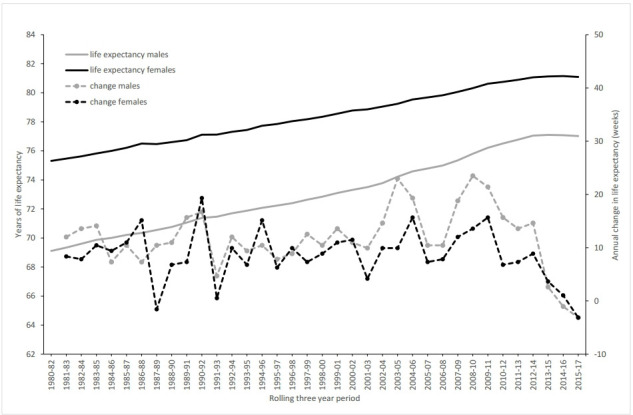
Annual gains in life expectancy in Scotland were slower in recent years than in the previous two decades. This analysis investigates how deaths in different age groups and from different causes have contributed to annual average change in life expectancy across two time periods: 2000-2002 to 2012-2014 and 2012-2014 to 2015-2017.
Scotland.
Life expectancy at birth was calculated from death and population counts, disaggregated by 5 year age group and by underlying cause of death. Arriaga's method of life expectancy decomposition was applied to produce estimates of the contribution of different age groups and underlying causes to changes in life expectancy at birth for the two periods.
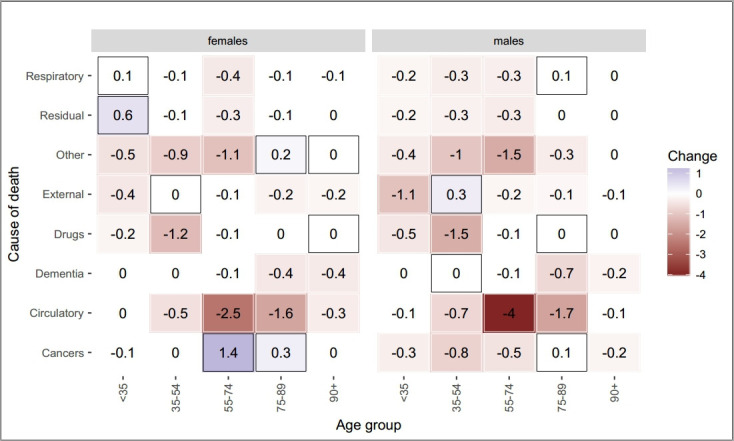
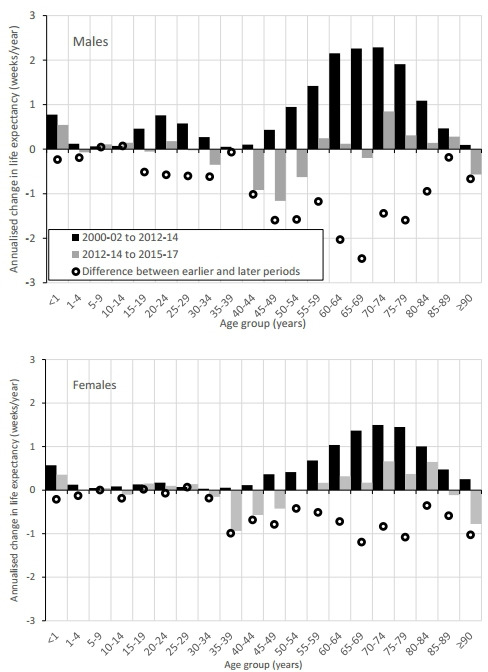
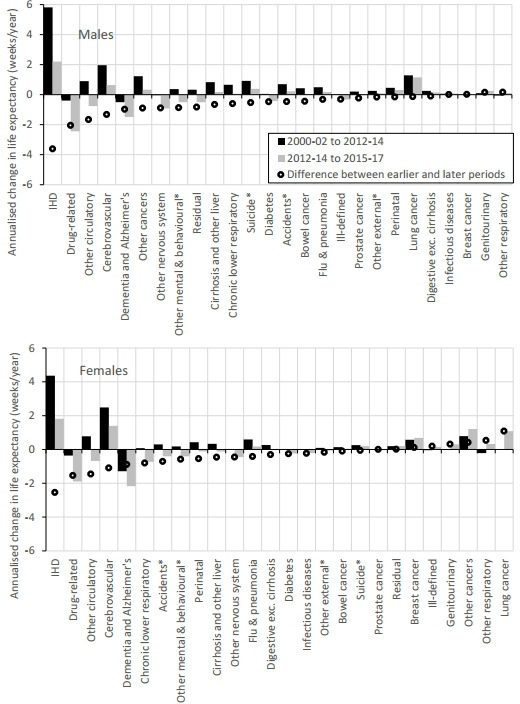
Annualised gains in life expectancy between 2012-2014 and 2015-2017 were markedly smaller than in the earlier period. Almost all age groups saw worsening mortality trends, which deteriorated for most cause of death groups between 2012-2014 and 2015-2017. In particular, the previously observed substantial life expectancy gains due to reductions in mortality from circulatory causes, which most benefited those aged 55-84 years, more than halved. Mortality rates for those aged 30-54 years and 90+ years worsened, due in large part to increases in drug-related deaths, and dementia and Alzheimer's disease, respectively.
Future research should seek to explain the changes in mortality trends for all age groups and causes. More investigation is required to establish to what extent shortcomings in the social security system and public services may be contributing to the adverse trends and preventing mitigation of the impact of other contributing factors, such as influenza outbreaks.
近年来,苏格兰预期寿命的年增长速度比前二十年有所放缓。本分析调查了不同年龄组和不同原因导致的死亡如何促成了两个时间段(2000 - 2002年至2012 - 2014年以及2012 - 2014年至2015 - 2017年)预期寿命的年平均变化。
苏格兰。
根据死亡人数和人口计数计算出生时的预期寿命,并按5岁年龄组和潜在死因进行分类。应用阿瑞亚加的预期寿命分解方法来估计不同年龄组和潜在原因对这两个时期出生时预期寿命变化的贡献。
2012 - 2014年至2015 - 2017年期间预期寿命的年化增长明显低于早期。几乎所有年龄组的死亡率趋势都在恶化,在2012 - 2014年至2015 - 2017年期间,大多数死因组的情况都有所恶化。特别是,此前观察到的由于循环系统疾病死亡率下降而带来的显著预期寿命增长(这对55 - 84岁的人群益处最大)减少了一半以上。30 - 54岁和90岁以上人群的死亡率恶化,主要分别归因于与药物相关的死亡增加以及痴呆症和阿尔茨海默病。
未来的研究应致力于解释所有年龄组和死因的死亡率趋势变化。需要进行更多调查,以确定社会保障系统和公共服务的缺陷在多大程度上可能导致了这些不利趋势,并阻碍了对其他促成因素(如流感爆发)影响的缓解。