Department of Biotechnology, Yonsei University, Seoul, Republic of Korea.
The Interdisciplinary Graduate Program in Integrative Biotechnology and Translational Medicine, Yonsei University, Incheon, Republic of Korea.
Sci Rep. 2020 Oct 8;10(1):16862. doi: 10.1038/s41598-020-73820-8.
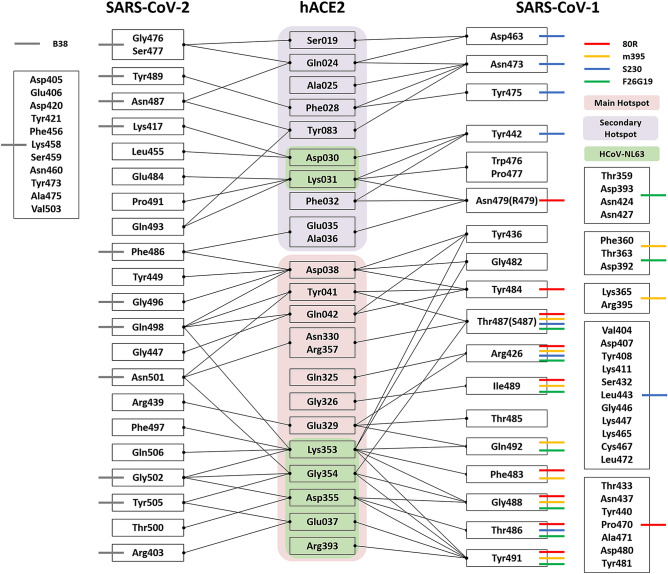
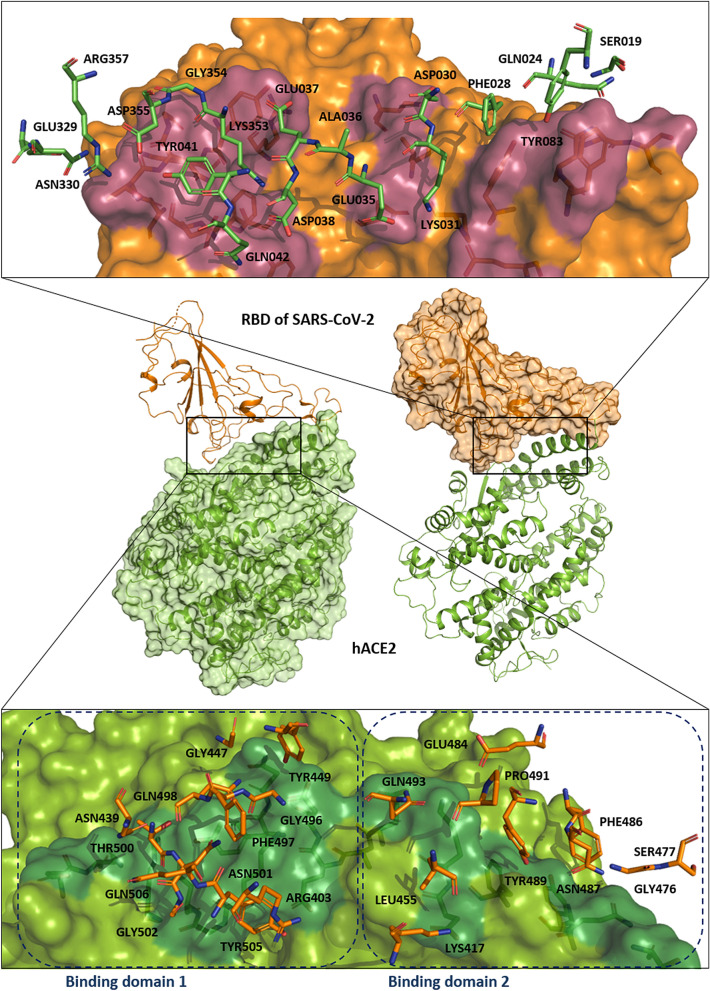
The prevalence of a novel β-coronavirus (SARS-CoV-2) was declared as a public health emergency of international concern on 30 January 2020 and a global pandemic on 11 March 2020 by WHO. The spike glycoprotein of SARS-CoV-2 is regarded as a key target for the development of vaccines and therapeutic antibodies. In order to develop anti-viral therapeutics for SARS-CoV-2, it is crucial to find amino acid pairs that strongly attract each other at the interface of the spike glycoprotein and the human angiotensin-converting enzyme 2 (hACE2) complex. In order to find hot spot residues, the strongly attracting amino acid pairs at the protein-protein interaction (PPI) interface, we introduce a reliable inter-residue interaction energy calculation method, FMO-DFTB3/D/PCM/3D-SPIEs. In addition to the SARS-CoV-2 spike glycoprotein/hACE2 complex, the hot spot residues of SARS-CoV-1 spike glycoprotein/hACE2 complex, SARS-CoV-1 spike glycoprotein/antibody complex, and HCoV-NL63 spike glycoprotein/hACE2 complex were obtained using the same FMO method. Following this, a 3D-SPIEs-based interaction map was constructed with hot spot residues for the hACE2/SARS-CoV-1 spike glycoprotein, hACE2/HCoV-NL63 spike glycoprotein, and hACE2/SARS-CoV-2 spike glycoprotein complexes. Finally, the three 3D-SPIEs-based interaction maps were combined and analyzed to find the consensus hot spots among the three complexes. As a result of the analysis, two hot spots were identified between hACE2 and the three spike proteins. In particular, E37, K353, G354, and D355 of the hACE2 receptor strongly interact with the spike proteins of coronaviruses. The 3D-SPIEs-based map would provide valuable information to develop anti-viral therapeutics that inhibit PPIs between the spike protein of SARS-CoV-2 and hACE2.
新型β冠状病毒(SARS-CoV-2)的流行于 2020 年 1 月 30 日被世界卫生组织宣布为国际关注的突发公共卫生事件,并于 2020 年 3 月 11 日宣布为全球大流行。SARS-CoV-2 的刺突糖蛋白被认为是疫苗和治疗性抗体开发的关键靶标。为了开发针对 SARS-CoV-2 的抗病毒治疗方法,找到在刺突糖蛋白和人血管紧张素转化酶 2(hACE2)复合物界面上强烈吸引彼此的氨基酸对至关重要。为了找到热点残基,即蛋白质-蛋白质相互作用(PPI)界面上强烈吸引的氨基酸对,我们引入了一种可靠的残基间相互作用能计算方法,FMO-DFTB3/D/PCM/3D-SPIEs。除了 SARS-CoV-2 刺突糖蛋白/hACE2 复合物外,还使用相同的 FMO 方法获得了 SARS-CoV-1 刺突糖蛋白/hACE2 复合物、SARS-CoV-1 刺突糖蛋白/抗体复合物和 HCoV-NL63 刺突糖蛋白/hACE2 复合物的热点残基。接下来,构建了基于 3D-SPIEs 的 hACE2/SARS-CoV-1 刺突糖蛋白、hACE2/HCoV-NL63 刺突糖蛋白和 hACE2/SARS-CoV-2 刺突糖蛋白复合物的热点残基相互作用图。最后,将这三个基于 3D-SPIEs 的相互作用图组合并分析,以找到三个复合物之间的共识热点。分析结果表明,hACE2 受体的 E37、K353、G354 和 D355 与冠状病毒的三种刺突蛋白强烈相互作用。基于 3D-SPIEs 的图谱将为开发抑制 SARS-CoV-2 刺突蛋白与 hACE2 之间 PPI 的抗病毒治疗方法提供有价值的信息。