Peka Mykyta, Balatsky Viktor
V. N. Karazin Kharkiv National University, 4 Svobody Sq, Kharkiv, 61022, Ukraine.
Institute of Pig Breeding and Agroindustrial Production, National Academy of Agrarian Sciences of Ukraine, 1 Shvedska Mohyla St, Poltava, 36013, Ukraine.
Vet Anim Sci. 2023 Jul 12;21:100303. doi: 10.1016/j.vas.2023.100303. eCollection 2023 Sep.
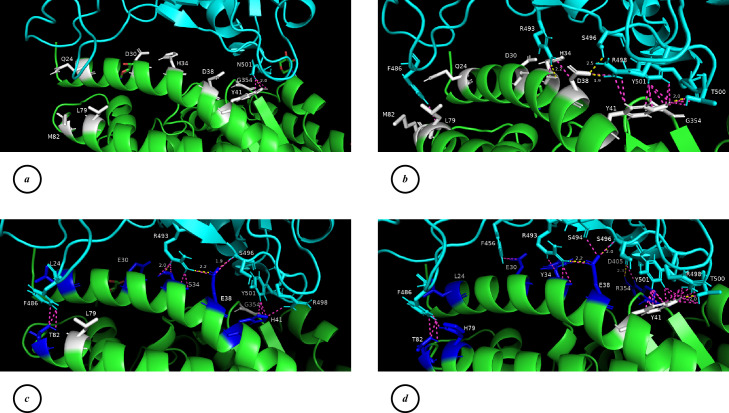
The high mutation rate of SARS-CoV-2, which has led to the emergence of a number of virus variants, creates risks of transmission from humans to animal species and the emergence of new animal reservoirs of COVID-19. This study aimed to identify animal species among livestock susceptible to infection and develop an approach that would be possible to use for assessing the hazards caused by new SARS-CoV-2 variants for animals. Bioinformatic analysis was used to evaluate the ability of receptor-binding domains (RBDs) of different SARS-CoV-2 variants to interact with ACE2 receptors of livestock species. The results indicated that the stability of RBD-ACE2 complexes depends on both amino acid residues in the ACE2 sequences of animal species and on mutations in the RBDs of SARS-CoV-2 variants, with the residues in the interface of the RBD-ACE2 complex being the most important. All studied SARS-CoV-2 variants had high affinity for ferret and American mink receptors, while the affinity for horse, donkey, and bird species' receptors significantly increased in the highly mutated Omicron variant. Hazards that future SARS-CoV-2 variants may acquire specificity to new animal species remain high given the mutability of the virus. The continued use and expansion of the bioinformatic approach presented in this study may be relevant for monitoring transmission risks and preventing the emergence of new reservoirs of COVID-19 among animals.
新冠病毒(SARS-CoV-2)的高突变率导致了多种病毒变体的出现,这带来了从人类传播到动物物种的风险以及新冠病毒新动物宿主出现的风险。本研究旨在确定易感染的家畜物种,并开发一种可用于评估新型SARS-CoV-2变体对动物造成危害的方法。采用生物信息学分析来评估不同SARS-CoV-2变体的受体结合域(RBD)与家畜物种的血管紧张素转换酶2(ACE2)受体相互作用的能力。结果表明,RBD-ACE2复合物的稳定性既取决于动物物种ACE2序列中的氨基酸残基,也取决于SARS-CoV-2变体RBD中的突变,其中RBD-ACE2复合物界面处的残基最为重要。所有研究的SARS-CoV-2变体对雪貂和美国水貂受体具有高亲和力,而在高度突变的奥密克戎变体中,对马、驴和鸟类受体的亲和力显著增加。鉴于病毒的可变性,未来SARS-CoV-2变体可能获得对新动物物种特异性的风险仍然很高。本研究中提出的生物信息学方法的持续应用和扩展可能与监测传播风险以及预防动物中新冠病毒新宿主的出现相关。