Department of Endocrinology, Tongji Hospital, Tongji Medical College, Huazhong University of Science and Technology, Wuhan, China.
Department of Gastroenterology, Tongji Hospital, Tongji Medical College, Huazhong University of Science and Technology, Wuhan, China.
J Diabetes Investig. 2021 Jun;12(6):1064-1073. doi: 10.1111/jdi.13431. Epub 2020 Nov 8.
AIMS/INTRODUCTION: This study aimed to explore the association between glycemic control before admission with severity and mortality of coronavirus disease 2019, and tried to reveal the mechanism.
A total of 77 inpatients were grouped into sufficient control group (glycated hemoglobin [HbA1c] <6.5%, n = 49) and insufficient control group (HbA1c ≥6.5%, n = 28). Regression models were used to analyze the clinical data.
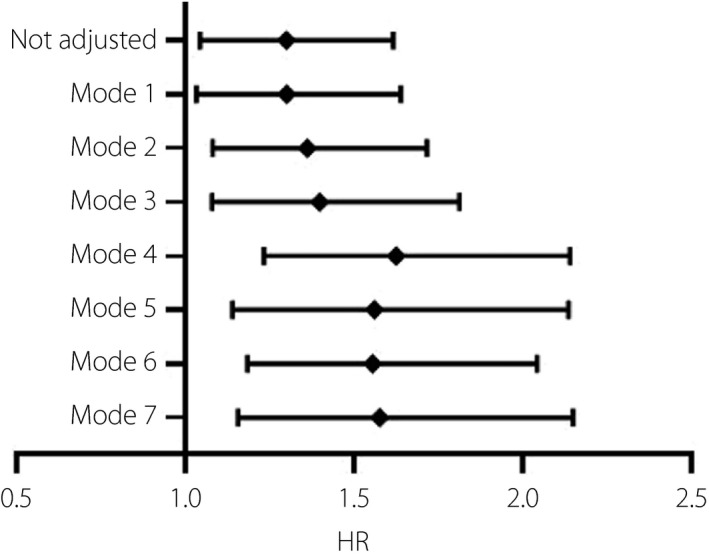
Compared with patients with HbA1c <6.5, patients with HbA1c ≥6.5 showed higher heart rate (101 vs 89 b.p.m., P = 0.012), lower percutaneous oxygen saturation (93 vs 97%, P = 0.001), higher levels of multiple indicators of inflammation, such as white blood cell count (7.9 vs 5.9 × 10 /L, P = 0.019), neutrophil count (6.5 vs 4.1 × 10 /L, P = 0.001), high-sensitivity C-reactive protein (52 vs 30 mg/L, P = 0.025) and serum ferritin (1,287 vs 716 μg/L, P = 0.023), as well as lower levels of lymphocyte count (0.7 vs 0.8 × 10 /L, P = 0.049) at hospital admission. Thus, patients with HbA1c ≥6.5 were more likely to develop secondary respiratory infections (25 [89%] vs 33 [67%], P = 0.032) and acute respiratory distress syndrome (17 [61%] vs 14 [29%], P = 0.006) than patients with HbA1c <6.5, resulting in a higher proportion of critically ill patients (19 [68%] vs 18 [37%], P = 0.009) and non-survivors (13 [46%] vs 11 [22%], P = 0.029). After adjustment for potential risk factors, HbA1c was independently associated with in-hospital death.
HbA1c was an independent risk factor for poor outcomes in coronavirus disease 2019 patients. Severe pulmonary infection and consequent acute respiratory distress syndrome might be the primary causes of death in insufficient glycemic control patients.
目的/引言:本研究旨在探讨入院前血糖控制与 2019 年冠状病毒病(COVID-19)严重程度和死亡率之间的关系,并试图揭示其机制。
共纳入 77 例住院患者,分为血糖控制良好组(糖化血红蛋白[HbA1c]<6.5%,n=49)和血糖控制不佳组(HbA1c≥6.5%,n=28)。采用回归模型分析临床资料。
与 HbA1c<6.5%的患者相比,HbA1c≥6.5%的患者心率更高(101 比 89 b.p.m.,P=0.012),经皮氧饱和度更低(93 比 97%,P=0.001),多项炎症指标水平更高,如白细胞计数(7.9 比 5.9×10 /L,P=0.019)、中性粒细胞计数(6.5 比 4.1×10 /L,P=0.001)、高敏 C 反应蛋白(52 比 30 mg/L,P=0.025)和血清铁蛋白(1287 比 716μg/L,P=0.023),淋巴细胞计数更低(0.7 比 0.8×10 /L,P=0.049)。因此,HbA1c≥6.5%的患者更易发生继发性肺部感染(25 [89%] 比 33 [67%],P=0.032)和急性呼吸窘迫综合征(17 [61%] 比 14 [29%],P=0.006),重症患者比例更高(19 [68%] 比 18 [37%],P=0.009)和死亡率更高(13 [46%] 比 11 [22%],P=0.029)。在校正潜在危险因素后,HbA1c 与住院死亡独立相关。
HbA1c 是 COVID-19 患者不良预后的独立危险因素。血糖控制不佳患者严重肺部感染和随之而来的急性呼吸窘迫综合征可能是死亡的主要原因。